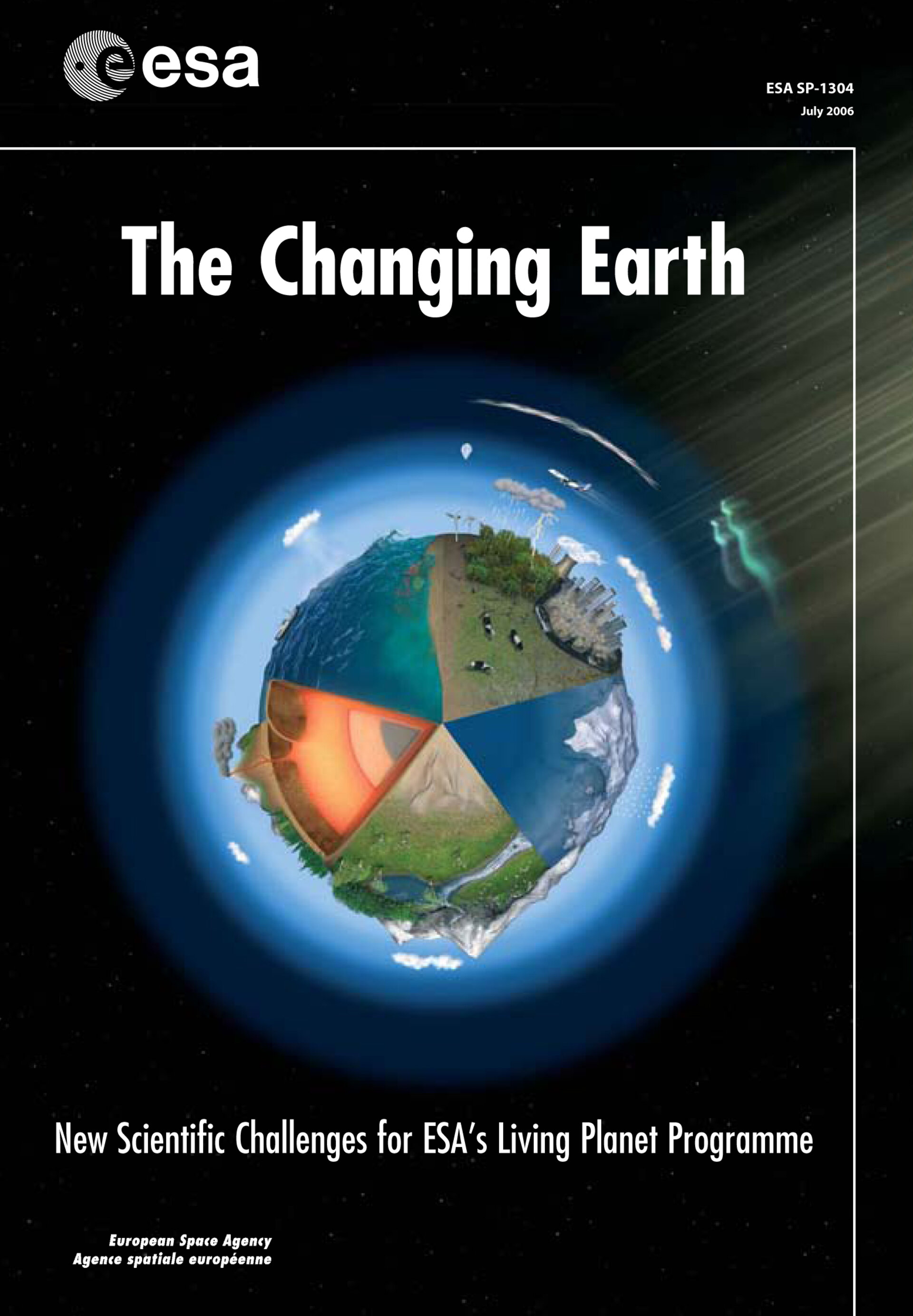
ESA SP-1304 The Changing Earth
New scientific challenges outlined here have been formulated under the guidance of the ESA’s Earth Science Advisory Committee and in consultation with the scientific community. These challenges will guide ESA’s efforts in providing essential Earth observation information to all user communities, in close cooperation with our international partners.
Read online
Since the launch of ERS-1 some fifteen years ago, ESA has become a major provider of Earth-observation data to the Earth-science community. This has resulted in significant progress in a broad range of scientific areas, which also forms the basis for the development of new applications. This has been achieved mainly through exploitation of the ERS and Envisat satellites.
When ESA established its Living Planet Programme in the mid-1990s, a new approach to satellite observations for Earth science was initiated, with focused missions defined, developed and operated in close cooperation with the scientific community. A comprehensive strategy was formulated for the implementation of the Programme, which has resulted in the selection of six Earth Explorer satellite missions covering a broad range of science issues.
At the Ministerial Council meeting in Berlin in December 2005, ESA Member States reconfirmed their commitment to the concept of the Living Planet Programme by funding the third phase covering the period 2008-2012. In addition to this, they approved the initiation of the Global Monitoring for Environment and Security (GMES) space component, in close cooperation with the European Commission.
Although this programme is designed to provide data that underpin operational services, it will also contribute significantly to Earth science, in particular through the collection of long time series of observations. In turn, the Earth Explorers will provide new understanding that paves the way for new operational services: in this sense, the Living Planet Programme comprises complementary elements of research and operations. This synergy has long been demonstrated by the development and scientific exploitation of meteorological satellites, which continues to be an important part of the Living Planet Programme.
In order to make optimum use of its space assets, the Agency also implements a versatile ground segment together with associated user services that provide easy and uniform access to a wide variety of data sources. This is carried out in close cooperation with our Member States, ensuring that the most cost-effective implementation and optimum scientific return are achieved.
Development of specific cooperations with major science initiatives through, for example, the Earth Systems Science Partnership and with international user organisations such as the United Nations Conventions, have also been a feature of the Programme. In all its aspects, it has also been a major contributor to the development of European industry in the technology-development, manufacturing and service sectors.
The new scientific challenges outlined in this document have been formulated under the guidance of the Agency’s Earth Science Advisory Committee and in consultation with the scientific community. These challenges will guide ESA’s efforts in providing essential Earth-observation information to all relevant user communities, in close cooperation with our international partners.
Volker Liebig
Director of Earth Observation Programmes
Contents (click on any article to download PDF)
Executive Summary
1 Introduction
2 Previous Strategy and Achievements
3 The Challenges of a Changing World
4 Rationale of Earth System Science
4.1 Oceans
4.2 Atmosphere
4.3 Cryosphere
4.4 Land Surface
4.5 Solid Earth
5 The Wider Context
6 Living Planet Contributions and Implementation Issues