

ESA pavilion at the 49th Paris Air & Space Show
The 49th Paris Air & Space Show will take place 20–26 June at Le Bourget, bringing together key players from international space agencies and industry to highlight the increasingly important role of space in a rapidly changing world.
The ESA Pavilion, themed as "Space, a key asset for Europe; L’espace, un atout essential pour l’Europe", will be located in its usual place between the full-scale models of the Ariane 1 and Ariane 5 launchers.
It will showcase the importance of space systems and applications in facing global challenges and providing decision-makers with tools to respond to critical challenges such as climate change and global security.
At the same time, the pavilion will showcase the key importance of space to inspire new generations and to foster a knowledge-based society.
Le Bourget is also the opportunity for ESA to underline the importance of international cooperation to build the future of space.
The exhibition features the many dimensions of space: space for a better understanding of our Earth and its place in the Universe; space as a generator of new technologies and innovation; space for improving the quality of life and fostering European growth, knowledge and employment.

The visit is a journey from the boundaries of the Universe to Earth’s core. The visit starts with a multi-mirror space tunnel with spectacular views of our vulnerable planet from the International Space Station.
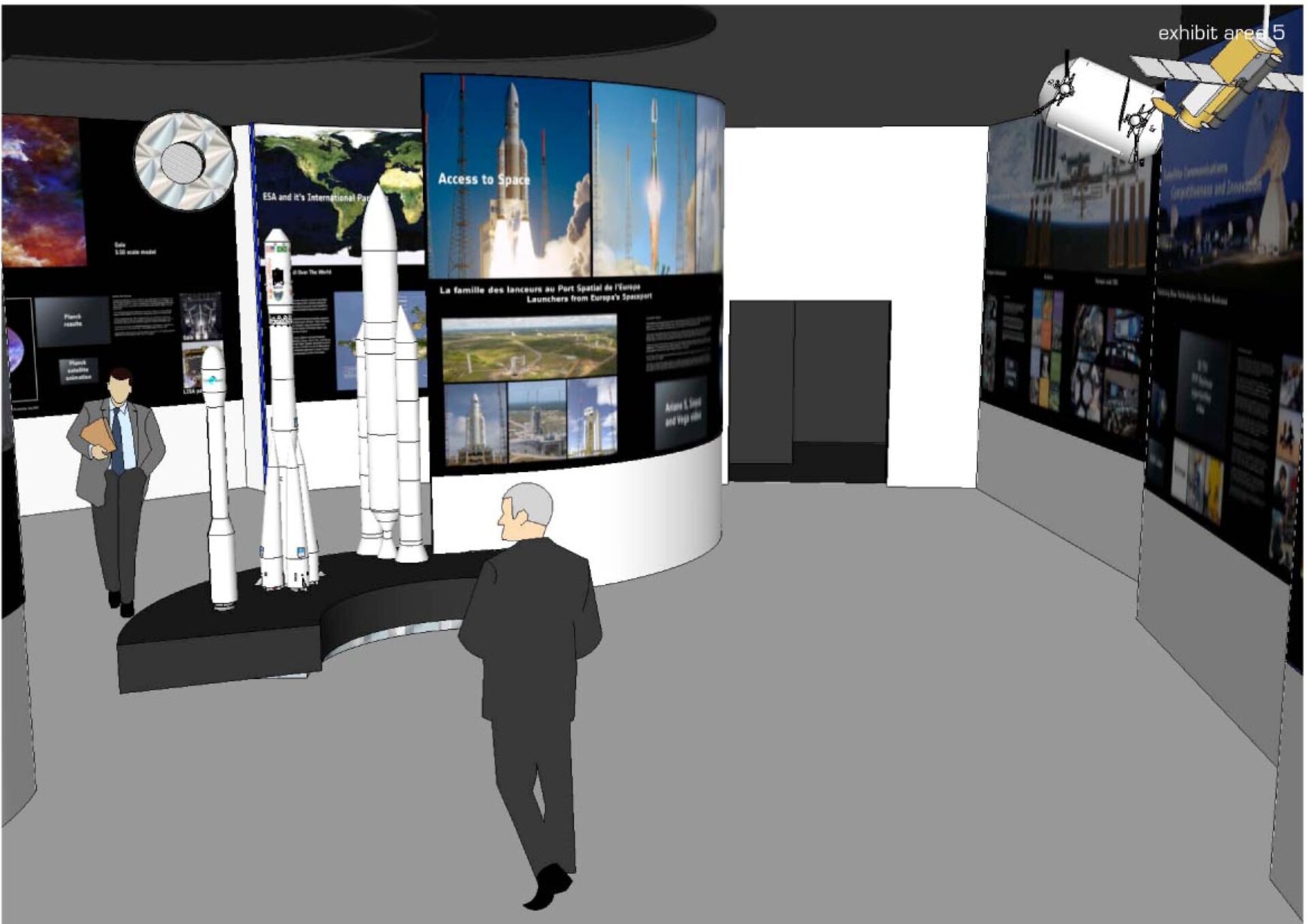
After this first immersion in space, visitors are plunged into the heart of the Guiana Space Centre, Europe’s Spaceport in French Guiana, where Vega and the Russian-built Soyuz are shortly to be launched for the first time, offering, along with the highly successful Ariane 5, a wide range of launch services, key for the strategic independence of Europe.
Visitors will be introduced to the mysteries of the cosmos with the spectacular results from Herschel and Planck. Herschel is looking into the cosmic gas and dust clouds in the infrared to understand how stars and galaxies are born and evolve. Planck is surveying the first light in the cosmos to improve our knowledge about the Universe today.
Visitors can also learn more about the upcoming launch of BepiColombo, a joint mission with Japan that will explore the enigmatic innermost planet Mercury, and the new joint ESA-NASA programme for the future exploration of Mars.
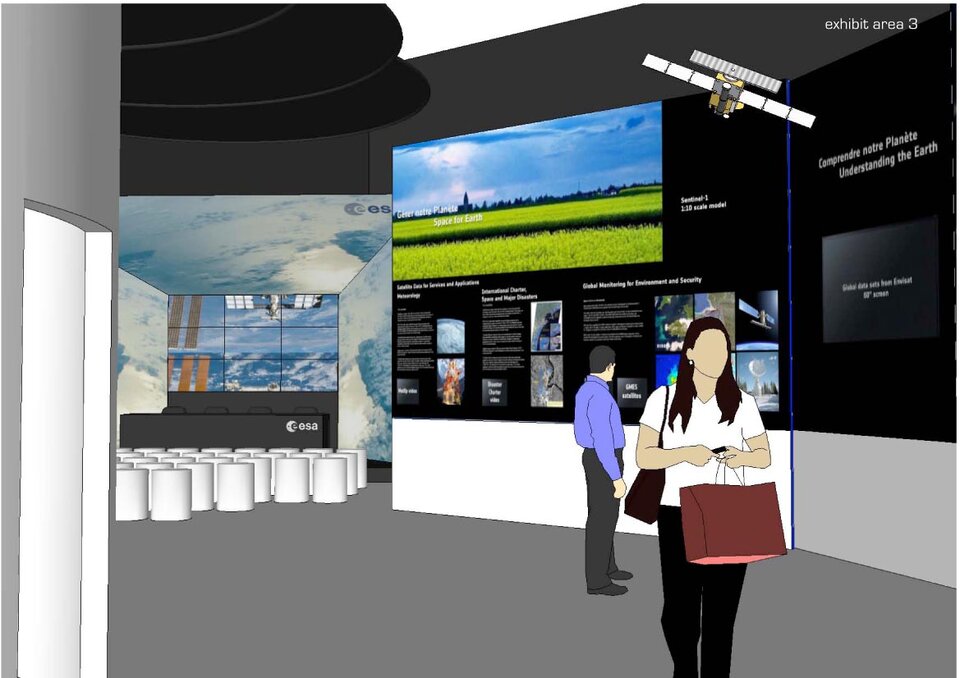
Touring the exhibition, visitors travel from our neighbouring planets to the different facets of our ever-changing Earth: atmosphere, oceans, land and ice.
Particular emphasis will be placed on the results from the three Earth Explorer satellites.
CryoSat is measuring changes in the thickness of continental ice sheets and marine ice.
GOCE has provided a new gravity model of Earth and a new reference height model for the oceans.
SMOS is measuring soil moisture and ocean salinity for a better understanding of the water cycle, a vital indicator for weather patterns, climate monitoring and predicting extreme events.
Earth observation plays a key role for rapid response to major disasters: by combining data from different space agencies, an international Charter allows timely delivery of data for rapid risk and damage assessment to assist the coordination of resources and expertise from around the world.
ESA will show how space allows meteorological satellites to provide data on the atmosphere, clouds, temperature, humidity, ozone levels and wind flow.
Examples of services from the EU-led GMES initiative – Global Monitoring for Environment and Security – will be displayed for improved land use, atmospheric, ocean and coastal monitoring, risk and emergency management.
The first satellites to be launched in 2011 as part of the Galileo satellite navigation system will be shown together with a special focus on aviation applications of EGNOS, the European Geostationary Navigation Overlay Service.
Telecommunication satellites will be highlighted with the coming launch of Alphasat I-XL satellite, a public-private partnership between ESA and Inmarsat

From Earth we arrive in the microgravity world of the International Space Station: a special multi-screen display will show the wealth of scientific experiments being carried out in the Columbus laboratory in weightless conditions, covering material sciences, human physiology, fluid science, Earth observation and plant biology.
Europe's contributions to the Station will be featured, including the launch and docking of the second Automated Transfer Vehicle (ATV), Johannes Kepler, last February and new stunning views from Cupola, an unequalled window in the Station, provided by Europe.
A unique film will show images of the Station with the Shuttle and ATV attached taken by ESA astronaut Paolo Nespoli some weeks ago, at the end of his MagISStra mission.
During the weekend, ESA experts will give overviews of ESA programmes on exploration of the Solar System and deep space, Earth observation and meteorology, launchers, human spaceflight and space laboratories.
ESA astronauts will be at the pavilion to share their exciting experiences working and living on the Space Station, along with a virtual tour of the orbital outpost.
The audience is also invited to discover more about space with a new 3D space quiz.
For further information, please contact
Maria Menendez
Head of Exhibition and Images Office
Communication Department
Tel: +33 1 53 69 71 67
Email: Maria.Menendez@esa.int
Wendy Slater
Exhibition Officer
Communication Departement
Tel: + 33 1 53 69 74 18
Email: Wendy.Slater@esa.int
Annie Sorlin
Epsec, Exhibition Assistant
Communication Department
Tel: + 33 1 53 69 75 90
Email: Annie.Sorlin@esa.int


