• → European Space Agency

      • Space for Europe
      • Space News
      • Space in Images
      • Space in Videos
    • About Us

      • Welcome to ESA
      • DG's News and Views
      • For Member State Delegations
      • Business with ESA
      • ESA Exhibitions
      • ESA Publications
      • Careers at ESA
    • Our Activities

      • Space News
      • Observing the Earth
      • Human Spaceflight
      • Launchers
      • Navigation
      • Space Science
      • Space Engineering
      • Operations
      • Technology
      • Telecommunications & Integrated Applications
    • For Public

    • For Media

      • Media
      • ESA TV
      • Videos for professionals
      • Photos
    • For Educators

    • For Kids

    • ESA

    • United Kingdom

    • All about ESA
    • ESA facts and figures
    • ESA's Director General
    • Frequently asked questions
    • Business with ESA
    • ESA in the UK
    • Harwell
    • ESERO UK
    • Publications
    • United Kingdom Space Activity 1957-1987
    • Multimedia
    • Multimedia gallery
    • Online videos
    • Earth images gallery
    • Press
    • Press releases
    • Resources
    • UK Space Directory
    • Follow us
    • ESA on Twitter
    • ESA on Flickr
    •  ESA on YouTube
    • ESA on Livestream
    • Services
    • RSS feeds

    ESA > ESA in your country > United Kingdom

    Going to Mars for Christmas

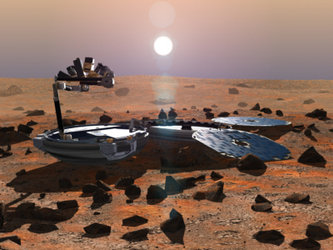
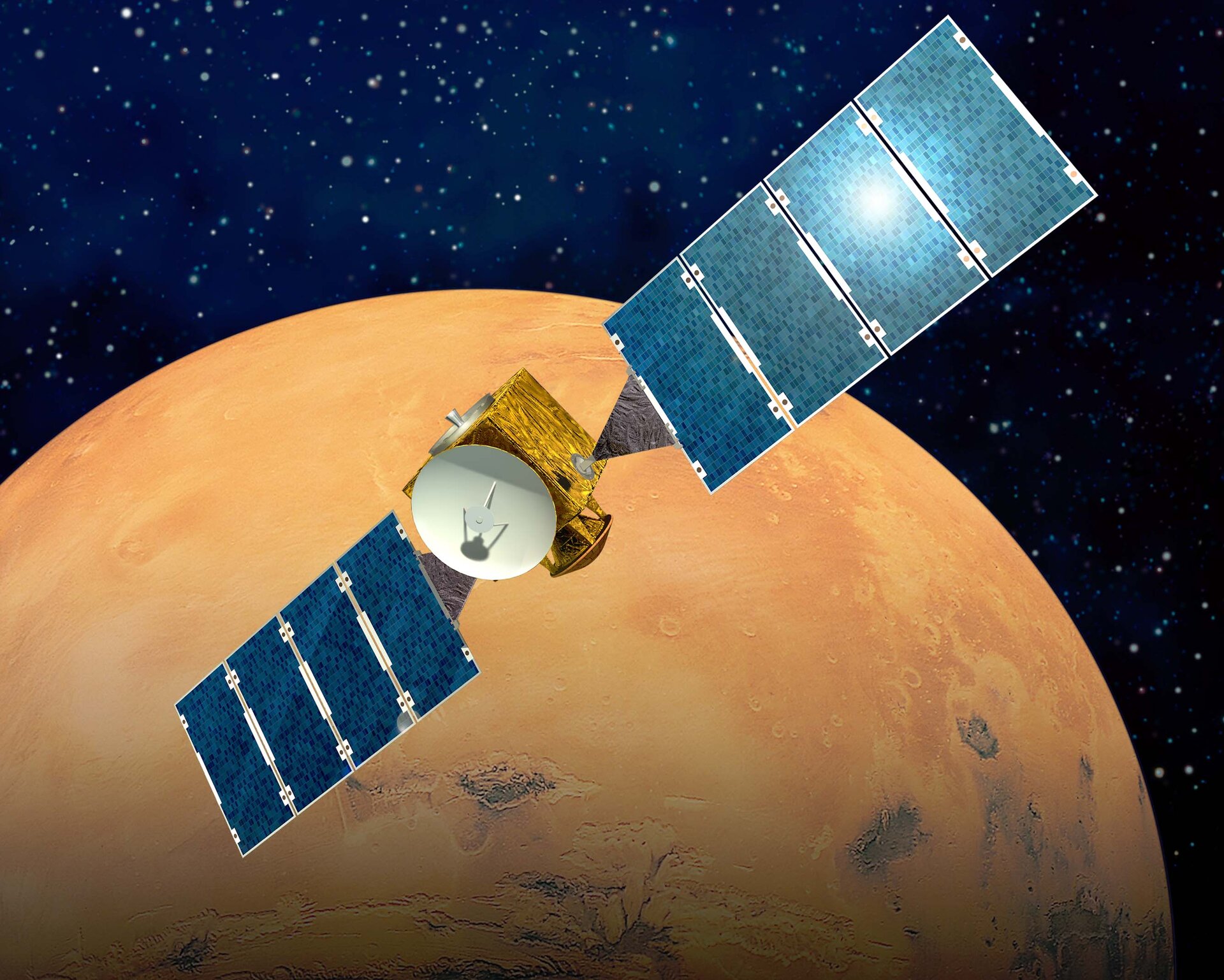
    Mars Express orbiter (artist impression)
    13 November 2003

    Europe's mission to the Red Planet, Mars Express, is on schedule to arrive at the planet on Christmas Day, 2003.

    The lander, Beagle 2, is due to descend through the Martian atmosphere and touch down also on 25 December.

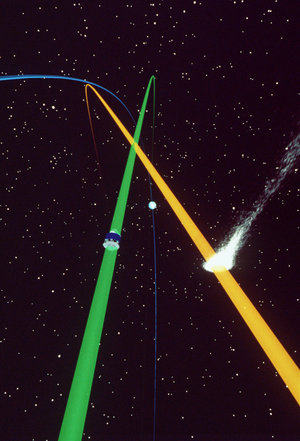
    Mars Express is now within 20 million kilometres of the Red Planet and the next mission milestone comes on 19 December, when Mars Express will release Beagle 2. The orbiter spacecraft will send Beagle 2 spinning towards the planet on a precise trajectory.

    Into orbit

    Beagle has no propulsion system of its own, so it relies on correct aiming by the orbiter to find its way to the planned landing site, a flat basin in the low northern latitudes of Mars.

    ESA engineers will then fire the orbiter's main engine in the early hours of 25 December to put Mars Express into orbit around Mars (called Mars Orbit Insertion, or MOI).


    Landing

    When Beagle 2 begins its descent, it will be slowed by friction with the Martian atmosphere. Nearer to the surface, parachutes will deploy and large gas-filled bags will inflate to cushion the final touchdown. Beagle 2 should bounce to a halt on Martian soil early on Christmas morning.

    The first day on Mars is important for the lander because it has only a few hours to collect enough sunlight with its solar panels to recharge its battery.

    Waiting for signal

    We then have to wait for the radio 'life' signal from Beagle 2, relayed through the US Mars Odyssey spacecraft, to see if the probe has survived the landing. This could take hours or even days.

    If nothing is received on Christmas morning, the UK Jodrell Bank Telescope will search for the faint radio signal from Beagle 2 in the evening. The Mars Express orbiter can also search for the lander but, because of its orbit, it will not be in place to do this until early January.

    If all goes well, Mars Express and Beagle 2 will then begin their main mission - trying to answer the questions of whether there has been water, and possibly life, on Mars.

    Rate this

    Views

    Share

    • Currently 0 out of 5 Stars.
    • 1
    • 2
    • 3
    • 4
    • 5
    Rating: 0/5 (0 votes cast)

    Thank you for rating!

    You have already rated this page, you can only rate it once!

    Your rating has been changed, thanks for rating!

    20
    Tweet
    • More about...
      • Mars Express overview
        • Types of orbit
        • Europe goes to Mars
        • Related articles
          • What is a 'launch window'?
            • Interplanetary trajectories
              • The search for life
                • Mars Express has the sophisticated science to find the water ice on Mars

    Connect with us

    • RSS
    • Youtube
    • Twitter
    • Flickr
    • G+
    • Facebook
    • Livestream
    • Subscribe
    • App Store
    • LATEST ARTICLES
    • · Rare merger reveals secrets of gal…
    • · Watching for hazards: ESA opens as…
    • · ESA astronaut Timothy Peake set fo…
    • · Space drives e-mobility
    • · Proba-V opens its eyes
    • FAQ

    • Jobs at ESA

    • Site Map

    • Contacts

    • Terms and conditions