• → European Space Agency

      • Space for Europe
      • Space News
      • Space in Images
      • Space in Videos
    • About Us

      • Welcome to ESA
      • DG's News and Views
      • For Member State Delegations
      • Business with ESA
      • ESA Exhibitions
      • ESA Publications
      • Careers at ESA
    • Our Activities

      • Space News
      • Observing the Earth
      • Human Spaceflight
      • Launchers
      • Navigation
      • Space Science
      • Space Engineering
      • Operations
      • Technology
      • Telecommunications & Integrated Applications
    • For Public

    • For Media

    • For Educators

    • For Kids

    • ESA

    • Education

    • Teachers' Corner

    • ESA Kids

    • About ESA Education
    • Education programme
    • International collaboration
    • Projects for Teachers
    • European Space Education Resource Office
    • CanSats
    • Hands-on Projects
    • CubeSats
    • Drop Your Thesis!
    • European Student Earth Orbiter
    • European Student Moon Orbiter
    • Fly Your Thesis!
    • Global Educational Network for Satellite Operations
    • Spin Your Thesis!
    • Previous projects
    • Hands-on Collaboration
    • REXUS/BEXUS rocket & balloon experiments
    • GENSO Experimental Orbital Initial Demonstration
    • Previous projects
    • Opportunities
    • Conferences
    • Courses
    • Gaining experience
    • Affiliation programme
    • Subscribe for news

    ESA > Education

    7. Active sensors

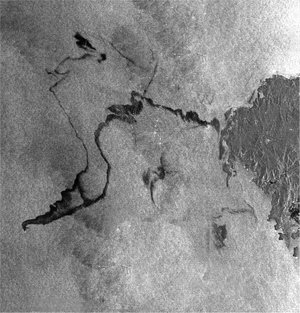
    Passive sensors main disadvantage is that if the sky is covered with clouds, they cannot be used to observe the Earth surface (or the oceans). Therefore, another type of sensor must be used. These are called “active sensors” because they rely on their own sources of radiation to “illuminate” objects so that the energy reflected and returned to the sensor may be measured. The most common active sensor used in remote sensing is “radar”.

    The radar is an active sensor. This means that it receive the reflection of the impulse it gave. It operates in the microwave and radio wavelength regions of the electromagnetic spectrum. The wavelengths range from 1 mm to 20 m.

    Active sensors: radar

    The advantage of using microwaves is that they pass through gases and clouds and can even penetrate solids to a limited degree. Microwaves are generated electronically and this artificial radiation is emitted by an antenna. The radar instrument produces regular pulses of energy, of a known wavelength where waves are vibrating in a predetermined orientation.

    Rate this

    Views

    Share

    • Currently 5 out of 5 Stars.
    • 1
    • 2
    • 3
    • 4
    • 5
    Rating: 5/5 (1 votes cast)

    Thank you for rating!

    You have already rated this page, you can only rate it once!

    Your rating has been changed, thanks for rating!

    311
    Tweet
    • Earth observation
      • 1. Introduction
        • 2. Orbit
        • 3. Geostationary orbit
        • 4. Polar orbit
          • 5. Sensors
            • 6. Passive sensors
              • 7. Active sensors
                • 8. Digital image processing
                  • 9. Classroom exercises
                  • 10. Image processing exercise (LEOWorks)
                    • 11. Resources
                    • Download materials
                    • Galicia, Prestige oil spill (573 KB)
                    • Kathmandu (131 KB)
                    • Meteosat 9 (203 KB)
                    • The Nile Delta (251 KB)
                    • Landsat_AH.zip
                      (1.52 MB)
                    • Related links
                    • Eduspace
                    • Observing the Earth
                    • EUMETSAT Image Gallery

    Connect with us

    • RSS
    • Youtube
    • Twitter
    • Flickr
    • G+
    • Facebook
    • Livestream
    • Subscribe
    • App Store
    • LATEST ARTICLES
    • · Proba-V opens its eyes
    • · First new Galileo satellite arrive…
    • · Next destination: space
    • · Leak repaired on International Spa…
    • · After Chelyabinsk: European expert…
    • FAQ

    • Jobs at ESA

    • Site Map

    • Contacts

    • Terms and conditions