

Meet the teams
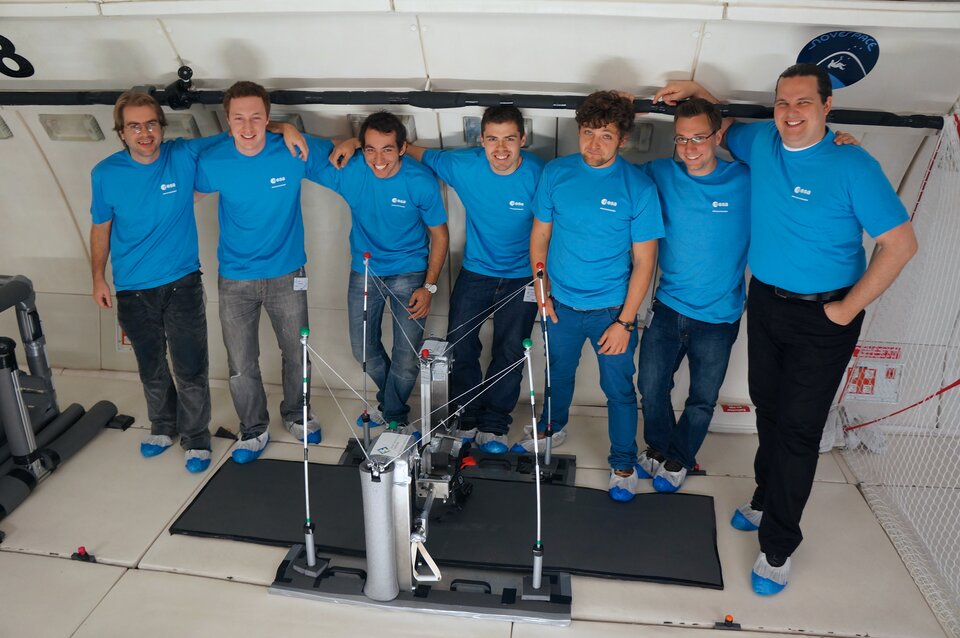
Three teams of postgraduate students flew their experiments during the 2012 'Fly Your Thesis!' campaign. Here is an introduction to the team from Munich, Germany.

Hydronauts2Fly team – Verification of the Human Neutral Body Posture
| University | Technische Universität München |
| Endorsing professor |
Ulrich Walter Technische Universität München |
| Project scientist & coordinator |
Thomas Dirlich Technische Universität München |
| ELGRA mentor |
Matthias Sperl German Aerospace Center |
| Team |
Clemens Plank Manuel Kollmar Boris Werner Sebastian Diehl |
| Test Subjects / Additional Support |
Katja Schmid Georg Basta Martin Kaspar Elisabeth Butzhammer |
The goal of this student team is to better understand the neutral (relaxed) body posture of humans in microgravity. This knowledge may later be useful when optimising the layout of space stations, or when improving the design of extra vehicular activity (EVA) suits. It may also support ergonomic applications on Earth.
The work is based on the research and methods developed since 2008 by the “Hydronauten” project. Seventeen subjects were observed in underwater conditions. The data showed that most reached and maintained a unique relaxed body posture. To quantify these body postures the positions of each subject’s torso, limbs, and head were measured using a 3D body volume model using the university’s PCMAN software. Using the gathered data, a custom-programmed multi-body computer simulation has been developed to recreate a subject’s relaxed body posture in microgravity.
All experiments up to now have been performed in underwater conditions, where the balance between gravity and buoyancy simulates microgravity. However, the underwater tests are not entirely accurate reproductions of true microgravity. Differences in the density of various body parts and between individual subjects – for instance the size and structure of the subjects’ air-filled lungs – may affect the posture results underwater. Nevertheless, the computer simulation can be used to predict body postures in true microgravity based on the gathered underwater data. The results obtained by the team from the parabolic flights will allow them to improve their computer model and more correctly simulate the observed human behaviour.
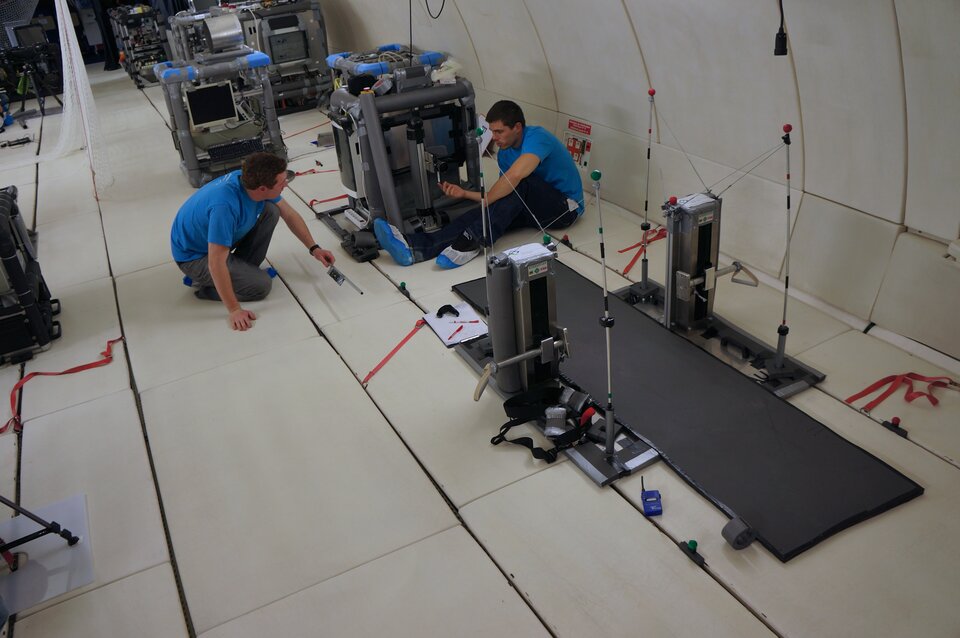
To perform experiments in the airplane, the team adapted their underwater setup, test-rig and method. As in the underwater environment, the subject wore a bathing suit and was fixed at the hip by a climbing harness. Three cameras constantly recorded the subject. Additionally, sensors mounted on the subject’s hands and feet recorded accelerations during the experiment. The cameras and the sensors were synchronised using a central control unit. The subject wore a blindfold and headphones to isolate him/her from external interferences and a special levitation mechanism automatically lifted the subject off the floor of the plane during the microgravity phase, removing tactile interference.
The operator commanded the subject to perform a pre-defined task, either a full-body stretch or a crouch, at the beginning of each weightless phase using an acoustic signal. This strong muscular effort was followed by a phase of complete muscular relaxation. Due to the limited weightless time during each parabola, the main purpose of the experiment was to study the dynamics of the relaxation rather than the final relaxed body posture.
Read more about this experiment on the ERASMUS Experiment Archive.

