

Meet the teams
Four teams of postgraduate students flew their experiments during the 'Fly Your Thesis!' 2009 campaign. Here is an introduction to the UK-French team.

AstEx - Simulating asteroidal regoliths: implications for geology and sample return
| University | The Open University and the University of Nice-Sophia Antipolis |
| Endorsing professor |
Dr. Simon F. Green The Open University |
| Assistant professor |
Dr. Patrick Michel University of Nice-Sophia Antipolis/CNRS |
| ELGRA mentor | Dr. Jürgen Blum |
| Team |
Benjamin Rozitis Naomi Murdoch Thomas-Louis de Lophem |
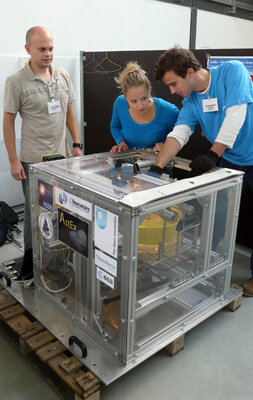
AstEx is a team comprising three students; two from the Open University in the United Kingdom and one affiliated with both the Open University and the University of Nice-Sophia Antipolis, France. The aim of their experiment was to study the behaviour of granular material in microgravity, with possible applications in the design of future asteroid sample return missions and in the interpretation of asteroid geology.
Most asteroids are small, rocky bodies – debris left over from the formation of the planets 4.5 billion years ago. As a consequence of their small size and very low mass, any object (or astronaut) on their surface would experience very low gravity conditions. However, contrary to earlier expectations, asteroids have been shown to be coated with granular material (regolith).
There is still some uncertainty about how such asteroidal regolith material behaves in this small gravity regime. The AstEx experiment served to investigate how a steady state (constant) flow can be achieved in a granular material under microgravity conditions. A granular flow was started by applying rotational shear forces to a large number of spherical glass beads. Individual beads were tracked by high speed cameras so that their positions and velocities could be determined.
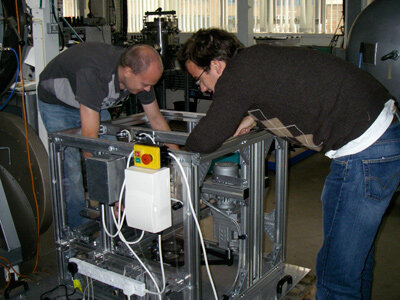
By calculating the velocities of the glass beads, the time required to initiate a steady state flow could be determined. The glass beads were tracked during the period of microgravity available during a single parabola flown by the Airbus A300 aircraft. Comparisons with ground based experiments should show how a steady state flow in microgravity differs from a steady state flow on Earth.
Another investigation was carried out to determine what effect reversing the direction of shear has on the steady state flow. Again, this will be compared with ground-based results. Each of the studies was repeated with glass beads of different sizes, and with different shear rates.
The AstEx experiment worked well during the parabolic flight campaign and provided the student team with a very large amount of data to be analysed.
These investigations could help us to understand the nature and distribution of granular material on asteroid surfaces. The results could also help with the design of an efficient anchor, a sub-surface asteroid sampling mechanism or any device aimed at interacting with the surface of regolith-covered bodies, including the Moon and Mars.
Read more about this experiment on the ERASMUS Experiment Archive.

