Meet the teams: HyperMEA
Four teams of university students were selected to develop and perform their hypergravity experiments during ESA's 'Spin your Thesis!' 2011 campaign. Here is an introduction to the Italian team.


Acclimation of plants to hypergravity
| Universities | University of Florence |
| Endorsing professor | Stefano Mancuso |
| Assistant professor |
Elisa Masi University of Florence |
| Team | Diego Comparini, Emanuela Monetti |
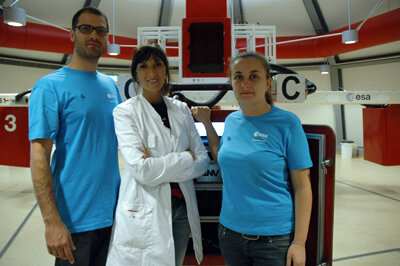
The HyperMEA team comprised two students from the University of Florence, Italy. Their experiment was a follow-up to a previous investigation performed during the ‘Spin Your Thesis’ 2010 campaign, which analysed the effect of acclimation at 2g on the electrical response of roots subjected to stress at hyper-g level (5g).
Plants have evolved under the constant force of gravity, and its presence strongly influences their growth and development. For this reason, changes in gravitational field strength (hypergravity or microgravity), can be considered as a source of stress that is perceived at root level and then transmitted to the other organs by signalling chains, leading to an adaptation of plant physiology.
In stress conditions, plants have the ability to respond to environmental changes through a process called 'acclimation', which involves the alteration of the expression of complex gene networks through sensing of environmental cues, signal transduction, and modification of biochemical pathways. These transcriptional changes can result in successful adaptations, leading to improved stress tolerance.
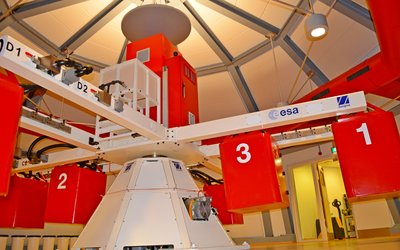
The aim of the HyperMEA experiment was to verify the effect of a period of acclimation to a higher gravity level on the physiological electrical response of root apices, in order to confirm and understand the role of hypergravity as a source of stress for plants. By using the Large Diameter Centrifuge, the team was able to modify the magnitude of gravity, resulting in a direct influence on the growth and metabolism of plant cells and organs.
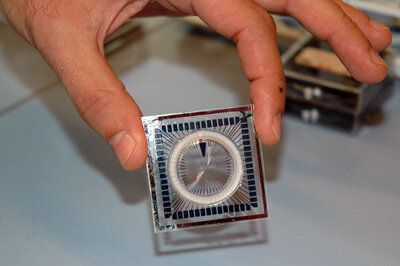
Detection of the electrical network activity of root apices was conducted by measuring the onset of potentials, spikes and bursts in root apex sections, through the use of a Multi-Electrode Array (MEA). The MEA system is a planar, multi-electrode array that allows monitoring of non-invasive, spontaneous activity as a change in the electrical potential of the intercellular space surrounding the cell at up to 60 sites in the tissue.
The experiment studied and evaluated how the electrical activity of root apices changes in acclimated plants over a period of one hour, under conditions of five times Earth’s gravity, compared with non-acclimated plants. Preliminary acclimation was achieved by subjecting a number of 3-day-old maize seedlings to four hours in the centrifuge at twice Earth's gravity.
The data obtained was used to correlate the electrical activity to the presence/absence of acclimation by comparing data from acclimated and non-acclimated plants. The outcome was a more sensitive detection of the electrical activity occurring in the root apex, confirming the data obtained in the previous ‘Spin Your Thesis!’ campaign. These results were used to correlate the electrical activity to the presence/absence of acclimation and to elucidate the response of plants in hypergravity conditions.
Read the final experiment report here.