


Summer School students design exoplanet missions
58 young science and engineering students from all over Europe have just completed a stimulating 10 days of work in the beautiful village of Alpbach in the Austrian Alps. This year, the theme of the Alpbach Summer School was "Exoplanets: Discovering and characterizing Earth type planets".
Although more than 300 exoplanets have already been discovered, the search continues for Earth-sized worlds. With this in mind, the Summer School programme was designed to motivate the students by conceiving and assessing future mission concepts that could discover and characterise Earth-like exoplanets located in the habitable zones of distant stars.
The programme included more than 20 lectures given by experts in various exoplanet-related fields. These covered all aspects of exoplanet studies, including the current state of knowledge, planet detection techniques, mission and spacecraft design, detection of biomarkers, and planetary characteristics.
A key element of the Summer School was the workshop, which occupied more than half of the available time. Divided into four teams, the students were asked to define the objectives of a scientific space mission devoted to exoplanet research, and then design a mission that would meet these objectives. Each team had to produce a report and then present its results to an expert review panel during the final day of the workshop. Their innovative projects included:
- PACMAN (The Planet Atmosphere Composition and Morphology ANalysis Mission). This space observatory, equipped with a 3.5 m primary mirror telescope, would orbit around the L2 Lagrange point to observe terrestrial exoplanets at visible and near-infrared wavelengths.
- POLAR BEAR (POLARized Biomarkers from Exoplanetary Atmospheric Reflection). This mission, also located at L2, would conduct spectral analysis of starlight which is reflected and then polarized by planets in order to characterise their atmospheres and surfaces, and detect biomarkers.
- DWARFS (Diverse Worlds Around Faint Stars). This was a 4 m space telescope fitted with a photometer and two spectrographs, observing at near-infrared/mid-infrared wavelengths to determine the atmospheric composition and physical properties of rocky exoplanets.
- CST (Carl Sagan Space Telescope). A very large space observatory, equipped with a mid-infrared observatory and a UV telescope to detect biomarkers and study star/planet interaction.
Although the students who attended were several years younger than usual for this event, the jury was very appreciative of their efforts.
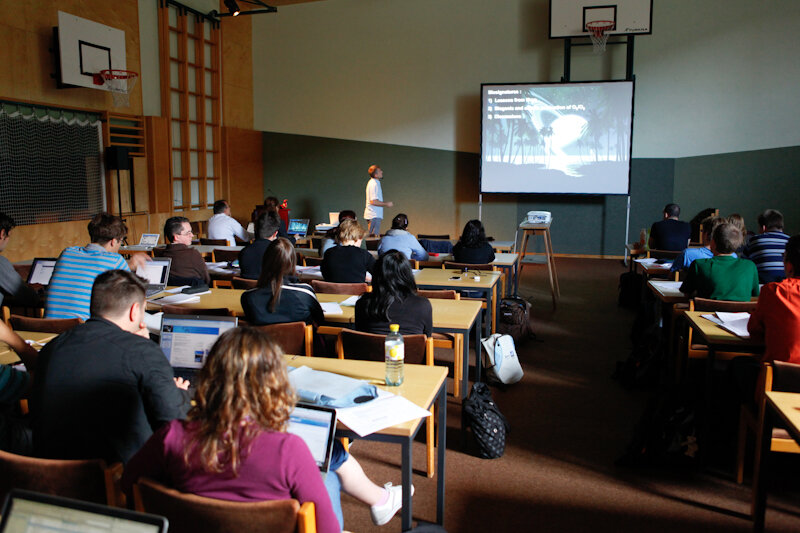
"All of the teams worked very hard and absorbed a lot of information in a limited time", said panel chairman Roger Bonnet. "The scientific and technical definitions of the missions, their organisation and presentations were excellent. The presentations were all very exciting and attracted a lot of attention from the audience."
The Summer School Oscars awarded by the jury in the categories Science Case, Technical Case, Competitiveness and Presentation were spread among all four teams, including a special award from Professor Bonnet and the Alpbach 2009 tutors.
The Alpbach Summer School 2009 was organised by the Aeronautics and Space Agency of the Austrian Research Promotion Agency (FFG). It was co-sponsored by ESA and the national space authorities of its member and co-operating states, with the support of the International Space Science Institute (ISSI) and Austrospace as well as the European Southern Observatory (ESO).

