• → European Space Agency

      • Space for Europe
      • Space News
      • Space in Images
      • Space in Videos
    • About Us

      • Welcome to ESA
      • DG's News and Views
      • For Member State Delegations
      • Business with ESA
      • ESA Exhibitions
      • ESA Publications
      • Careers at ESA
    • Our Activities

      • Space News
      • Observing the Earth
      • Human Spaceflight
      • Launchers
      • Navigation
      • Space Science
      • Space Engineering
      • Operations
      • Technology
      • Telecommunications & Integrated Applications
    • For Public

    • For Media

    • For Educators

    • For Kids

    • ESA

    • [1/6] Kangerdlugssuaq glacier, Greenland
    • [2/6] First data via Malargüe station: Mars as seen by VMC
    • [3/6] VA211 liftoff
    • [4/6] Eyeing up the total solar eclipse
    • [5/6] Three of the first six Galileo FOC satellites at OHB
    • [6/6] Hubble view of star-forming region S106

    Kangerdlugssuaq glacier, Greenland
    Kangerdlugssuaq glacier, Greenland

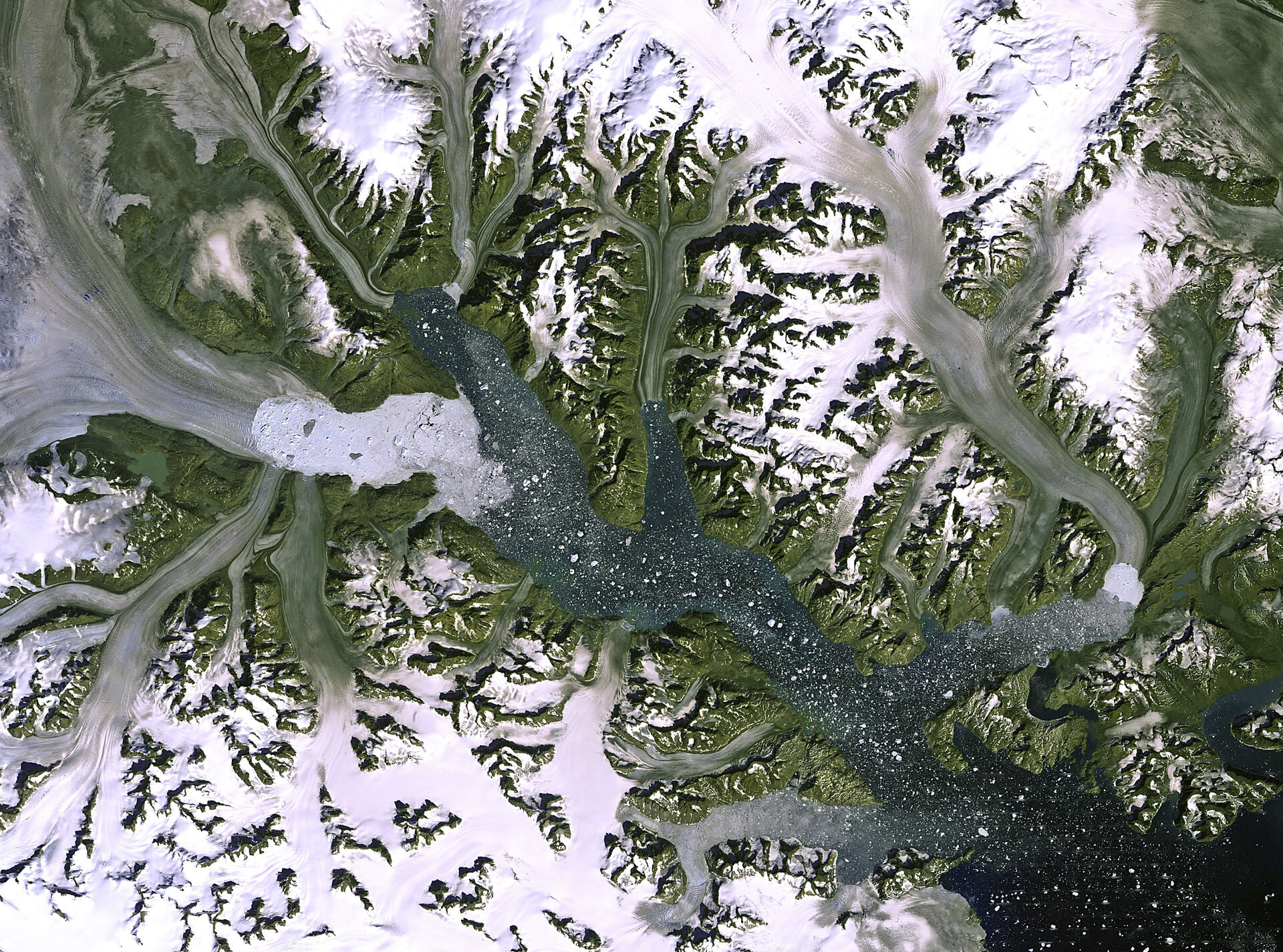
    The Kangerdlugssuaq glacier and its ice stream are pictured in this week’s image, acquired on 19 September 2012 by Landsat-7. It is the largest outlet glacier on Greenland’s east coast, discharging ice into the surrounding oceans. In this image we can see hundreds of icebergs speckling the water. A recent study based on satellite observations revealed that over the past 20 years the ice melting in Greenland and Antarctica has contributed about 11 mm to the global sea-level rise. This image clearly shows the glacier’s calving front, where ice breaks away. Over the years, satellite images have shown that this front has retreated – an indication that the glacier is getting smaller over time. 

    This image is featured on the Earth from Space video programme.

    Credits: USGS/ESA
    First data via Malargüe station: Mars as seen by VMC
    First data via Malargüe station: Mars as seen by VMC

    Low-resolution VMC image acquired on 15 December 2012 at 03:10:03 GMT at an altitude of 9761.02 km above Mars, on Mars Express orbit number 11396.

    On 18 December 2012, this image was selected as the symbolic 'first data' to be downloaded via ESA's new Malargüe deep-space tracking station in Argentina. The image was acquired by the Visual Monitoring Camera on the Mars orbiter and travelled 327 million kilometres in just over 18 minutes.

    The tracking pass began at about 22:11 GMT (23:11 CET) on 18 December. On arrival at the station, the data were transmitted to ESOC, ESA’s European Space Operations Centre, Darmstadt, Germany.

    More images via ESA's VMC Blog.

    Credits: ESA
    VA211 liftoff
    VA211 liftoff

    On 19 December, an Ariane 5 launcher lifted off from Europe’s Spaceport in French Guiana on its mission to place two telecom satellites, Skynet-5D and Mexsat Bicentenario, into their planned transfer orbits.

    Credits: n/a
    Eyeing up the total solar eclipse
    Eyeing up the total solar eclipse

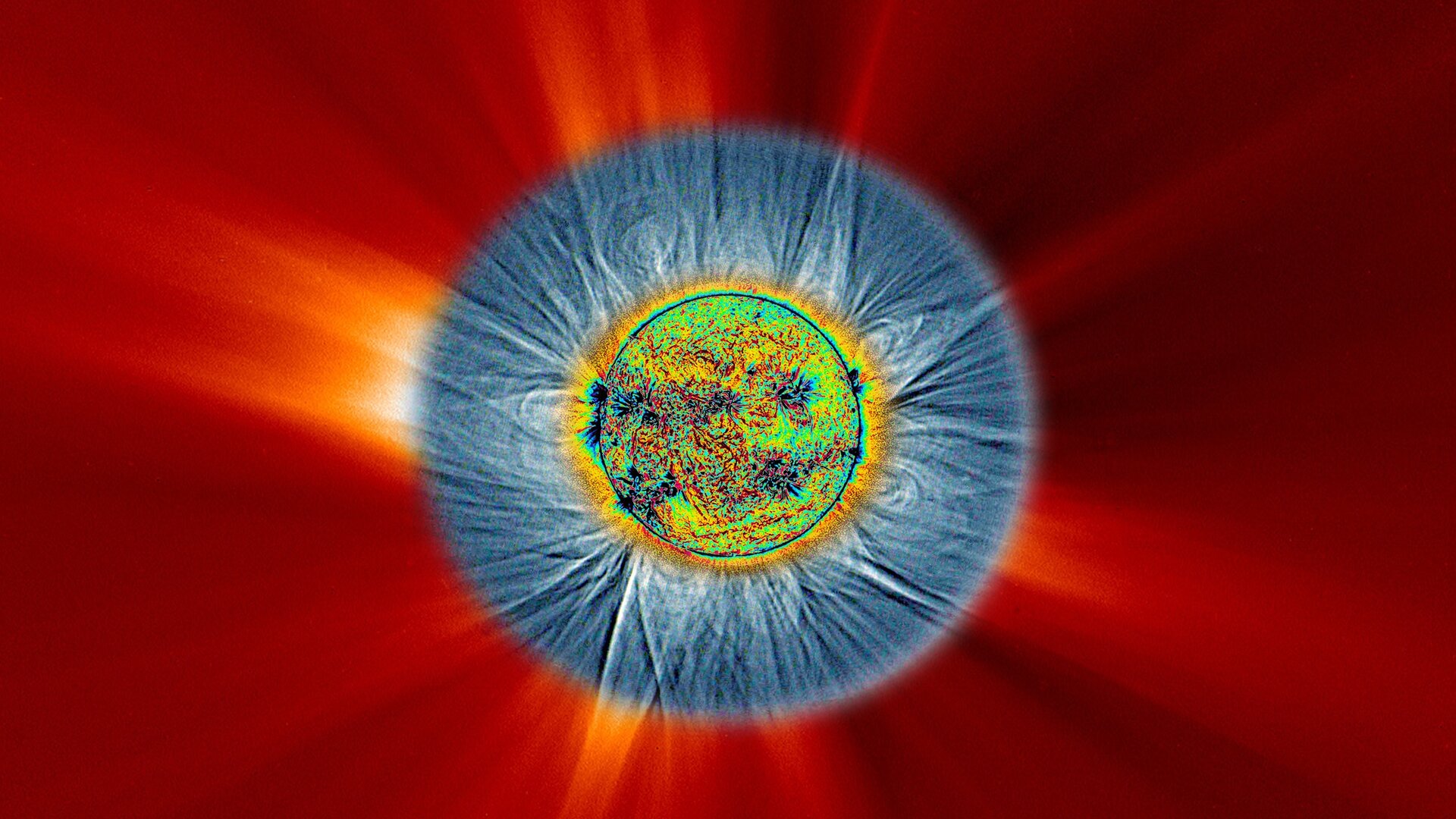
    The Sun appears to be eyeballing us in this unique portrayal of the total solar eclipse of 13/14 November 2012, which combines ground-based images (blue ring) with views from ESA’s Proba-2 (false-colour central disc) and ESA/NASA’s SOHO satellites (background).

    Loops of magnetic field lines and ‘streamers’ can clearly be seen in the ground-based white-light images, spilling over into the corresponding wide-field view from SOHO as the solar wind blows these features out into space.

    The connection between the ground- and space-based images provides a unique opportunity to correlate difficult-to-see regions of the Sun’s atmosphere, visible only during the fleeting moments of a total solar eclipse, with well-known features on the solar disc and the wider solar environment.

    Credits: J.M. Lecleire, S. Koutchmy, CNRS/CNES, Proba-2/SWAP, SOHO/LASCO, ESA & NASA
    Three of the first six Galileo FOC satellites at OHB
    Three of the first six Galileo FOC satellites at OHB

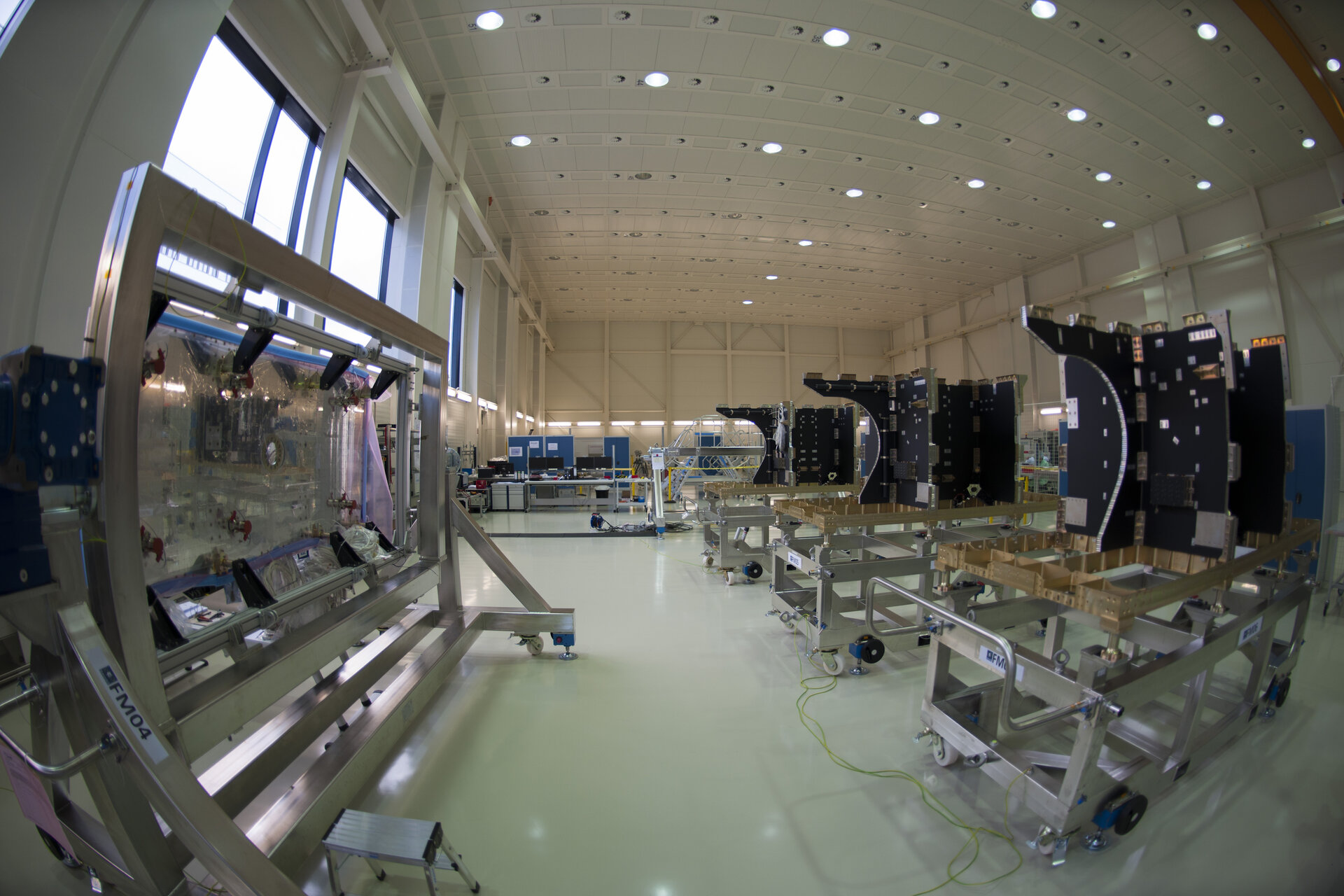
    Three of the first six Galileo Full Operational Capability (FOC) satellites being assembled and prepared for the testing phase at OHB, Bremen, on 19 September 2012.

    The FOC phase consists of the deployment of the remaining ground and space infrastructure. It includes an intermediate initial operational capability phase with 18 satellites in operation (the four IOV satellites plus 14 others). The full system will consist of the complete satellite constellation, control centres located in Europe and a network of sensor stations and uplink stations installed around the globe.

    Credits: ESA-S. Corvaja, 2012
    Hubble view of star-forming region S106
    Hubble view of star-forming region S106

    This image from the NASA/ESA Hubble Space Telescope shows Sh 2-106, or S106 for short. This is a compact star forming region in the constellation Cygnus (The Swan). A newly-formed star called S106 IR is shrouded in dust at the centre of the image, and is responsible for the the surrounding gas cloud’s hourglass-like shape and the turbulence visible within. Light from glowing hydrogen is coloured blue in this image.

    Credits: NASA/ESA

    Week in Images

    Our week through the lens:
    17-21 December 2012

    Access the image

    Access the image

    Access the image

    Access the image

    Access the image

    Access the image

    Rate this

    Views

    Share

    • Currently 5 out of 5 Stars.
    • 1
    • 2
    • 3
    • 4
    • 5
    Rating: 4.87/5 (8 votes cast)

    Thank you for rating!

    You have already rated this page, you can only rate it once!

    Your rating has been changed, thanks for rating!

    843
    facebook
    twitter
    reddit
    google plus
    digg
    tumbler
    digg
    blogger
    myspace

    Connect with us

    • RSS
    • Youtube
    • Twitter
    • Flickr
    • Google Buzz
    • Subscribe
    • App Store
    • LATEST ARTICLES
    • · CryoSat hits land
    • · Ariane 5 completes seven launches …
    • · Measuring skull pressure without t…
    • · Malargüe station inauguration
    • · The solar wind is swirly
    • FAQ

    • Jobs at ESA

    • Site Map

    • Contacts

    • Terms and conditions