• → European Space Agency

      • Space for Europe
      • Space News
      • Space in Images
      • Space in Videos
    • About Us

      • Welcome to ESA
      • DG's News and Views
      • For Member State Delegations
      • Business with ESA
      • ESA Exhibitions
      • ESA Publications
      • Careers at ESA
    • Our Activities

      • Space News
      • Observing the Earth
      • Human Spaceflight
      • Launchers
      • Navigation
      • Space Science
      • Space Engineering
      • Operations
      • Technology
      • Telecommunications & Integrated Applications
    • For Public

    • For Media

    • For Educators

    • For Kids

    • ESA

    • Human Spaceflight and Exploration

    • Columbus

    • About Columbus
    • Columbus laboratory
    • Columbus facts & figures
    • Columbus facilities
    • Biolab
    • European Drawer Rack
    • European Physiology Modules
    • European Transport Carrier
    • Fluid Science Laboratory
    • Microgravity Science Glovebox
    • External payloads
    • SOLAR
    • Vessel-ID
    • Columbus mission
    • About the mission
    • Mission objectives
    • Daily activities STS-122
    • Mission facts STS-122
    • Crew biographies
    • Columbus operations
    • Columbus Control Centre
    • User Support and Operations Centres
    • Downloads
    • Columbus Information Kit (pdf)
    • Exploring with Columbus (pdf)
    • Multimedia
    • Image gallery
    • Columbus videos
    • Exhibition material

    ESA > Our Activities > Human Spaceflight > Columbus

    The Columbus Mission

    The Columbus Mission
    27 November 2007

    Named after one of the greatest explorers of all time, the European Columbus laboratory has been transferred to the cargo bay of the Space Shuttle Atlantis and now awaits its historical flight into orbit

    Vodcast

    Play now | Download

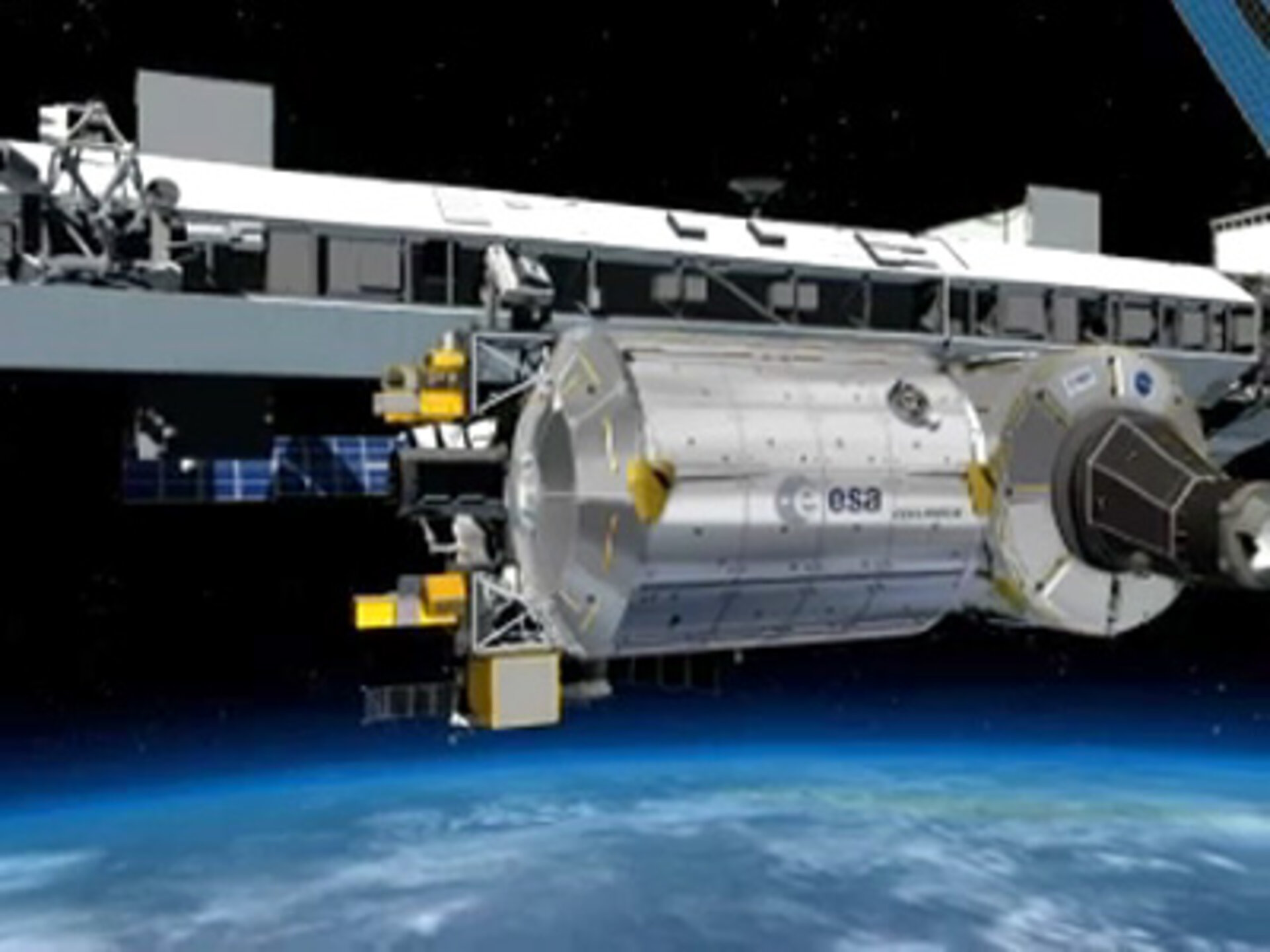
    Columbus, with its planned operational lifetime of ten years, is Europe's first laboratory for long-term research in space conditions. Scientific experiments will be performed on board in the weightlessness of orbit.

    Once in orbit, Columbus will be taken out of the cargo bay by the Shuttle’s robotic arm. The European laboratory will then be moved to the Italian-built Node 2 connector, where it will be permanently fixed to the Station.

    Each rack inside Columbus is a laboratory in its own right. Experiments in life sciences, physiology and physics can all be carried out within the one structure. These facilities are pre-installed inside Columbus so experiments can start immediately after it arrives at the ISS.

    Experiments can also be mounted outside Columbus, to examine the effects of exposure to the space environment. Two such experiments will be launched along with the laboratory.

    Rate this

    Views

    Share

    • Currently 0 out of 5 Stars.
    • 1
    • 2
    • 3
    • 4
    • 5
    Rating: 0/5 (0 votes cast)

    Thank you for rating!

    You have already rated this page, you can only rate it once!

    Your rating has been changed, thanks for rating!

    16
    Tweet
    • Human Spaceflight and Exploration
    • Columbus Mission
    • Related ESApod
      • Hans Schlegel prepares for Columbus Mission
        • ESA astronaut Léopold Eyharts ready to make space history
          • ESA astronaut Paolo Nespoli paves the way for Columbus
            • Columbus Control Centre – heart of European ISS operations
              • European Columbus laboratory is ready to launch
                • ISS update October 2007
                • iTunesPodcast
                • Yahoo! Podcasts
                • RSS Podcast ESApod
                • Learnoutloud
                • Podcastnet
                • Podnova Podcast
                • ESApod
                • Required software
                •  Windows Media Player
                •  QuickTime

    Connect with us

    • RSS
    • Youtube
    • Twitter
    • Flickr
    • G+
    • Facebook
    • Livestream
    • Subscribe
    • App Store
    • LATEST ARTICLES
    • · Proba-V opens its eyes
    • · First new Galileo satellite arrive…
    • · Next destination: space
    • · Leak repaired on International Spa…
    • · After Chelyabinsk: European expert…
    • FAQ

    • Jobs at ESA

    • Site Map

    • Contacts

    • Terms and conditions