


ESA Parabolic Flight Campaign successfully completed in Bordeaux
ESA’s 51st Parabolic Flight Campaign took place this week in Bordeaux, France. Fourteen scientific experiments were conducted by European scientists under microgravity conditions on the modified Airbus A300 aircraft. Four of the experiments were conducted by student teams as part of ESA’s ‘Fly Your Thesis!’ programme.
There are not many ways to create the weightless environment of space here on Earth. The closest we can get is an aircraft flying on a parabolic path, like an object thrown into the air and falling back, creating up to 22 seconds of microgravity at a time.
The duration is short, but it is usually enough to conduct scientific experiments and an opportunity to test technology before actually launching the equipment to space. With repeated parabolas, experiments can accumulate about 12 minutes of weightlessness during one flight.

For these experiments, ESA uses the Airbus A300 ‘Zero-G’ aircraft owned and operated by French company Novespace. The plane is located in Bordeaux, flying at altitudes of 4–8 km over the Atlantic Ocean in airspace that is not used by commercial aviation.
The experiments for each flight campaign are carefully selected from the vast number of proposals submitted by the scientific and technical communities. These experiments, flown during the past two decades, have not only produced countless scientific papers, but have also laid the path for research being conducted in the European Columbus laboratory on the International Space Station. ESA’s campaigns are conducted under the responsibility of the Directorate of Human Spaceflight.
Scientific passengers
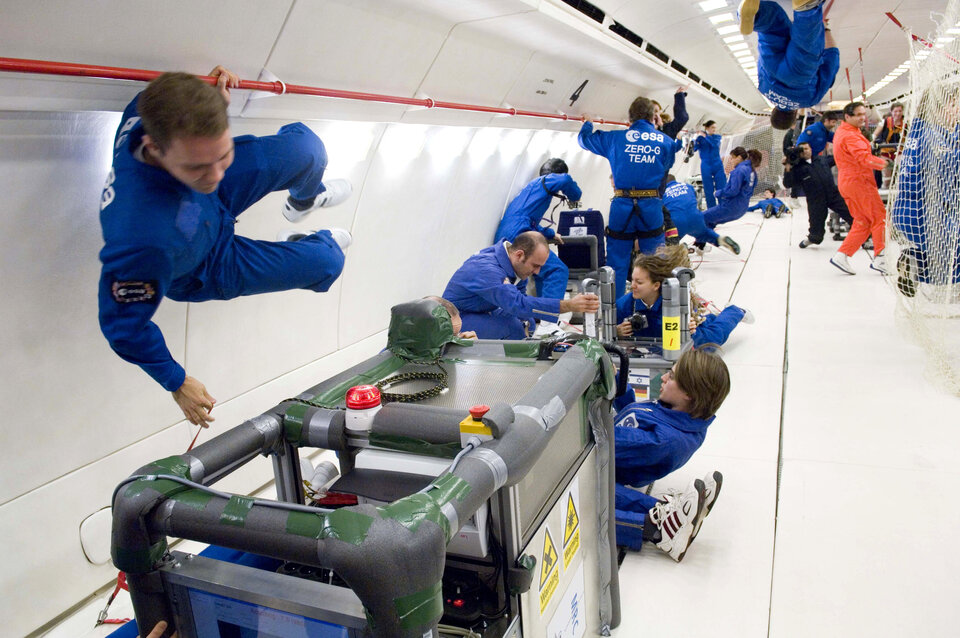
The latest campaign included 14 experiments from universities and research institutions in nine European countries and Canada. The topics include fluid and material sciences (such as observing metallic foams with X-rays), human physiology (such as perception of spatial environment in weightlessness) and biology (such as cell behaviour in microgravity). One experiment prepared for another that will fly on the Maxus-8 sounding rocket later this year.
Another experiment investigated ‘Marangoni convection’. This effect can be seen in some of the most spectacular photos taken of physics experiments under microgravity conditions: a column rises above the surface of liquid as if being stirred by an invisible spoon. The experiment by Dr T. Gambaryan-Roisman and Prof. P. Stefan from the Technical University of Darmstadt, Germany, could eventually help to reduce engine emissions.
The cellular effects of weightlessness on the loss of muscle mass were studied by the Swiss Federal Institute of Technology (ETH) in Zurich, Switzerland. Muscle loss can be caused by illness or by long-duration spaceflight because the muscles do not have to work against gravity. Thus a deeper understanding of the cell behaviour in microgravity can lead to better treatment of muscular illnesses and provide help for future astronauts.
Students: Fly your thesis!
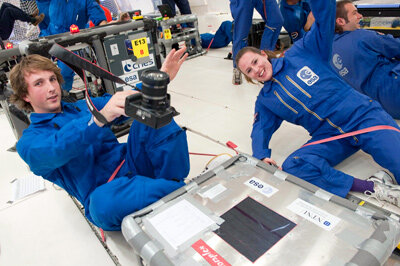
Four of the experiments were conducted by student teams from Germany, UK/France, Spain and Norway. ESA began the the ‘Fly your thesis!’ programme in May 2008, calling for university teams throughout Europe to propose microgravity experiments.
Students from the University of Münster, in Germany, looked at the behaviour of light dust and gas under different illumination conditions creating a force that affects the whole system. This effect can be seen in large-scale phenomena like planet formation in planetary nebulae, or the dust devils and sand storms seen on Mars. A group from the Open University in the UK and the University of Nice-Sophia Antipolis, in France, simulated the loose surface material on asteroids and other such small bodies. This study is of interest for planning sample-return missions to asteroids.
25 years of ESA parabolic flights

This campaign marked 25 years of ESA participation. The first flights were conducted in cooperation with NASA, but Europe has flown its own aircraft since 1989. Before the current workhorse, a modified Caravelle airliner was used. These aircraft are flown by the pilots from the French national test flight centre, Centre d’Essais en Vol.
ESA is organising a two-day symposium to celebrate the double anniversary and to showcase examples of research that has benefited from the parabolic flight campaigns. The ESA Parabolic Flight Symposium takes place on 19–20 November at ESTEC, in Noordwijk, the Netherlands, and all interested scientists are welcome to participate.
Because of the limited space at the venue, interested scientists are kindly requested to register for the symposium in advance by email. The address is PFsymposium@esa.int.


