• → European Space Agency

      • Space for Europe
      • Space News
      • Space in Images
      • Space in Videos
    • About Us

      • Welcome to ESA
      • DG's News and Views
      • For Member State Delegations
      • Business with ESA
      • ESA Exhibitions
      • ESA Publications
      • Careers at ESA
    • Our Activities

      • Space News
      • Observing the Earth
      • Human Spaceflight
      • Launchers
      • Navigation
      • Space Science
      • Space Engineering
      • Operations
      • Technology
      • Telecommunications & Integrated Applications
    • For Public

    • For Media

    • For Educators

    • For Kids

    • ESA

    • Human Spaceflight

    • Astronauts

    • International Space Station

    • Research

    • Education

    • About Education
    • What we do & why we do it
    • @ESAHSOeducation
    • Browse lessons by

      • Age range

        • Primary level

          • Columbus: Past, present and future…
          • The Eclipse that saved Columbus
          • The Automated Transfer Vehicle
          • ATV: a very special delivery
          • Life in Space
          • A drop of water
          • Primary level ISS Education Kit - downloads
          • PromISSe educational experiments
          • Greenhouse in space
        • Secondary level

          • Ingredients for Life: On Earth and in Space
          • Spaceship Earth
          • ATV: a very special delivery - Lesson notes
          • Bubbles in space
          • Lesson plan for use with the ISS Education Kit on the web
          • A space compass
          • Bugs in Space
          • Space (fluid) oddities
          • Science fiction - science fact
          • Searching for the Missing Universe
          • Feeding our future – nutrition on Earth and in space
          • Newton in space
          • Body space
          • Space matters
          • Space robotics
          • ISS 3-D Teaching Tool: Spaceflight Challenge I
          • Take your classroom into space
          • ISS Education Kit - downloads
          • Do objects have weight in space?
          • Exploring capillarity
          • Greenhouse in space
        • University level

          • SpaceMaster
          • Life in Space
          • EuMAS
      • Mission

        • Astrolab

          • A space compass
          • Space robotics
        • OasISS

          • Life in Space
          • A drop of water
          • Bubbles in space
          • Take your classroom into space
          • Do objects have weight in space?
          • Exploring capillarity
        • PromISSe

          • Radiation
          • Balance in space
          • Immunology
          • Ingredients for Life: On Earth and in Space
          • PromISSe educational experiments
        • Eneide

          • ISS DVD Lesson series
        • Delta

          • Body space
        • Columbus

          • Columbus: Past, present and future…
          • The Eclipse that saved Columbus
          • Bugs in Space
          • Space (fluid) oddities
        • Cervantes

          • Newton in space
        • MagISStra

          • Greenhouse in space
      • Subject

        • Physics

          • Radiation
          • Bubbles in space
          • Lesson plan for use with the ISS Education Kit on the web
          • A space compass
          • Science fiction - science fact
          • Searching for the Missing Universe
          • Newton in space
          • Space matters
          • Space robotics
          • Take your classroom into space
          • Do objects have weight in space?
          • Exploring capillarity
          • PromISSe educational experiments
        • History

          • Columbus: Past, present and future…
          • The Eclipse that saved Columbus
        • Earth sciences

          • What is radiation?
        • Chemistry

          • Foam
        • Biology

          • Balance in space
          • Body space
          • Bugs in Space
          • Greenhouse in space
          • Immunology
          • Ingredients for Life: On Earth and in Space
          • Feeding our future – nutrition on Earth and in space
          • ISS 3-D Teaching Tool: Spaceflight Challenge I
          • ISS education kit
    • ISS Education Fund

      • What is the ISSEF?
      • Funding participants
      • Honorary participants
      • What does the ISSEF do?
      • ISSEF funding
      • Who can participate?
      • Benefits of participation
      • Application form
    • Services
    • Subscribe
    • RSS feeds

    ESA > Our Activities > Human Spaceflight > Education

    ESA Columbus Essay Contest winner - Regina Peldszus

    Looking over the Edge

    The Value of Human Spaceflight for European Citizens

    What happens to chopsticks when the parameter of gravity is changed? This is something Science Officer Don Pettit demonstrated and recorded during dinner-preparations on the International Space Station in 2003. He 'drank' tea out of a bag using the utensils. In microgravity, also liquids can reliably be picked up by chopstick; something that we did not think about or expect to be feasible on earth, even if we were on of the billions of skilled users in the world.

    A tiny story about the changed potential of two simple sticks catapulted into space can make us think 'outside the box', and maybe encourage us to imagine and anticipate the potentials of other objects, ideas, or people. Imagine the possibilities of what else the dangerous, beautiful and banal idiosyncrasies of living in space show us.

    From a design researcher's point of view, human spaceflight offers a vast chance to problem solve – this form of creativity, based on the ability to imagine and anticipate, is what policy makers, engineers, scientists, artists, doctors and managers need everyday to shape, sustain and enrich the lives of their fellow citizens.

    For those not directly involved in space programmes – most of the nearly 490 million Europeans – the creative potential of spaceflight can encourage and inspire them to look at their own environment in a different light. Supported by space-related infrastructures, they can then go an act on what they have found, make changes and progress. They can use communications technology to observe and weave networks; transport technology to travel and trade; and health care solutions to protect others’ lives - all of which make an informed, caring and proactive citizen.

    Spaceflight has been changing, and will continue to change, the way we look at our world. This doesn’t make us lose surprise over the quotidian, or make us more jaded. But it can make us more accepting, curious and open-minded. By seeing things we take for granted in a different light, we abandon set ways and prejudices. Like old explorers who try out new things, we depend on curiosity and the urge it gives us to move on, in order to re-evaluate and improve the status quo. This form of peaceful progress can only be achieved by critical, constructive and creative characters, and we need these traits in a world where the new and unfamiliar is often judged and rejected.

    When there is no effort made to find out about who or what is behind the garden fence, the country border, the edge, there would be no information, no bonds, no new opportunities. If the states of Europe had not looked over their own edge with curiosity and acceptance, there would be no union today, and no joint space programme.


    Pulling together across boundaries is not only a value of human spaceflight in Europe today, but was also one of the pre-requisites when the 10 founding states got together in 1975 after decades of co-operation, to merge into what ESA is today with its 17 members.

    Sending real people into space who analyse and imagine, and who will relate their inspiring experience to millions of earthbound citizens, is one of the greatest chances we have today to expand our own earthbound horizons on a large scale. Not just by creating valuable new possibilities through science, technology, education and business, but by triggering thought and setting of inspirational sparks in Europeans from all walks of life.

    In a modern Europe made up of 27 countries that have each looked over their own borders for more than half a century in order to pull together with the determination to ensure peace, ESA’s work in reaching out to new boundaries in co-operation with other space programmes of the world plays an integral part.

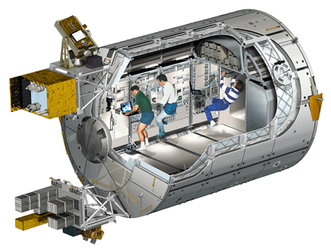
    Far from being an idealistic vision, Columbus is a real manifestation of this European spirit, and a hardware example of borderless co-operation, taking its place in the largest international peaceful project, the ISS. By celebrating this vision through ESA's mission, spaceflight ensures the peaceful crossing of boundaries, in the scientific, political, economical and cultural framework of Europe. The insights of human spaceflight make citizens look over the edge. Not just the edge of our earthly atmosphere, but above all the edge in our heads.
    Last update: 14 November 2007

    Rate this

    Views

    Share

    • Currently 0 out of 5 Stars.
    • 1
    • 2
    • 3
    • 4
    • 5
    Rating: 0/5 (0 votes cast)

    Thank you for rating!

    You have already rated this page, you can only rate it once!

    Your rating has been changed, thanks for rating!

    21
    Tweet
    • Related links
      • ESA Columbus Essay Contest winner
      • ESA launches SUCCESS student contest!
      • Columbus
      • Columbus Control Centre
        • European Columbus laboratory
        • Essays
        • Daniela Petrova
        • Benjamin Lenoir
        • Regina Peldszus
        • Bernhard Schaffer
        • Philippa Molyneux

    Connect with us

    • RSS
    • Youtube
    • Twitter
    • Flickr
    • G+
    • Facebook
    • Livestream
    • Subscribe
    • App Store
    • LATEST ARTICLES
    • · ESA astronaut Timothy Peake set fo…
    • · Space drives e-mobility
    • · Proba-V opens its eyes
    • · First new Galileo satellite arrive…
    • · Next destination: space
    • FAQ

    • Jobs at ESA

    • Site Map

    • Contacts

    • Terms and conditions