• → European Space Agency

      • Space for Europe
      • Space News
      • Space in Images
      • Space in Videos
    • About Us

      • Welcome to ESA
      • DG's News and Views
      • For Member State Delegations
      • Business with ESA
      • ESA Exhibitions
      • ESA Publications
      • Careers at ESA
    • Our Activities

      • Space News
      • Observing the Earth
      • Human Spaceflight
      • Launchers
      • Navigation
      • Space Science
      • Space Engineering
      • Operations
      • Technology
      • Telecommunications & Integrated Applications
    • For Public

    • For Media

    • For Educators

    • For Kids

    • ESA

    • Human Spaceflight

    • Astronauts

    • International Space Station

    • Research

    • Education

    • About Education
    • What we do & why we do it
    • @ESAHSOeducation
    • Browse lessons by

      • Age range

        • Primary level

          • Columbus: Past, present and future…
          • The Eclipse that saved Columbus
          • The Automated Transfer Vehicle
          • ATV: a very special delivery
          • Life in Space
          • A drop of water
          • Primary level ISS Education Kit - downloads
          • PromISSe educational experiments
          • Greenhouse in space
        • Secondary level

          • Ingredients for Life: On Earth and in Space
          • Spaceship Earth
          • ATV: a very special delivery - Lesson notes
          • Bubbles in space
          • Lesson plan for use with the ISS Education Kit on the web
          • A space compass
          • Bugs in Space
          • Space (fluid) oddities
          • Science fiction - science fact
          • Searching for the Missing Universe
          • Feeding our future – nutrition on Earth and in space
          • Newton in space
          • Body space
          • Space matters
          • Space robotics
          • ISS 3-D Teaching Tool: Spaceflight Challenge I
          • Take your classroom into space
          • ISS Education Kit - downloads
          • Do objects have weight in space?
          • Exploring capillarity
          • Greenhouse in space
        • University level

          • SpaceMaster
          • Life in Space
          • EuMAS
      • Mission

        • Astrolab

          • A space compass
          • Space robotics
        • OasISS

          • Life in Space
          • A drop of water
          • Bubbles in space
          • Take your classroom into space
          • Do objects have weight in space?
          • Exploring capillarity
        • PromISSe

          • Radiation
          • Balance in space
          • Immunology
          • Ingredients for Life: On Earth and in Space
          • PromISSe educational experiments
        • Eneide

          • ISS DVD Lesson series
        • Delta

          • Body space
        • Columbus

          • Columbus: Past, present and future…
          • The Eclipse that saved Columbus
          • Bugs in Space
          • Space (fluid) oddities
        • Cervantes

          • Newton in space
        • MagISStra

          • Greenhouse in space
      • Subject

        • Physics

          • Radiation
          • Bubbles in space
          • Lesson plan for use with the ISS Education Kit on the web
          • A space compass
          • Science fiction - science fact
          • Searching for the Missing Universe
          • Newton in space
          • Space matters
          • Space robotics
          • Take your classroom into space
          • Do objects have weight in space?
          • Exploring capillarity
          • PromISSe educational experiments
        • History

          • Columbus: Past, present and future…
          • The Eclipse that saved Columbus
        • Earth sciences

          • What is radiation?
        • Chemistry

          • Foam
        • Biology

          • Balance in space
          • Body space
          • Bugs in Space
          • Greenhouse in space
          • Immunology
          • Ingredients for Life: On Earth and in Space
          • Feeding our future – nutrition on Earth and in space
          • ISS 3-D Teaching Tool: Spaceflight Challenge I
          • ISS education kit
    • ISS Education Fund

      • What is the ISSEF?
      • Funding participants
      • Honorary participants
      • What does the ISSEF do?
      • ISSEF funding
      • Who can participate?
      • Benefits of participation
      • Application form
    • Services
    • Subscribe
    • RSS feeds

    ESA > Our Activities > Human Spaceflight > Education

    Learning about the ISS – a school visit to ESTEC

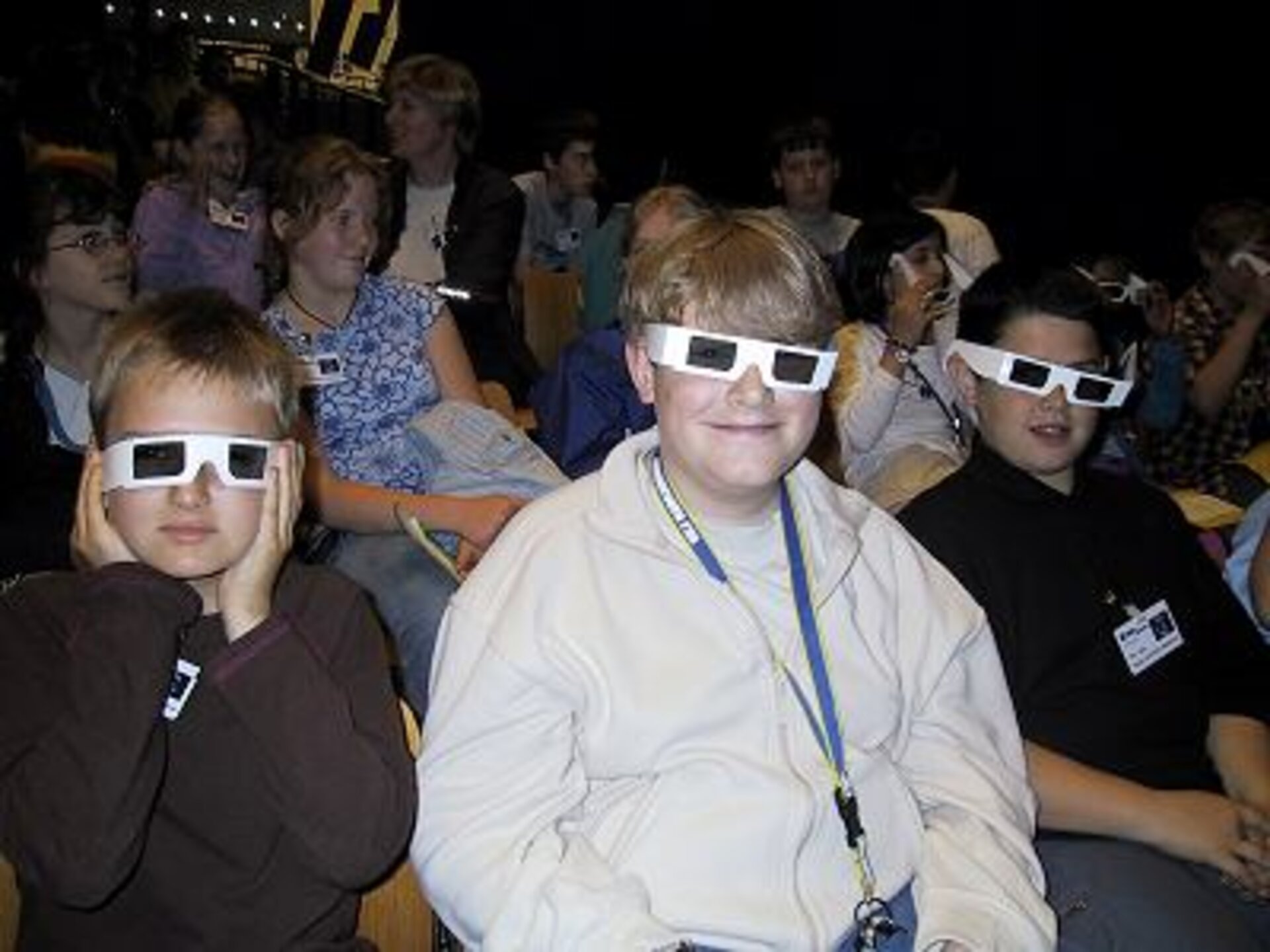
    Virtual Reality tour
    A Virtual Reality tour of the International Space Station
    29 May 2002

    On Wednesday 22 May, a group of school children from the American School in The Hague visited the ISS User Information Centre at ESTEC, The Netherlands. The children learnt all about the International Space Station (ISS) and also talked to one of ESA’s astronauts.

    Ninety children, age 11, followed a programme of lectures and demonstrations about the ISS, covering topics such as why we have a space station, how to get there and how space affects the human body.

    The morning started with highlights from the recent Marco Polo ‘taxi’ flight which carried a crew of three, including ESA astronaut Roberto Vittori, to the ISS. This gave the children an idea of what a launch is like, what the inside of the Space Station looks like, how objects float around in weightlessness and the experience of re-entry when the astronauts return to Earth.

    Reaching the ISS
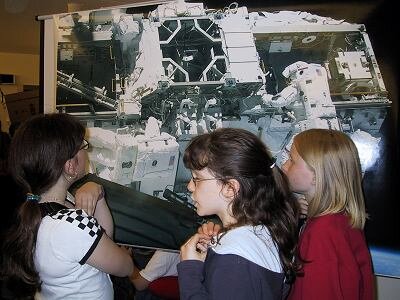
    Learning about the International Space Station
    Learning about the International Space Station

    Using some simple demonstrations Rogier Schonenborg explained how propulsion is used to reach the ISS. The children had plenty of searching questions.

    What happens to the human body in space?

    Using a bottle half-filled with coloured water, physiologist Rebecca Forth demonstrated what happens to the fluids in the human body when astronauts go up to the ISS. Rebecca also explained why astronauts can get space sick, how your eyes can trick you in space, and how it feels to return back to Earth again.


    Why do we do experiments on board ISS?
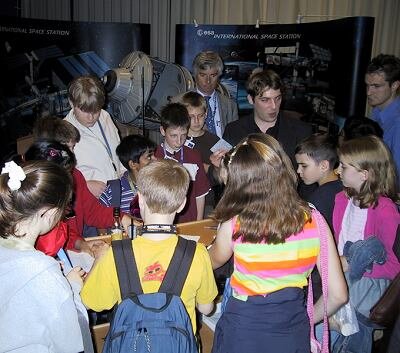
    Science on board the ISS
    Scientific experiments on the Space Station

    David Jarvis showed six different experiments that could be run on the Space Station. His demonstrations were particularly enthusiastically received. Every one of the children wanted to give David a hand when demonstrating the experiments and their answers to his questions showed that they clearly understood the importance of science on board ISS.

    Life as an astronaut

    Before sharing his experiences with the children, ESA astronaut Ulf Merbold, a veteran of three space flights, took the children on a Virtual Reality tour of the Space Station. Ulf went on to talk about the important role astronauts fulfil on behalf of the scientific community when they carry out experiments on board the Station. He also described life on board the Russian Mir space station, which he visited during the EUROMIR 94 mission in 1994.

    The children jumped at the chance to talk to a real astronaut and many questions were fired at Ulf. Questions such as, “What was it like sitting in a Soyuz capsule?” and “What was his most exciting memory of flying up in space?”. The questions could probably have continued for much longer, but it was soon time to board the buses and return to school.

    It was an altogether worthwhile and educating morning. Not only were they very enthusiastic about the visit to the ISS User Information Centre, the children also learnt a great deal about the International Space Station – most certainly ‘mission accomplished’.

    Rate this

    Views

    Share

    • Currently 0 out of 5 Stars.
    • 1
    • 2
    • 3
    • 4
    • 5
    Rating: 0/5 (0 votes cast)

    Thank you for rating!

    You have already rated this page, you can only rate it once!

    Your rating has been changed, thanks for rating!

    14
    Tweet

    Connect with us

    • RSS
    • Youtube
    • Twitter
    • Flickr
    • G+
    • Facebook
    • Livestream
    • Subscribe
    • App Store
    • LATEST ARTICLES
    • · ESA astronaut Timothy Peake set fo…
    • · Space drives e-mobility
    • · Proba-V opens its eyes
    • · First new Galileo satellite arrive…
    • · Next destination: space
    • FAQ

    • Jobs at ESA

    • Site Map

    • Contacts

    • Terms and conditions