• → European Space Agency

      • Space for Europe
      • Space News
      • Space in Images
      • Space in Videos
    • About Us

      • Welcome to ESA
      • DG's News and Views
      • For Member State Delegations
      • Business with ESA
      • ESA Exhibitions
      • ESA Publications
      • Careers at ESA
    • Our Activities

      • Space News
      • Observing the Earth
      • Human Spaceflight
      • Launchers
      • Navigation
      • Space Science
      • Space Engineering
      • Operations
      • Technology
      • Telecommunications & Integrated Applications
    • For Public

    • For Media

    • For Educators

    • For Kids

    • ESA

    • Human Spaceflight

    • Astronauts

    • International Space Station

    • Research

    • Education

    • Our vision
    • About human spaceflight
    • Current missions
    • Volare
    • Bedrest studies
    • ATV
    • Concordia
    • Past missions

      • PromISSe
      • Mars500
      • MagISStra
      • DAMA mission
      • Node-3 & Cupola
      • Expert
      • Alissé
      • OasISS
      • Columbus
      • Esperia
      • Celsius
      • Astrolab
      • Eneide
      • DELTA
      • Cervantes
      • Odissea
      • Marco Polo
      • Andromède
      • STS-100
    • Multimedia
    • Video
    • Multimedia gallery
    • RSS feeds
    • Resources
    • Experiment archive
    • Services
    • Subscribe

    ESA > Our Activities > Human Spaceflight

    Fly us to the Moon…south pole to be precise

    31 March 2010

    The south polar region of the Moon, with dark craters and high ridges, is a world away from the relatively smooth terrain visited by Apollo astronauts four decades ago. This rugged moonscape is the target for Europe’s next leap into space.

    The possible deposits of water ice, heavily cratered terrain and long periods of sunlight make the lunar south pole and areas around it extremely interesting for explorers and scientists. It is therefore a prime target for future human missions to the Moon.

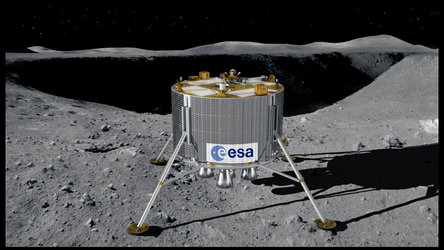
    Europe is now looking at a lander mission to pave the way for astronauts. This precursor would be the first European Moonlander and the first to visit the south polar region.

    ESA is now asking industry to submit proposals for this Lunar Lander mission.


    Preparing for human exploration

    Aldrin's lunar bootprint

    ESA’s Lunar Lander would pave the way for future human exploration on the Moon. There are two core goals.

    The first requires that it uses the latest navigation technology to fly a precise course from lunar orbit to the surface and touch down safely and accurately. On the way down, it must image the surface and recognise dangerous features by itself, using its own ‘intelligence’.

    Then the Lander shall investigate this unique region with a suite of instruments. It will investigate the properties and possible health effects of radiation and lunar dust on future astronauts, and it will examine the soil for signs of resources that could be used by human explorers.

    Europe’s vision: a leader in exploration

    Lunar Lander concept from OHB-System AG
    Lunar Lander concept from OHB-System AG

    Several European industrial teams have already assessed the various mission options and designs. The next step is ‘Phase-B1’, which will mature the mission and spacecraft design and examine in detail the demands of landing and working at specific southern sites.

    This 18-month phase will begin this summer, taking the Lunar Lander from a design concept to hardware reality. The goal is for launch by the end of this decade.

    Involving European researchers and industry is crucial for defining the detailed mission objectives and identifying instruments to address them. For instance, a request for information in 2009 produced more than 200 responses.

    Information session on Lunar Lander

    Lunar Lander concept  from Astrium GmbH
    Lunar Lander concept from Astrium GmbH

    As part of the process of involving European researchers and industry in the project, an information day will be held at ESA’s space research and technology centre (ESTEC) in the Netherlands on 14 April.

    The day is aimed at those who responded to the 2009 request and will include an update on the mission outline, mission objectives and the model payload to be used for Phase-B1.

    Further information on the information day can be obtained by contacting explorationcall@esa.int
    Rate this

    Views

    Share

    • Currently 0 out of 5 Stars.
    • 1
    • 2
    • 3
    • 4
    • 5
    Rating: 0/5 (0 votes cast)

    Thank you for rating!

    You have already rated this page, you can only rate it once!

    Your rating has been changed, thanks for rating!

    74
    Tweet
    • SMART-1
    • Related articles
      • Next step for ESA’s first Moon lander
        • Fly us to the Moon…south pole to be precise
        • International Lunar Exploration Working Group (ILEWG)
        • Global Lunar Conference
        • Related links
        • Lunar Reconnaissance Orbiter (LRO)
          • Chandrayaan-1
          • KAGUYA at JAXA
          • Video on the lunar lander programme

    Connect with us

    • RSS
    • Youtube
    • Twitter
    • Flickr
    • G+
    • Facebook
    • Livestream
    • Subscribe
    • App Store
    • LATEST ARTICLES
    • · ESA astronaut Timothy Peake set fo…
    • · Space drives e-mobility
    • · Proba-V opens its eyes
    • · First new Galileo satellite arrive…
    • · Next destination: space
    • FAQ

    • Jobs at ESA

    • Site Map

    • Contacts

    • Terms and conditions