• → European Space Agency

      • Space for Europe
      • Space News
      • Space in Images
      • Space in Videos
    • About Us

      • Welcome to ESA
      • DG's News and Views
      • For Member State Delegations
      • Business with ESA
      • ESA Exhibitions
      • ESA Publications
      • Careers at ESA
    • Our Activities

      • Space News
      • Observing the Earth
      • Human Spaceflight
      • Launchers
      • Navigation
      • Space Science
      • Space Engineering
      • Operations
      • Technology
      • Telecommunications & Integrated Applications
    • For Public

    • For Media

    • For Educators

    • For Kids

    • ESA

    • Human Spaceflight

    • Astronauts

    • International Space Station

    • Research

    • Education

    • About the International Space Station
    • Pushing the boundaries of science and technology
    • Current status
    • Where is the International Space Station?
    • Building the International Space Station
    • International collaboration
    • International Space Station legal framework
    • Europe's partners
    • European participation
    • Space Station elements
    • Control centres
    • How much does it cost?

    ESA > Our Activities > Human Spaceflight > International Space Station

    ISS: International Space Station

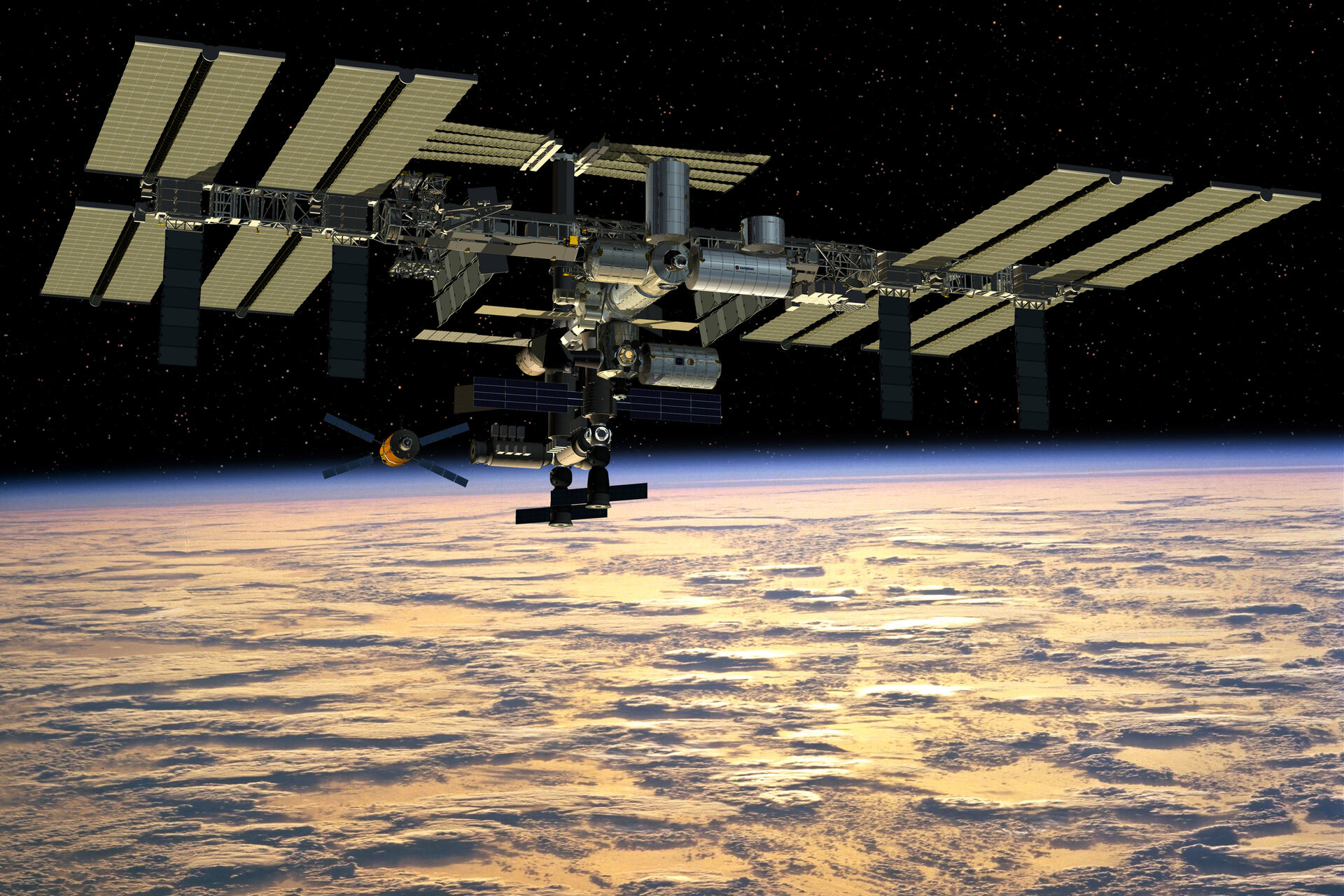
    The International Space Station
    The International Space Station

    Versatile permanently inhabited research institute in Low Earth Orbit

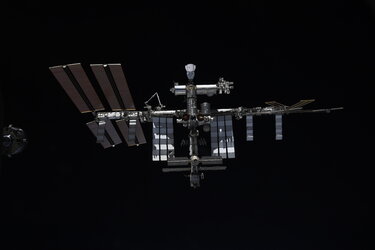
    The International Space Station is a versatile research institute and a large observation platform in outer space for scientific research and applications. It also serves as a test centre to facilitate introduction of new technologies. This permanently human occupied outpost in outer space should also serve as a stepping stone for further space exploration.

    Dimensions and mass  
    Width 108 m
    Length 74 m (~88 m incl. ATV or Progress)
    Height 45 m
    Pressurized volume 1200 m3
    Total mass at completion ~450 000 kg

    Configuration  
    On launch
    Launched in components on different launch vehicles
    provided by 4 of the 5 participating partners. Station assembled in orbit.
    1st launch 20 November 1998
    Assembly complete 2010
    On orbit
    Orbital altitude 370-460 km
    Orbital inclination 51.6°
    Orbital velocity 7.7-7.6 km/s (~27 500 km/h)

    Available launch vehicles
    European Ariane-5 launcher
    Japanese H-IIA launcher
    Russian Proton launcher
    Russian Soyuz launcher
    United States Space Shuttle

    Available transport vehicles for crew and/or supplies  
    European Automated Transfer Vehicle (ATV) Servicing and logistics vehicle
    Japanese HII Transfer Vehicle (HTV) Servicing and logistics vehicle
    Russian Soyuz spacecraft Manned spacecraft that accommodates upto 3 cosmonauts
    Russian Progress vehicle Servicing and logistics vehicle
    US Space Shuttle Manned spacecraft for up to 7 astronauts
    Equipped with the Multi Purpose Logistics Module (MPLM), the Un-pressurized Logistics Carrier (ULC)
    or other Space Station structural parts in its cargo bay

    Partners
    Canada, Canadian Space Agency (CSA)
    Europe, European Space Agency (ESA) representing 10 of the 18 Member States
    Japan, Japan Aerospace Exploration Agency (JAXA)
    Russia, Roscosmos
    USA, National Aeronautics and Space Administration (NASA)

    Last update: 6 November 2009

    Rate this

    Views

    Share

    • Currently 0 out of 5 Stars.
    • 1
    • 2
    • 3
    • 4
    • 5
    Rating: 0/5 (0 votes cast)

    Thank you for rating!

    You have already rated this page, you can only rate it once!

    Your rating has been changed, thanks for rating!

    272
    Tweet
    • More information
    • ISS factsheet (pdf)

    Connect with us

    • RSS
    • Youtube
    • Twitter
    • Flickr
    • G+
    • Facebook
    • Livestream
    • Subscribe
    • App Store
    • LATEST ARTICLES
    • · ESA astronaut Timothy Peake set fo…
    • · Space drives e-mobility
    • · Proba-V opens its eyes
    • · First new Galileo satellite arrive…
    • · Next destination: space
    • FAQ

    • Jobs at ESA

    • Site Map

    • Contacts

    • Terms and conditions