• → European Space Agency

      • Space for Europe
      • Space News
      • Space in Images
      • Space in Videos
    • About Us

      • Welcome to ESA
      • DG's News and Views
      • For Member State Delegations
      • Business with ESA
      • ESA Exhibitions
      • ESA Publications
      • Careers at ESA
    • Our Activities

      • Space News
      • Observing the Earth
      • Human Spaceflight
      • Launchers
      • Navigation
      • Space Science
      • Space Engineering
      • Operations
      • Technology
      • Telecommunications & Integrated Applications
    • For Public

    • For Media

      • Media
      • ESA TV
      • Videos for professionals
      • Photos
    • For Educators

    • For Kids

    • ESA

    • Human Spaceflight

    • Astronauts

    • International Space Station

    • Research

    • Education

    • About the International Space Station
    • Pushing the boundaries of science and technology
    • Current status
    • Where is the International Space Station?
    • Building the International Space Station
    • International collaboration
    • International Space Station legal framework
    • Europe's partners
    • European participation
    • Space Station elements
    • Control centres
    • How much does it cost?

    ESA > Our Activities > Human Spaceflight > International Space Station

    Successful communication test for ATV

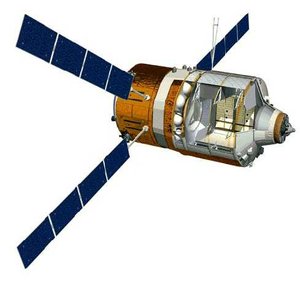
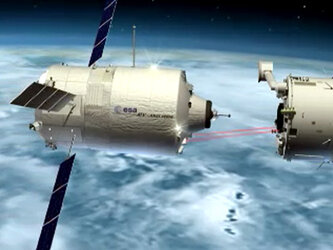
    Cutaway view of the Automated Transfer Vehicle
    26 February 2002

    Thousands of kilometres away from ESA's European Space and Technology Centre (ESTEC) in Noordwijk, The Netherlands, where the Automated Transfer Vehicle (ATV) qualification model started its 11-month test programme last December, the ATV communication boxes have been through an outstanding test with NASA at the Goddard Space Center, near Washington D.C..

    “This is the best piece of hardware we have ever tested”, said the NASA engineers who worked with their European counterparts to check communications links between the ATV electronic boxes and the Tracking and Data Relay Satellites (TDRS), which are used for the International Space Station.

    The January test involved an S-band transponder and an amplifier having an uplink and a downlink according to the specifications with a rate of 1 kilobit/sec up and 8 kilobits/sec down, which could be increased to 64 kilobits/sec when data are stored and need to be quickly sent. The operation took place in a shielded lab to avoid interferences and with a NASA communications truck beaming – in open air - towards one of the two TDRS standing in geostationary orbit over the USA.
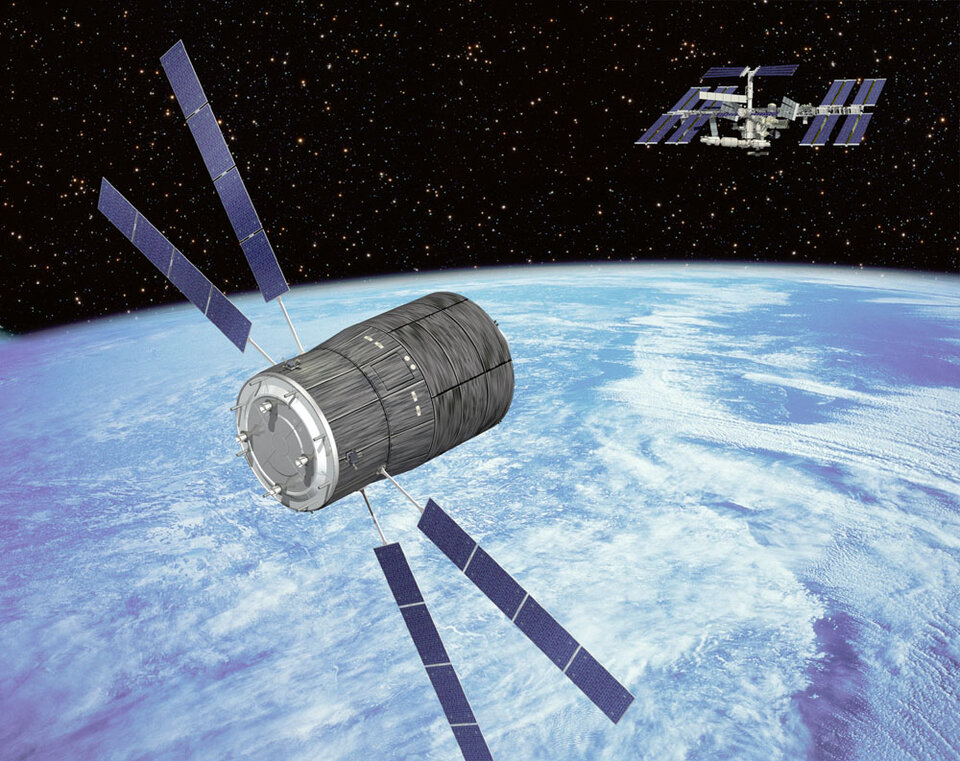
    The Automated Transfer Vehicle
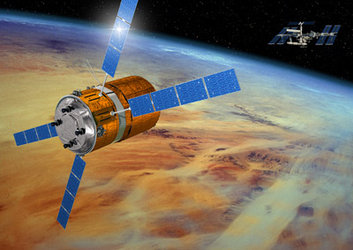
    ATV will automatically dock with the ISS

    “The control went so well that the 10-day original test duration could be shortened to almost half”, said Detlef Otto, who is in charge of the ATV communication system for ESA.

    During a nominal flight, the ATV communication system will work for telemetry and commands in both directions. Alcatel Espacio in Madrid, Spain built the transponder. Communications will start after the launch, 4 minutes before separation of the ATV from the Ariane 5 launcher and continue up to the rendezvous phase with ISS.

    ESA engineers are also considering using Artemis, the European communication satellite, on an experimental basis.


    The NASA TDRS network is being upgraded with more advanced spacecraft in order to relay large volumes of data - voice, television, and scientific - from several orbiting scientific satellites back to their respective ground control centers. Two 15-foot antennas aboard the latest spacecraft are about to support the International Space Station with high-resolution digital television, as well as dump enormous volumes of data at rates of up to 300 megabits/second, which is 5,000 times faster than the standard 56K home computer modem.

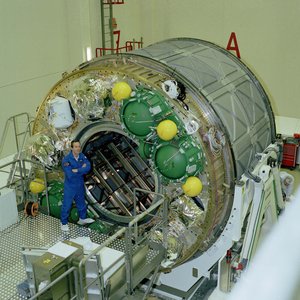
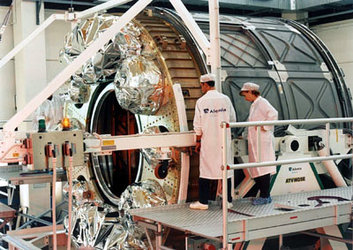
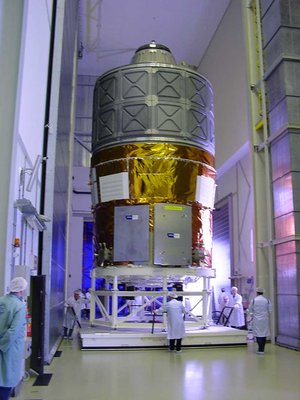
    In the meantime, at ESTEC, the first successful ATV hardware test took place last December, using acoustic vibrations to simulate the stress the ATV will encounter during the first three minutes of launch on top of the powerful European Ariane 5 launcher. In the second half of February, the ATV will undergo new tests called ‘modal’ involving vibrations of the full-size 20-tonne mock-up and data analysis to define mathematical models for the ATV structures.
    Rate this

    Views

    Share

    • Currently 0 out of 5 Stars.
    • 1
    • 2
    • 3
    • 4
    • 5
    Rating: 0/5 (0 votes cast)

    Thank you for rating!

    You have already rated this page, you can only rate it once!

    Your rating has been changed, thanks for rating!

    96
    Tweet
    • News articles
      • Initial ATV test campaign completed ahead of schedule
        • ATV: The most challenging spacecraft ever built by Europe is taking shape
          • First test for Automated Transfer Vehicle
            • Automated Transfer Vehicle test campaign underway
              • Another module for the International Space Station leaves Turin
              • Technical updates
                • Collocation of ESA ATV management team and Prime Contractor EADS-LV: A very positive step
                  • Successful communication test for ATV
                  • Background
                  • ATV mission scenario - picture report
                    • ATV mission scenario - animation
                    • ATV fact sheet
                    • Related links
                    • How to build an ATV paper model
                    • ESTEC test centre
                    • Alenia Aerospazio
                    • Astrium Space

    Connect with us

    • RSS
    • Youtube
    • Twitter
    • Flickr
    • G+
    • Facebook
    • Livestream
    • Subscribe
    • App Store
    • LATEST ARTICLES
    • · Earth Explorers take centre stage …
    • · The fast winds of Venus are gettin…
    • · ExoMars 2016 set to complete const…
    • · Herschel ends operations as orbiti…
    • · Europe’s largest spaceship reache…
    • FAQ

    • Jobs at ESA

    • Site Map

    • Contacts

    • Terms and conditions