• → European Space Agency

      • Space for Europe
      • Space News
      • Space in Images
      • Space in Videos
    • About Us

      • Welcome to ESA
      • DG's News and Views
      • For Member State Delegations
      • Business with ESA
      • ESA Exhibitions
      • ESA Publications
      • Careers at ESA
    • Our Activities

      • Space News
      • Observing the Earth
      • Human Spaceflight
      • Launchers
      • Navigation
      • Space Science
      • Space Engineering
      • Operations
      • Technology
      • Telecommunications & Integrated Applications
    • For Public

    • For Media

      • Media
      • ESA TV
      • Videos for professionals
      • Photos
    • For Educators

    • For Kids

    • ESA

    • Human Spaceflight

    • MagISStra

    • About MagISStra
    • About the MagISStra mission
    • Mission key data
    • Six months of science
    • A 3D experience
    • The educational dimension
    • Facts about the Soyuz
    • About the MagISStra mission name
    • About the MagISStra mission logo
    • Meet the crew
    • Paolo Nespoli
    • Catherine Coleman
    • Dmitri Kondratyev
    • Scott Kelly
    • Oleg Skripochka
    • Aleksandr Kaleri
    • Andrei Borisenko
    • Alexander Samokutyayev
    • Ronald Garan
    • About the Soyuz flights
    • Downloads
    • Launch Press Kit (English)
    • Launch Press Kit (Italian)
    • Info Kit (German)
    • Info Kit (French)
    • Info Kit (Dutch)
    • Multimedia
    • ESA Multimedia gallery
    • ESA Video archive
    • MagISStra at ESA webstreaming network
    • New MagISStra photos
    • Follow Paolo!
    • Follow @Astro_Paolo
    • @astro_paolo's pictures
    •  ESA on YouTube

    ESA > Our Activities > Human Spaceflight > MagISStra

    Studying Paolo’s brains

    Preparing Neurospat in the Columbus facility
    13 January 2011

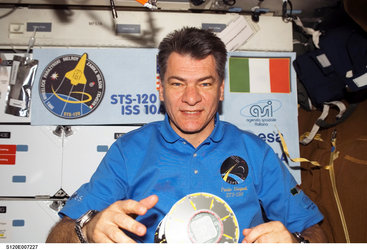
    ESA astronaut Paolo Nespoli, now working as a flight engineer on the International Space Station, is busy with a range of scientific experiments. The latest is peering inside his head to help understand how the human brain works.

    Our brains are changing all the time – nerves are rearranging themselves and the connections between the nerve cells are reforming as the brain memorises new information, stores the old and continuously adapts to new situations.

    New experiences, learning, physiological changes, sleep disturbance and fatigue are among the most influential factors.

    Sometimes, especially after an accident or a cerebral stroke, the recover power of brain tissue is simply mind-boggling: the remaining healthy tissue can take over the functions of damaged areas.

    Space is a stress factor

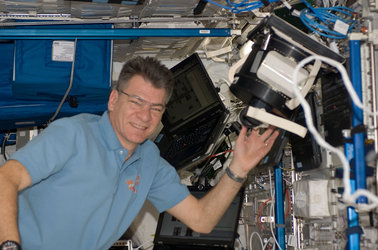
    Paolo Nespoli gets gel injections on the scalp for Neurospat
    Cady gives Paolo gel injections in the scalp

    The weightlessness in orbit is also a big change for brains. Not only are there changes in blood circulation and other physical conditions, but the way that cognitive functions of daily life are managed also alter dramatically.

    Adapting to the multitudinous effects that gravity has on the human body and the way the brain deals with them is perhaps the greatest demand that the nervous system has to face in space. The increased load on the cognitive capacity is accompanied by a multitude of stresses on the brain.

    On 21 December, his second full working day on the Station, Paolo set up the Neurospat experiment with assistance from crewmate Cady Coleman.

    Neurospat aims to detect the brain’s mechanisms involved in the altered behaviour in weightlessness and to locate the crucial parts of the cerebral cortex.


    Helping life on Earth

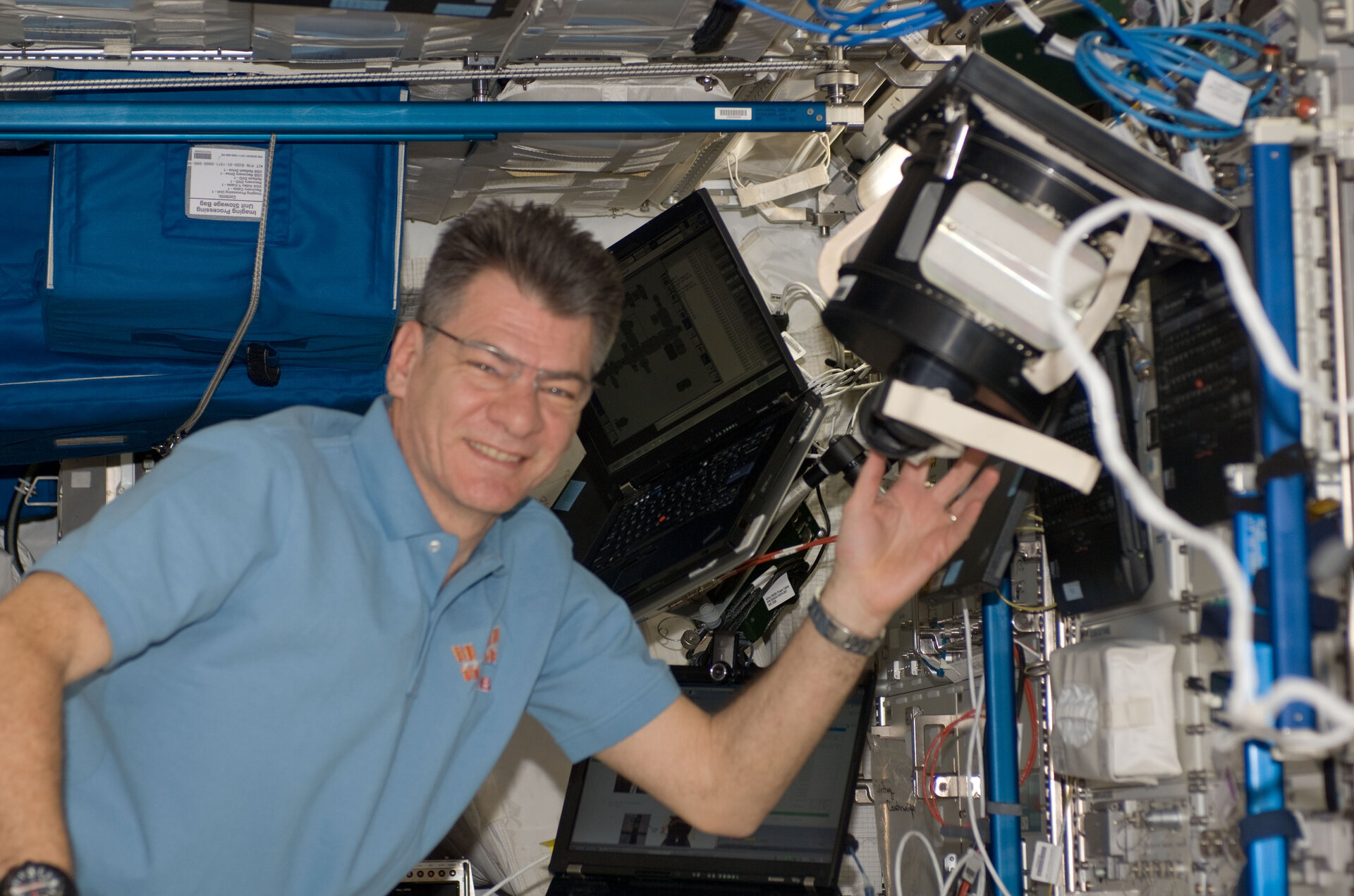
    Display unit of the Neurospat experiment
    Specially designed display unit of the Neurospat experiment

    Neurospat uses a laptop computer with a special program, a visor to focus on the computer without external visual distractions and an electroencephalograph to record brain activity.

    By recording this activity, European scientists are probing the activity that underlies cognitive processes involved in four different tasks: visual-motor tracking, perception of how the body is oriented, 3D navigation and discriminating the orientation of objects.

    Paolo Nespoli talks with BBC, live from the ISS

    Rate this

    Views

    Share

    • Currently 0 out of 5 Stars.
    • 1
    • 2
    • 3
    • 4
    • 5
    Rating: 0/5 (0 votes cast)

    Thank you for rating!

    You have already rated this page, you can only rate it once!

    Your rating has been changed, thanks for rating!

    86
    Tweet
    • Video: ISS with Endeavour and ATV-2
    • Replay of the press conference with Paolo Nespoli (English)
    • Replay of the press conference with Paolo Nespoli
    • Watch the landing video replay
    • MagISStra mission
    • Related articles
      • The story behind Paolo’s Space Station photos
        • Welcome home, Paolo!
          • Eau de Cologne
            • @Astro_Paolo and views from space: “It’s amazing!”
              • Studying Paolo’s brains
                • Paolo Nespoli arrives at the Space Station
                  • Replay the Soyuz docking and hatch opening
                    • Paolo Nespoli heads to Space Station on MagISStra mission
                      • Six months of science
                      • Follow Paolo
                      • Follow @Astro_Paolo
                      • @astro_paolo's pictures
                      • Related links
                      • ISS Expedition 26 (NASA)
                      • Soyuz TMA-20 landing photos (NASA)
                      • In depth
                      • Launch Press Kit (English)
                      • Photos
                      • Paolo's ISS photos

    Connect with us

    • RSS
    • Youtube
    • Twitter
    • Flickr
    • G+
    • Facebook
    • Livestream
    • Subscribe
    • App Store
    • LATEST ARTICLES
    • · Rare merger reveals secrets of gal…
    • · Watching for hazards: ESA opens as…
    • · ESA astronaut Timothy Peake set fo…
    • · Space drives e-mobility
    • · Proba-V opens its eyes
    • FAQ

    • Jobs at ESA

    • Site Map

    • Contacts

    • Terms and conditions