• → European Space Agency

      • Space for Europe
      • Space News
      • Space in Images
      • Space in Videos
    • About Us

      • Welcome to ESA
      • DG's News and Views
      • For Member State Delegations
      • Business with ESA
      • ESA Exhibitions
      • ESA Publications
      • Careers at ESA
    • Our Activities

      • Space News
      • Observing the Earth
      • Human Spaceflight
      • Launchers
      • Navigation
      • Space Science
      • Space Engineering
      • Operations
      • Technology
      • Telecommunications & Integrated Applications
    • For Public

    • For Media

      • Media
      • ESA TV
      • Videos for professionals
      • Photos
    • For Educators

    • For Kids

    • ESA

    • mISSion possible

    • Glossary
    • Related web pages
    • Contact

    ESA > Our Activities > Human Spaceflight > mISSion possible

    Lesson 2: Training of an astronaut

    The astronauts have to get well prepared before flying to the International Space Station (ISS). They follow a complete and diverse training programme for more than a year. This programme includes lots of exercise in order to keep fit. They follow language lessons to learn Russian. They also learn how to fly a spacecraft, how to perform the experiments to be carried out during their mission, how to move around in weightlessness, and how to behave in case of an emergency.

    European astronauts normally do most of their training at the European Astronauts Centre (EAC) in Cologne, Germany. Together with the American astronauts and Russian cosmonauts, they also join training sessions at NASA’s Johnson Space Centre, United States, and in Star City, the Russian Space Agency’s training centre near Moscow.

    Astronauts usually get their first experience of weightlessness in a special plane simulating the conditions in space for short periods of up to 20 seconds. These so-called “parabolic flights” are a good way to learn how to move around while floating.

    Astronauts do a lot of sport: this daily exercise keeps them healthy.

    As a part of their training, astronauts learn how to fly a spacecraft to the ISS and back to Earth. Using a simulator, which is an exact reproduction of the real spacecraft, they train as space pilots.

    WET testing ERA

    In space, astronauts spend most of their time performing scientific experiments. Before they fly to the ISS, they train together with the scientists to learn how to carry out each of the experiments.

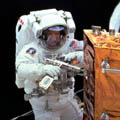
    In some cases, astronauts go to space in order to fix a part of the Space Station or to carry out one specific experiment. To get prepared for space walks, they wear spacesuits while training in water, working on full-scale mock-ups of the Space Station.

    Before going into space, astronauts also have to do parachute training and learn survival skills in the sea, forest and desert so that they know what to do in an emergency.


    Be active in space!
    (Sport)


    The Russian language lesson
    (Language)


    André's spacesuit
    (Language)


    Be a space mechanic
    (Technology)


    You know a lot about astronauts' training now, don't you? Check it out!
    (Quiz)


    You know a lot about astronauts' training now, don't you? Check it out!
    (Quiz)

    Last update: 7 January 2013

    Rate this

    Views

    Share

    • Currently 0 out of 5 Stars.
    • 1
    • 2
    • 3
    • 4
    • 5
    Rating: 0/5 (0 votes cast)

    Thank you for rating!

    You have already rated this page, you can only rate it once!

    Your rating has been changed, thanks for rating!

    93
    Tweet
    • PUZZLE: An astronaut in space
    • Being an astronaut
    • Training of an astronaut
      • PROJECT: ‘1st Primary Schools’ Interplanetary Summit

    Connect with us

    • RSS
    • Youtube
    • Twitter
    • Flickr
    • G+
    • Facebook
    • Livestream
    • Subscribe
    • App Store
    • LATEST ARTICLES
    • · Rare merger reveals secrets of gal…
    • · Watching for hazards: ESA opens as…
    • · ESA astronaut Timothy Peake set fo…
    • · Space drives e-mobility
    • · Proba-V opens its eyes
    • FAQ

    • Jobs at ESA

    • Site Map

    • Contacts

    • Terms and conditions