Ariane 5 fairing undergoes testing for shockless separation
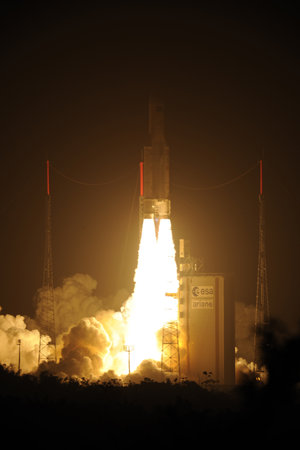
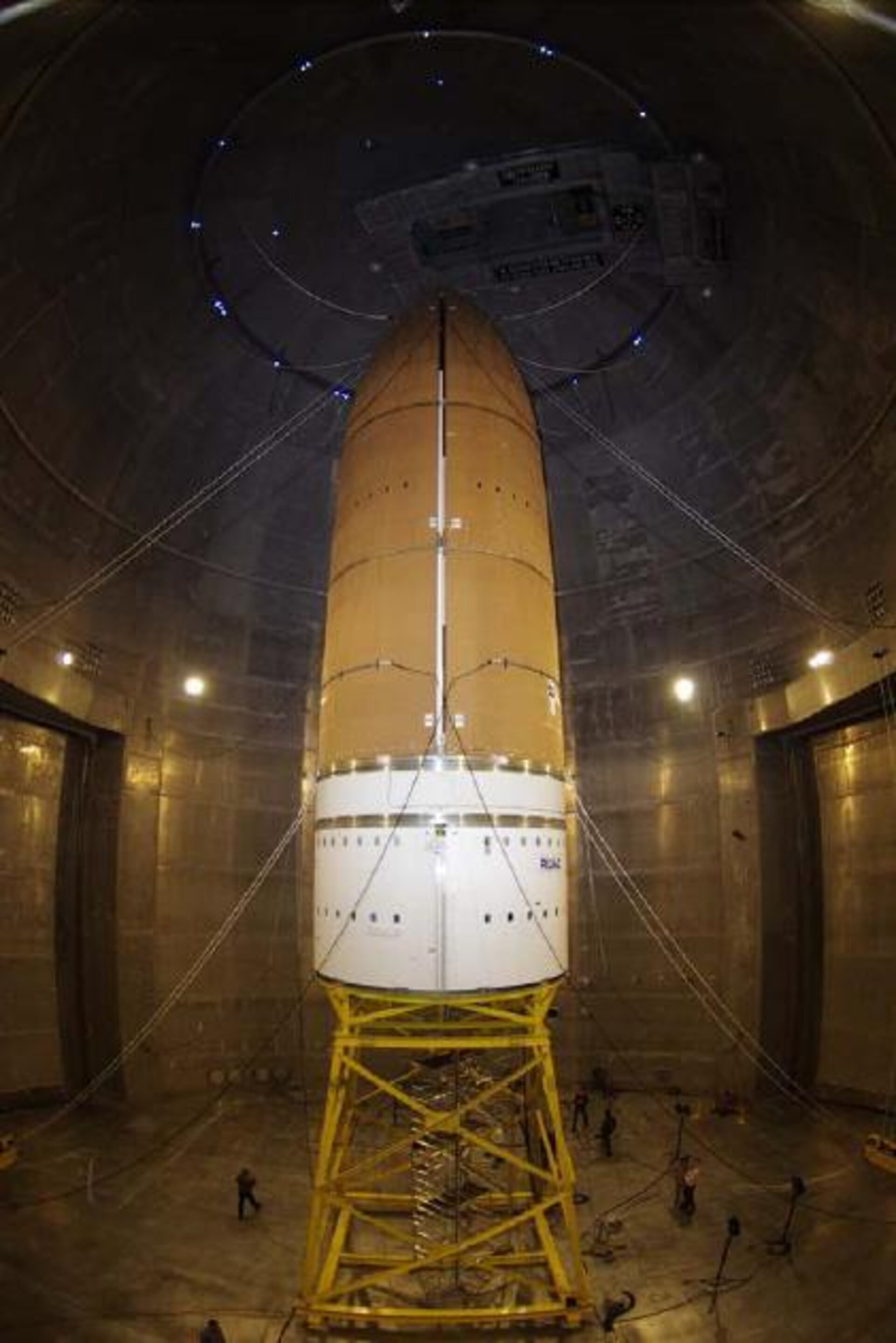
An Ariane 5 fairing underwent separation tests last week to help improve the ride to orbit provided by Europe’s heavy launcher for its passengers.
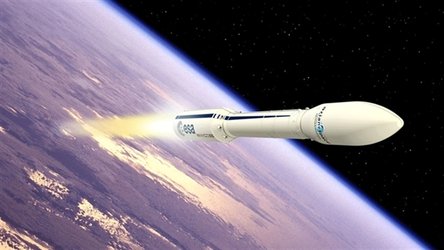
The fairing protects the payload during liftoff and ascent. When Ariane has left Earth’s atmosphere and protection is no longer needed, pyrotechnic charges separate the fairing halves vertically.
Different charges provide horizontal then vertical separation so that the fairing can be jettisoned safely as the launcher continues its journey. This occurs at about three minutes into the flight at an altitude of some 110 km.
Prior to any launch, satellites undergo complex and costly tests to verify they can withstand this separation. Damping rings weighing up to several hundred kilograms can be used if needed to lower the stress but this added weight significantly reduces the launcher’s capacity.
The new HSS-3+ horizontal separation system that was tested in the world’s largest vacuum chamber at NASA’s Glenn Research Plum Brook in Sandusky, USA, will reduce the shock levels right at the source without relying on these damping structures.
HSS-3+ uses two rings positioned symmetrically and designed so that the shock waves generated by the charges cancel each other out.
In addition, a set of springs ensures a safe distance between the launcher and the released fairing before the vertical separation system is activated.
This process must be reliable and the expected trajectory of the jettisoned fairings must be accurate.
This new approach significantly reduces stress on the payload by a factor of about 100. It is so minimal that even the most sensitive satellites, for instance those carrying large optical systems, will not be damaged.

A series of extensive simulations and tests was necessary to qualify the system. They culminated with a first separation test in mid-April and last week’s, both at NASA facilities.
More than 150 measurements were recorded, including the trajectory of the jettisoned fairing halves, the shock levels and the mechanical loads generated by the separation system on the adjacent structures.
Analysis shows a smooth and clean separation, with a good symmetry for both halves. Shock levels were low and comparable to previous tests.
Development of the system is now nearing completion and is expected to be qualified for its first flight in 2013.
Ariane 5 ARTA programme
HSS-3+ was developed by RUAG and Astrium as part of the Ariane 5 Research and Technology Accompaniment (ARTA) programme. ARTA validates modifications for the next production batch of Arianes to be flown and improves the vehicle’s performance. It ensures that Ariane 5 remains reliable, competitive and provides Europe’s independent access to space.
Ariane 5 ARTA programme
HSS-3+ was developed by RUAG and Astrium as part of the Ariane 5 Research and Technology Accompaniment (ARTA) programme. ARTA validates modifications for the next production batch of Arianes to be flown and improves the vehicle’s performance. It ensures that Ariane 5 remains reliable and provides Europe’s independent access to space.