• → European Space Agency

      • Space for Europe
      • Space News
      • Space in Images
      • Space in Videos
    • About Us

      • Welcome to ESA
      • DG's News and Views
      • For Member State Delegations
      • Business with ESA
      • ESA Exhibitions
      • ESA Publications
      • Careers at ESA
    • Our Activities

      • Space News
      • Observing the Earth
      • Human Spaceflight
      • Launchers
      • Navigation
      • Space Science
      • Space Engineering
      • Operations
      • Technology
      • Telecommunications & Integrated Applications
    • For Public

    • For Media

    • For Educators

    • For Kids

    • ESA

    • Home

    • Launch vehicles

    • Europe's Spaceport

    • New Technologies

    • Strategy for launchers
    • Launcher strategy
    • Future Launchers Preparatory Programme
    • International cooperation
    • Launchers and industry
    • Launcher history
    • A look at the past
    • Ariane 1, 2, 3
    • Ariane 4
    • Launches
    • Previous launches
    • Launch schedule
    • Multimedia
    • Image gallery
    • Video gallery
    • RSS feeds
    • Flyers
    • Vega - Europe's small launcher
    • Soyuz - Europe's medium launcher
    • IXV - Intermediate Experimental Vehicle
    • NGL - Europe's Next-Generation Launcher
    • Launchers on your desktop
    • Screensavers and wallpaper
    • Services
    • Glossary
    • Frequently asked questions
    • Comments

    ESA > Our Activities > Launchers

    Ariane 5’s fourth launch of 2010

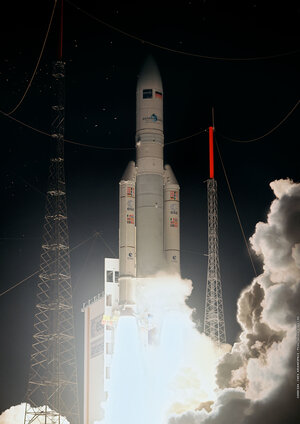
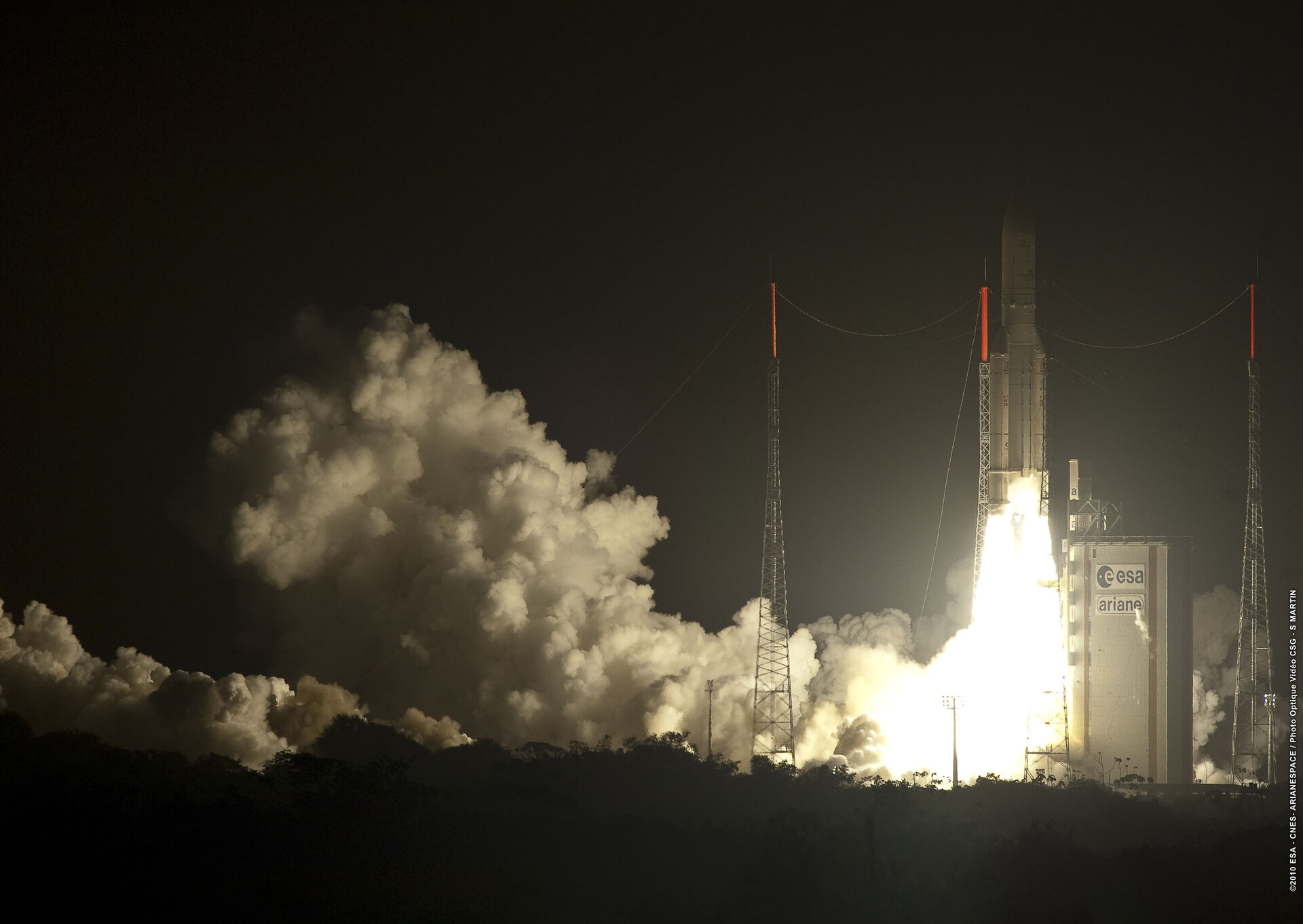
    Ariane 5 flight V197 liftoff
    29 October 2010

    Last night, an Ariane 5 lifted off from Europe’s Spaceport in French Guiana on a journey to place two telecommunications satellites, W3B and BSAT-3b, into orbit. Flight V197 was Ariane 5’s fourth dual-payload mission of the year.

    Liftoff of the 53rd Ariane 5 mission came at 23:51 CEST (21:51 GMT; 18:51 French Guiana). The target injection orbit had a perigee altitude of 250 km, an apogee altitude at injection of 35 913 km and an inclination of 2º.

    The satellites were accurately injected into their transfer orbits about 28 minutes and 37 minutes after liftoff, respectively.

    W3B will be positioned in ‘geostationary orbit’ above the equator at 30.5°E and will provide a wide range of services, from TV broadcasting to professional data networks and broadband access in Europe, the Middle East, Central Asia, Africa and islands in the Indian Ocean.

    BSAT-3b, to be positioned over 110°E, will provide direct-to-home broadcasting services in Japan using eight 130-watt Ku-band transponders.

    Satellites in a circular orbit with an altitude of 35 800 km keep pace with Earth’s rotation and appear stationary when observed from the ground, hence 'geostationary'.

    The payload mass for this launch was approximately 8260 kg; the satellite masses totalled 7460 kg, with payload adapters and dispensers making up the additional 800 kg.

    Ariane 5 flight V197 liftoff

    Arianespace and Europe’s Spaceport are planning two more Ariane launches in 2010, maintaining the heavy-lift vehicle’s flight rate. The ability to sustain high launch rates has been demonstrated: during the 12-month period from August 2007 to August 2008 there were nine launches (V177 – V185).


    V197 flight timeline

    The Ariane 5’s cryogenic, liquid-propellant main engine was ignited first. Seven seconds later, the solid-propellant boosters were also fired, and the vehicle lifted off a fraction of a second later.

    The solid boosters were jettisoned 2 min 22 sec after main engine ignition, and the fairing protecting the payload during the climb through Earth’s atmosphere was discarded at 3 min 9 sec. The launcher’s main engine was shut down at 8 min 50 sec; six seconds later, the main cryogenic stage separated from the upper stage and its payload.

    Ten seconds after main stage separation, the engine of the cryogenic upper stage was ignited to continue the journey. The engine was shut down at 24 min 47 sec into the flight, at which point the vehicle was travelling at 9358 m/s (33 689 km/h) at an altitude of 646 km. Geostationary transfer orbit had been achieved.

    At 28 min 11 sec after main engine ignition, W3B separated from the upper stage, followed by BSAT-3b at 37 min 50 sec. Ariane 5’s flight operations were completed 49 min 50 sec after main engine ignition.

    Rate this

    Views

    Share

    • Currently 0 out of 5 Stars.
    • 1
    • 2
    • 3
    • 4
    • 5
    Rating: 0/5 (0 votes cast)

    Thank you for rating!

    You have already rated this page, you can only rate it once!

    Your rating has been changed, thanks for rating!

    18
    Tweet
    • Related news
      • Ariane 5’s fourth launch of 2010
        • Ariane 5’s third launch of 2010
          • Ariane 5’s second launch of 2010
            • First Ariane 5 launch of 2010
              • Fifth Ariane 5 launch of 2009
                • Ariane 5 – Dual launch of telecommunications satellites
                • Visit Kourou
                • Countdown
                • Build a launcher
                • Ariane 5
                • Vega
                • Soyuz
                • External links
                • Arianespace

    Connect with us

    • RSS
    • Youtube
    • Twitter
    • Flickr
    • G+
    • Facebook
    • Livestream
    • Subscribe
    • App Store
    • LATEST ARTICLES
    • · Proba-V opens its eyes
    • · First new Galileo satellite arrive…
    • · Next destination: space
    • · Leak repaired on International Spa…
    • · After Chelyabinsk: European expert…
    • FAQ

    • Jobs at ESA

    • Site Map

    • Contacts

    • Terms and conditions