• → European Space Agency

      • Space for Europe
      • Space News
      • Space in Images
      • Space in Videos
    • About Us

      • Welcome to ESA
      • DG's News and Views
      • For Member State Delegations
      • Business with ESA
      • ESA Exhibitions
      • ESA Publications
      • Careers at ESA
    • Our Activities

      • Space News
      • Observing the Earth
      • Human Spaceflight
      • Launchers
      • Navigation
      • Space Science
      • Space Engineering
      • Operations
      • Technology
      • Telecommunications & Integrated Applications
    • For Public

    • For Media

    • For Educators

    • For Kids

    • ESA

    • Navigation

    • EGNOS

    • Galileo

    • Evolution

    • About satellite navigation
    • Europe's satellite navigation services
    • Resources
    • Development Facilities
    • Navipedia
    • Multimedia
    • Galileo's In-Orbit Validation phase - 2012 video
    • Galileo - Europe leads the way 3D video
    • Image gallery
    • Video gallery
    • Documents
    • Galileo factsheet (PDF)
    • Galileo IOV factsheet (PDF)
    • Galileo FOC factsheet (PDF)
    • GNSS Evolution factsheet (PDF)
    • Galileo IOV brochure (PDF)
    • Galileo IOV brochures in French and German (PDF)
    • Archives
    • News archive
    • Navigation projects
    • Services
    • Subscribe

    ESA > Our Activities > Navigation

    One year of Galileo signals; new website opens

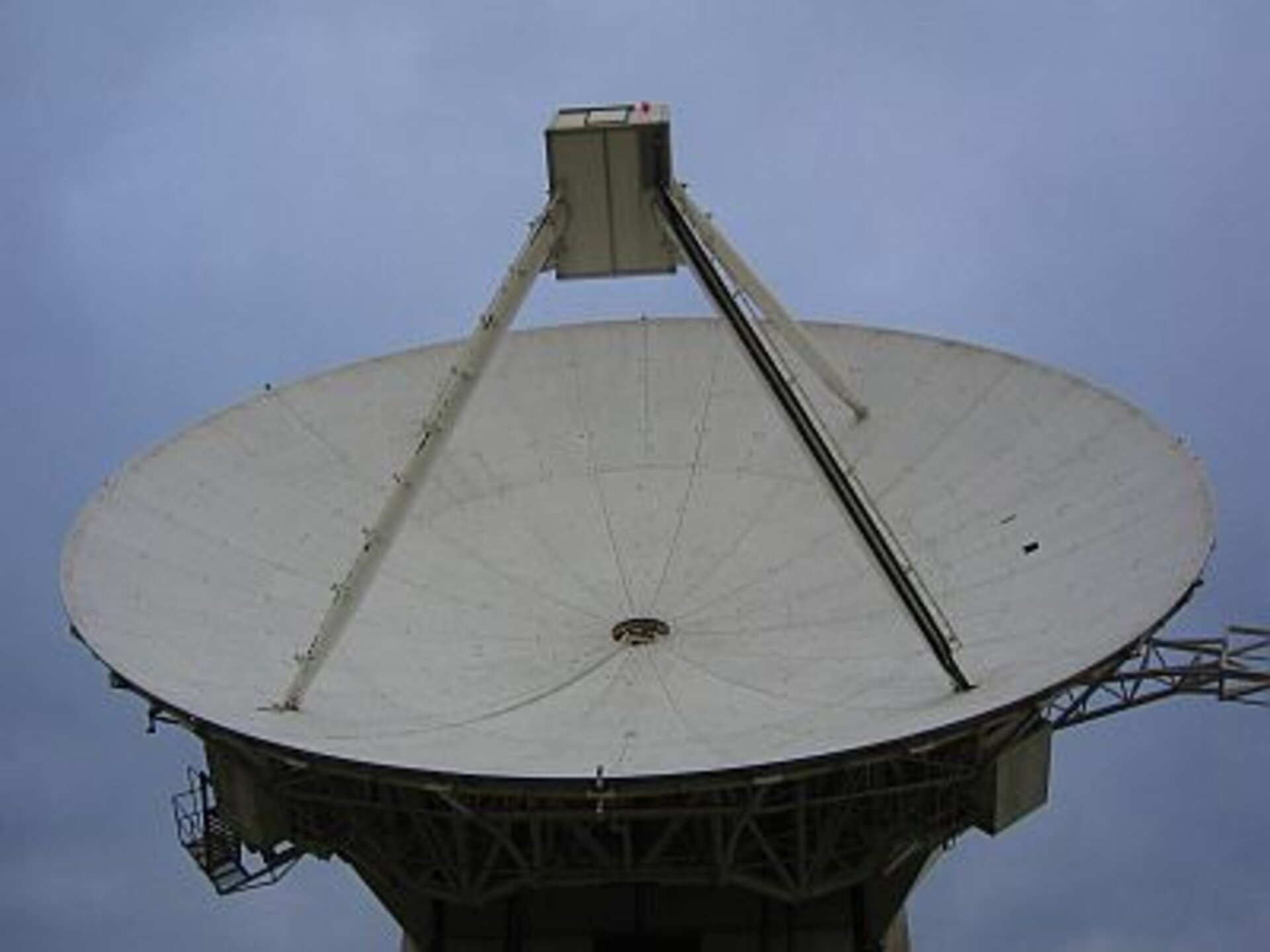
    Antenna at Chilbolton Observatory (UK)
    12 January 2007

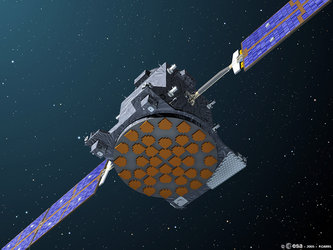
    One year ago today, GIOVE-A began transmitting Galileo navigation signals. This satellite is the first flight element in ESA’s in-orbit validation programme for Galileo.

    Carried into space from the Baikonur Cosmodrome in Kazakhstan by a Soyuz launch vehicle on 28 December 2005, GIOVE-A then successfully completed the initial tasks in its mission – orbit injection, deployment of its solar arrays and the commissioning and check-out of its various payload systems – before commencing the transmission of navigation signals.

    This signal transmission has secured the use of the frequencies allocated to the Galileo system by the International Telecommunication Unit (ITU), achieving the primary mission for which the satellite was constructed.

    The receivers that have been developed for Galileo were able to receive the first signals at ESA sites at Redu (Belgium) and Noordwijk (Netherlands), at the Chilbolton Observatory (UK) and at the Guildford (UK) mission control centre of Surrey Satellite Technology Ltd, the prime contractor for GIOVE-A.

    The navigation signal has been broadcast continuously to fulfil the other important objectives of the GIOVE mission:

    • verification of the critical technologies for the Galileo satellites, including the on-board Rubidium Atomic Frequency Standard (RAFS) clocks, the navigation signal generator and the chain of equipment that comprises the navigation payload
    • characterisation of the novel features of the Galileo signal design, including the verification of user receivers and their resistance to interference and multi-path reception in realistic static and dynamic conditions, aiming to better estimate the effect on navigation services and future applications
    • characterisation of the radiation environment of the Medium Earth Orbit (23 260 km altitude) planned for the Galileo constellation, to better understand this particular environment – particularly the radiation doses and electro-magnetic fields that could affect the design of the operational system

    GIOVE Mission Segment

    GIOVE architecture
    GIOVE architecture

    To complete the in-orbit validation mission, ESA has deployed the GIOVE Mission Segment, composed of a network of 13 monitoring stations located around the world and a GIOVE Processing Centre located at ESA’s European Space Research and Technology Centre (ESTEC), in Noordwijk, the Netherlands. The processing centre is currently receiving measurements for GIOVE-A, and will also receive data for the GIOVE-B satellite which will be launched by the end of 2007.

    The GIOVE Processing Centre computes precise orbits and clock timings for the GIOVE satellites, based on the measurements made by the global network of Galileo Experimental Sensor Stations that collect Galileo and GPS observables once per second. In the future, navigation messages will be generated and up-linked to the satellites through their control centres.

    The GIOVE Processing Centre is already started to provide fascinating, first-ever experimental results that will allow risk mitigation for the operational system development in the in-orbit validation phase.

    In satellite navigation, the achievable positional accuracy is driven by, among other factors, the performance of the navigation message broadcast by the satellites, the satellite clock stability, and the user’s receiver and environment. The GIOVE mission is confirming the correctness of assumptions made at the early stages of the Galileo system design using actual measurements performed in orbit. This confirmation shows that the service performance requirements can be met and the overall Galileo system design is on track.

    New website
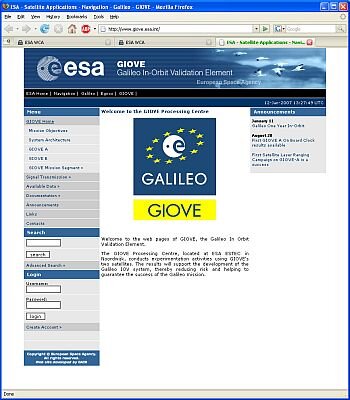
    GIOVE web site

    Information on the GIOVE mission is now accessible at www.giove.esa.int. This new website provides general information to the public and measurement data and core products to registered external users who are collaborating with ESA on the mission experiments.

    Galileo is a joint initiative of the European Commission (EC) and ESA. The EC is responsible for the political dimension and the high-level mission definition. ESA’s responsibility covers the technology development as well as design, development and in-orbit validation of the space and ground elements.

    Rate this

    Views

    Share

    • Currently 0 out of 5 Stars.
    • 1
    • 2
    • 3
    • 4
    • 5
    Rating: 0/5 (0 votes cast)

    Thank you for rating!

    You have already rated this page, you can only rate it once!

    Your rating has been changed, thanks for rating!

    50
    Tweet
    • Galileo
      Galileo
      First Galileo Launch
    • Related news
      • One year in space for Galileo In-Orbit Validation Element
        • GIOVE A transmits loud and clear
          • GIOVE. The clock is ticking
            • First Galileo signals transmitted by GIOVE-A
              • First Galileo satellite on orbit to demonstrate key technologies
              • Related links
              • GIOVE website
              • Galileo website (European Commission)
              • Surrey Satellite Technology - GIOVE A
              • European Satellite Navigation Industries
              • Galileo Tour
                Galileo Tour
                Galileo Tour

    Connect with us

    • RSS
    • Youtube
    • Twitter
    • Flickr
    • G+
    • Facebook
    • Livestream
    • Subscribe
    • App Store
    • LATEST ARTICLES
    • · Proba-V opens its eyes
    • · First new Galileo satellite arrive…
    • · Next destination: space
    • · Leak repaired on International Spa…
    • · After Chelyabinsk: European expert…
    • FAQ

    • Jobs at ESA

    • Site Map

    • Contacts

    • Terms and conditions