• → European Space Agency

      • Space for Europe
      • Space News
      • Space in Images
      • Space in Videos
    • About Us

      • Welcome to ESA
      • DG's News and Views
      • For Member State Delegations
      • Business with ESA
      • ESA Exhibitions
      • ESA Publications
      • Careers at ESA
    • Our Activities

      • Space News
      • Observing the Earth
      • Human Spaceflight
      • Launchers
      • Navigation
      • Space Science
      • Space Engineering
      • Operations
      • Technology
      • Telecommunications & Integrated Applications
    • For Public

    • For Media

      • Media
      • ESA TV
      • Videos for professionals
      • Photos
    • For Educators

    • For Kids

    • ESA

    • Home

    • Navigation

    • Galileo

    • Multimedia
    • Galileo image gallery
    • Galileo video gallery
    • Brochures
    • GIOVE - First Galileo Satellites (.pdf, 1.2 Mb)
    • Die Ersten Gallileo Satelliten - Giove A & B (.pdf, 1.1 Mb)
    • Les Premiers Satellites Gallileo - Giove A & B (.pdf, 576 kb)
    • Galileo I Primi Satelliti - Giove A & B (.pdf, 1.1 Mb)
    • Services

    ESA > Our Activities > Navigation > The future - Galileo > GIOVE-B launch

    Naming of the GIOVE satellites

    Galileo Galilei, 1564-1642
    Galileo Galilei
    8 April 2008

    Galileo, the European satellite navigation system, is named after the famous Italian scientist Galileo Galilei (1564-1642), paying tribute to his achievements not only in the field of astronomy but also navigation. GIOVE also has a strong link with both the renowned astronomer and with early navigation techniques.

    In 1610, as one of the first to turn his telescope to the sky, Galileo Galilei discovered four of the moons of the planet Jupiter. These were later named Io, Europa, Ganymede and Callisto. Galileo realised that the movements of these four natural satellites, whose eclipses are frequent and visible, provided a clock whose face could be seen from every point on the Earth.
     
    Tables describing the motion of the first four Jovian moons to be discovered were used to determine longitude both at sea and on land. Galileo's method of determining longitude by observing the eclipses of Jovian moons heralded a revolution in navigation, geodesy and cartography in the 17th and 18th centuries.

    Galileo's observations of Jupiter's moons

    GIOVE stands for 'Galileo In-Orbit Validation Element' and also refers to Jupiter, being the Italian name for the planet. Ms Karla Peijs, then the Dutch Minister of Transport, Public Works & Water Management, announced the choice of name in November 2005, during a visit to ESA's European Space Research and Technology Centre (ESTEC) in Noordwijk (The Netherlands). The naming ceremony was part of a media event during which GIOVE-A, the first experimental Galileo satellite was presented to the press and television.


    GIOVE-A in orbit (artist's impression)

    GIOVE-A was launched on 28 December 2005 and transmitted its first signals on 12 January 2006. The spacecraft remains in service, although it has reached the end of its two-year design life.

    GIOVE-B

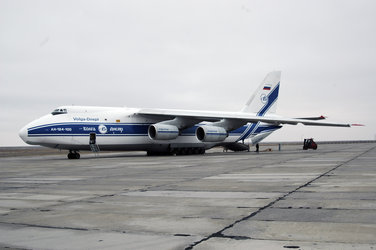
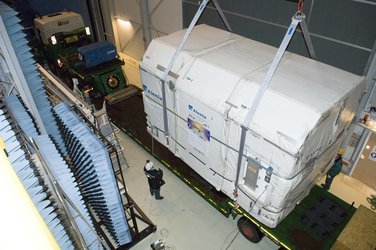
    GIOVE-B is now at the Baikonur Cosmodrome in Kazakhstan, where preparations are being made for it to be lifted into orbit by a Starsem Soyuz/Fregat launcher. The launch is scheduled for 00:16:02 CEST/Paris on 26 April (04:16 UTC+6/Baikonur, 22:16 UTC [26 April]).

    Rate this

    Views

    Share

    • Currently 0 out of 5 Stars.
    • 1
    • 2
    • 3
    • 4
    • 5
    Rating: 0/5 (0 votes cast)

    Thank you for rating!

    You have already rated this page, you can only rate it once!

    Your rating has been changed, thanks for rating!

    60
    Tweet
    • Related news
      • GIOVE-B under test; launcher integration under way
        • GIOVE-B in clean room at Baikonur Cosmodrome
          • GIOVE-B arrives at Baikonur Cosmodrome
            • GIOVE-B leaves ESTEC en-route to Baikonur
              • Second Galileo spacecraft prepares for launch
              • Related links
              • Galileo website (European Commission)
              • European GNSS Supervisory Authority (GSA)

    Connect with us

    • RSS
    • Youtube
    • Twitter
    • Flickr
    • G+
    • Facebook
    • Livestream
    • Subscribe
    • App Store
    • LATEST ARTICLES
    • · Earth Explorers take centre stage …
    • · The fast winds of Venus are gettin…
    • · ExoMars 2016 set to complete const…
    • · Herschel ends operations as orbiti…
    • · Europe’s largest spaceship reache…
    • FAQ

    • Jobs at ESA

    • Site Map

    • Contacts

    • Terms and conditions