• → European Space Agency

      • Space for Europe
      • Space News
      • Space in Images
      • Space in Videos
    • About Us

      • Welcome to ESA
      • DG's News and Views
      • For Member State Delegations
      • Business with ESA
      • ESA Exhibitions
      • ESA Publications
      • Careers at ESA
    • Our Activities

      • Space News
      • Observing the Earth
      • Human Spaceflight
      • Launchers
      • Navigation
      • Space Science
      • Space Engineering
      • Operations
      • Technology
      • Telecommunications & Integrated Applications
    • For Public

    • For Media

      • Media
      • ESA TV
      • Videos for professionals
      • Photos
    • For Educators

    • For Kids

    • ESA

    • Navigation

    • EGNOS

    • Galileo

    • Evolution

    • About Galileo
    • Why Europe needs Galileo
    • Galileo partners
    • Galileo : a constellation of 30 navigation satellites
    • Galileo on the ground
    • Satellite anatomy
    • Galileo’s clocks
    • Next steps
    • Documentation
    • Galileo's In-Orbit Validation phase - 2012 video
    • Open service signal - specifications
    • Galileo factsheet (PDF)
    • Galileo IOV factsheet (PDF)
    • Galileo FOC factsheet (PDF)
    • Technology developments archive
    • GSTB-V1 Technology Developments
    • Galileo technology developments
    • Subscription
    • Subscribe
    • Europe's satellite navigation services

    ESA > Our Activities > Navigation > The future - Galileo

    Overview

    An experimental Galileo satellite has been launched

    The Galileo Programme is being implemented in three phases:

    • Definition phase
    • Development and In-Orbit Validation
    • Full Deployment and Operations

    The Definition phase was completed in 2003 resulting in the basic specifications for the system.
     
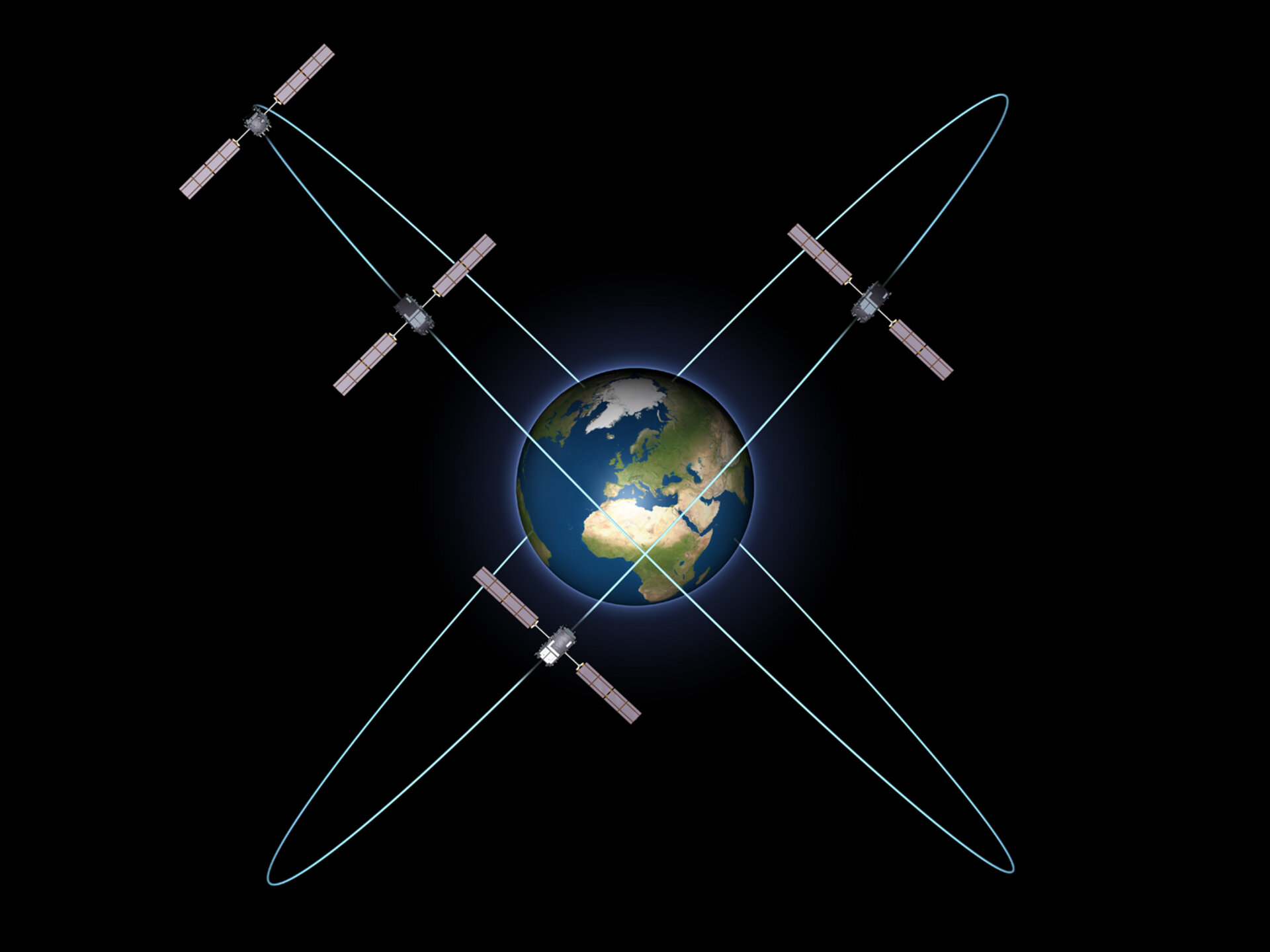
    The Development and In-Orbit Validation phase was initiated in late 2003. This phase aims to perform an in-orbit validation of the system using a reduced constellation of four satellites (which is the minimum number to guarantee the provision of exact positioning and time at test locations) along with a number of associated ground stations.
     
    Early in this phase, an experimental satellite was launched, to secure the Galileo frequency filings, to characterize the orbits to be used by the in-orbit validation satellites and to test some of the critical technologies, such as the atomic clocks. Launched on 28 December 2005, GIOVE-A transmitted the first Galileo signals in space on 12 January 2006.
     
    A further experimental satellite, GIOVE-B, was launched on 27 April 2008. Results from these two ongoing flights are of great value to the team currently preparing the next phase of the programme.
     
    The four satellites will be used for the primary In-Orbit Validation and will be part of the 30-satellite constellation. Their launch is planned in 2011. The ground stations needed for this phase are also being prepared. IOV will be a partial constellation associated with a representative ground system, allowing a real-world validation of the basic elements of Galileo.
     
    Once the In-Orbit Validation is complete, the lessons learned will be used as the programme enters its Full Deployment phase. This will cover construction of the full ground infrastructure and the launch of the remaining 26 satellites to complete the constellation.

    Last update: 1 July 2010

    Rate this

    Views

    Share

    • Currently 0 out of 5 Stars.
    • 1
    • 2
    • 3
    • 4
    • 5
    Rating: 0/5 (0 votes cast)

    Thank you for rating!

    You have already rated this page, you can only rate it once!

    Your rating has been changed, thanks for rating!

    57
    Tweet
    • First stages of Galileo
    • Galileo testbeds
    • First two satellites
    • In-orbit validation
    • Overview
    • In-orbit validation system: the first 4 satellites
    • Full deployment
    • The constellation: 27 satellites + 3 in reserve
      • Galileo system
      • Galileo specifications
      • Galileo signals and frequencies
      • How do the Galileo clocks work ?
      • Receivers
      • Services
      • Related Sites
      • GPS
      • GLONASS
      • CENC

    Connect with us

    • RSS
    • Youtube
    • Twitter
    • Flickr
    • G+
    • Facebook
    • Livestream
    • Subscribe
    • App Store
    • LATEST ARTICLES
    • · Rare merger reveals secrets of gal…
    • · Watching for hazards: ESA opens as…
    • · ESA astronaut Timothy Peake set fo…
    • · Space drives e-mobility
    • · Proba-V opens its eyes
    • FAQ

    • Jobs at ESA

    • Site Map

    • Contacts

    • Terms and conditions