

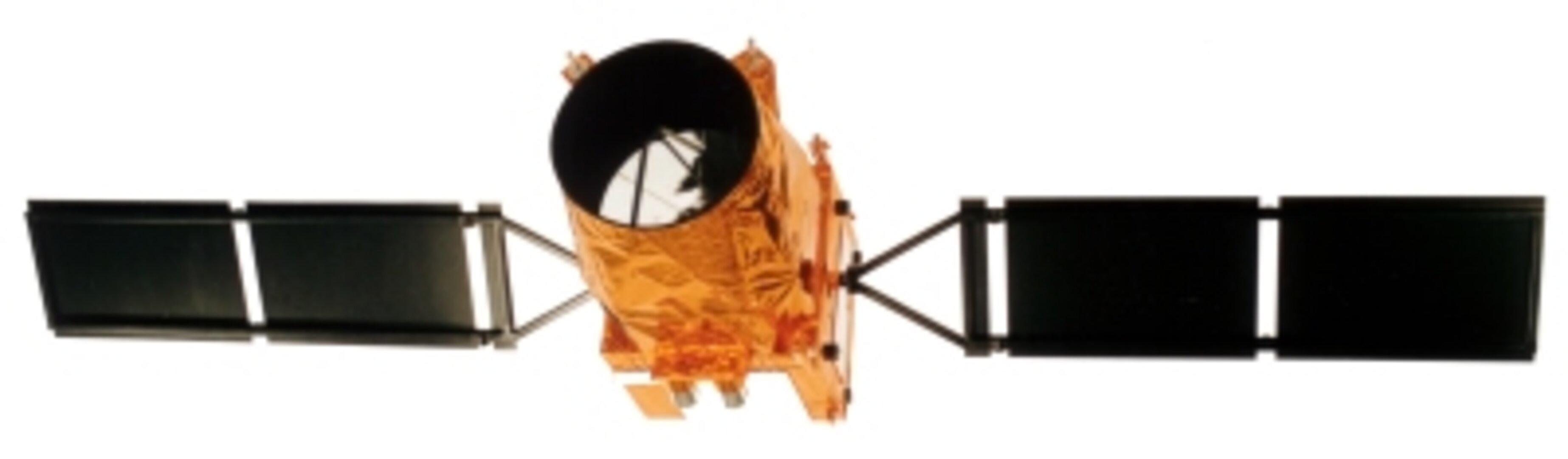
ESA set to contribute to better global weather forecasting as the Earth Explorer ADM-Aeolus mission advances
An important milestone has recently been reached in ESA’s Living Planet Programme as its second Earth Explorer Core Mission, ADM-Aeolus moves into the next phase of development. The ADM-Aeolus mission is designed to make novel advances in global wind profile observation and is intended to provide much needed information to improve weather forecasting and climate research.
The feasibility study phase (Phase A) of the ADM-Aeolus mission was successfully completed at the end of 1999, after which work proceeded rapidly on the pre-stages of the development and design of the satellite. This resulted in an important stage in the progress of the project being reached in the July of this year when it officially advanced to Phase B. During this phase, all the sub-systems, i.e. the ‘structures and boxes’ of the mission will be fully analysed and undergo detailed specification. Phase B is expected to last for about 1 year and after a Preliminary Design Review the ADM-Aeolus mission will enter the design and construction phase with the eventual launch of the satellite expected to be in October 2007.
The ADM-Aeolus mission is much needed because direct measurements of the global, three-dimensional wind field have never been measured before and deficiencies in the current observing system are impeding progress in both climate research and operational weather forecasting. The aim of the mission is to provide global observations of wind profiles with a vertical resolution that will satisfy the requirements of the World Meteorological Organisation (WMO). ADM-Aeolus is novel because for the first time this satellite will create a series of consistent global wind profiles giving meteorologists much better information with which to predict the weather. The satellite will be placed in a Sun-synchronous orbit at an altitude to 400 km and will always be in the dawn or dusk position. This unique orbit means that ADM-Aeolus will be able to provide accurate wind profiles for the entire plant, including remote areas lacking any ground-based weather station. Apart from providing a significant improvement in weather forecasting the mission will also further our understanding of the atmosphere and provide valuable data needed to address some of the key concerns of the World Climate Research Programme (WCRP) such as quantification of climate variability, validation and improvement of climate models and studies related to climate change.

ADM-Aeolus will carry just one large instrument - the Atmospheric Laser Doppler Lidar Instrument (ALADIN). This is a direct detection lidar operating in the ultra-violet spectral region (355 nm). It emits a short but powerful laser pulse towards the atmosphere, from which a small portion is scattered back by the air molecules and by cloud and aerosol particles. The telescope in ALADIN collects this backscattered light and directs it to an optical receiver, which measures the Doppler shift of the received light. Wind profiles will then be derived showing the relative strength and direction of winds at different altitudes.
So, the coming year will be an exacting time for the scientists involved in the ADM-Aeolus Earth Explorer mission as detailed specification work gets underway, and as Phase B of the project advances the prospect of improved global weather forecasting comes another step closer.

