• → European Space Agency

      • Space for Europe
      • Space News
      • Space in Images
      • Space in Videos
    • About Us

      • Welcome to ESA
      • DG's News and Views
      • For Member State Delegations
      • Business with ESA
      • ESA Exhibitions
      • ESA Publications
      • Careers at ESA
    • Our Activities

      • Space News
      • Observing the Earth
      • Human Spaceflight
      • Launchers
      • Navigation
      • Space Science
      • Space Engineering
      • Operations
      • Technology
      • Telecommunications & Integrated Applications
    • For Public

    • For Media

    • For Educators

    • For Kids

    • ESA

    • Observing the Earth

    • Understanding Our Planet

    • Securing Our Environment

    • Benefiting Our Economy

    • About Observing the Earth

      • How does Earth Observation work?
      • How to get Earth observation data
      • Integrating Earth Observation in your job
      • Earth Observation users speak
    • EO programmes
    • The Living Planet
    • GMES
    • ESA's Earth Observing missions
    • Envisat overview
    • ERS overview
    • Earth Explorers overview
    • Sentinels overview
    • MSG overview
    • MetOp overview
    • Proba-1 overview
    • Third Party Missions overview
    • Opportunities with us

      • Education & training
      • International cooperation
      • Milestones & announcements
    • Multimedia

      • Image Gallery
      • Video Gallery
      • Online resources
      • RSS feeds
    • Services
    • Subscribe

    ESA > Our Activities > Observing the Earth

    Earthquakes

    Turkey Earthquake, July 2001
    Turkey earthquake, July 2001

    Earthquakes strike some areas of the globe every year. Some are relatively minor and pass almost unobserved, while others can cause hundreds, if not thousands of deaths, as well as immense damage to buildings and infrastructure.

    One October 2001 earthquake in western Turkey killed nearly 50 people; fortunately far less than the two devastating earthquakes in 1999 which caused almost 20 000 deaths, left even more homeless, and resulted in immense and expensive damage to infrastructure.

    Scientists are still battling to find ways of assessing seismic risks in order to better understand earthquakes and to contribute to risk mitigation. Envisat can provide precise information to help them in their task. The technique of interferometry, using Envisat's ASAR instrument, makes it possible to measure the dislocation caused by an earthquake and to show the movement of the terrain. All this information can improve understanding of earthquake patterns and assist scientist in the search to find reliable methods of predicting them.
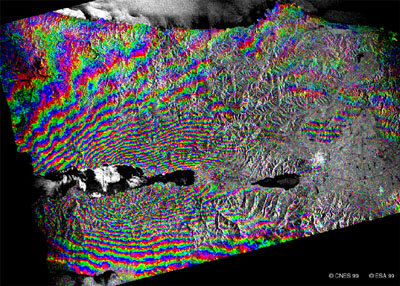
    Satellite image of the 1999 earthquake in Turkey

    Sometimes the after effects of an earthquake can be more devastating than the quake itself, which may last for just a few seconds. Earthquake victims have to be rehoused; buildings, roads and other infrastructure rebuilt; and industry and agriculture are disrupted. This places a heavy burden on governments, particularly in poorer countries.

    Unfortunately these costs are on the increase, mainly due to population growth and building in areas that are at risk. For the same reason, although the number of earthquakes has not increased the number of potential victims is growing.

    Envisat data are particularly useful immediately after an earthquake and a valuable tool for disaster management teams. Geo information from Earth observation satellites allows them to monitor the extent of the immediate damage, as well as possible flooding or landslides in remote and inaccessible terrain. Within hours of a catastrophe the ASAR sensor can focus on a disaster area - whatever the weather or the time of day - and send back in near real time the valuable data that will help the rescue and rehabilitation teams.

    Last update: 23 September 2004

    Rate this

    Views

    Share

    • Currently 0 out of 5 Stars.
    • 1
    • 2
    • 3
    • 4
    • 5
    Rating: 0/5 (0 votes cast)

    Thank you for rating!

    You have already rated this page, you can only rate it once!

    Your rating has been changed, thanks for rating!

    20
    Tweet
    • Envisat expected results
    • Envisat Expected Results Home Page
      • Oceans
        • Atmosphere
        • Land
          • Agriculture
            • Forests
              • Earthquakes
                • Floods
                  • Volcanoes
                  • Related links
                  • About Envisat
                  • Envisat Project Site
                  • EO Principal Investigator News
                  • Earthnet
                  • Envisat Launch
                  • Envisat multimedia links
                  • 3-D VRM Envisat model
                  • Earth Observation Gallery
                  • Envisat videos
                  • Envisat instruments

    Connect with us

    • RSS
    • Youtube
    • Twitter
    • Flickr
    • G+
    • Facebook
    • Livestream
    • Subscribe
    • App Store
    • LATEST ARTICLES
    • · Proba-V opens its eyes
    • · First new Galileo satellite arrive…
    • · Next destination: space
    • · Leak repaired on International Spa…
    • · After Chelyabinsk: European expert…
    • FAQ

    • Jobs at ESA

    • Site Map

    • Contacts

    • Terms and conditions