• → European Space Agency

      • Space for Europe
      • Space News
      • Space in Images
      • Space in Videos
    • About Us

      • Welcome to ESA
      • DG's News and Views
      • For Member State Delegations
      • Business with ESA
      • ESA Exhibitions
      • ESA Publications
      • Careers at ESA
    • Our Activities

      • Space News
      • Observing the Earth
      • Human Spaceflight
      • Launchers
      • Navigation
      • Space Science
      • Space Engineering
      • Operations
      • Technology
      • Telecommunications & Integrated Applications
    • For Public

    • For Media

    • For Educators

    • For Kids

    • ESA

    • Observing the Earth

    • Understanding Our Planet

    • Securing Our Environment

    • Benefiting Our Economy

    • About Observing the Earth

      • How does Earth Observation work?
      • How to get Earth observation data
      • Integrating Earth Observation in your job
      • Earth Observation users speak
    • EO programmes
    • The Living Planet
    • GMES
    • ESA's Earth Observing missions
    • Envisat overview
    • ERS overview
    • Earth Explorers overview
    • Sentinels overview
    • MSG overview
    • MetOp overview
    • Proba-1 overview
    • Third Party Missions overview
    • Opportunities with us

      • Education & training
      • International cooperation
      • Milestones & announcements
    • Multimedia

      • Image Gallery
      • Video Gallery
      • Online resources
      • RSS feeds
    • Services
    • Subscribe

    ESA > Our Activities > Observing the Earth

    European conference addresses increasing demand for EO data

    28 May 2008

    For more than 40 years, Earth observing satellites have delivered valuable data about our planet and have enabled a better understanding and improved management of the Earth and its environment. Demands for these data are increasing daily as decision-makers are faced with responding to environmental change, managing sustainable development and responding to natural disasters and civil security issues.

    In order to address these needs, ESA, the German Space Agency (DLR) and the German Aerospace Industries Association (BDLI) have jointly organised a conference aimed at identifying the challenges ahead and exploring specific needs for the future.

    European experts from ESA and DLR are attending the conference being held on 27 and 28 May on the occasion of the ILA Berlin Air Show in Germany to provide an overview of existing Earth observation (EO) applications in the area of climate, environmental management and the civil security sector.
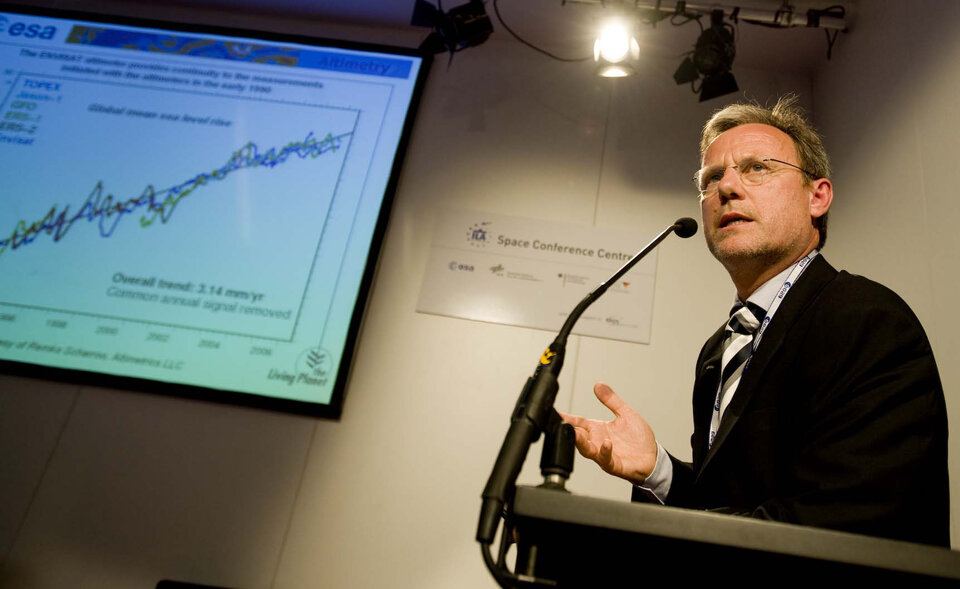
    Dr Volker Liebig
    Dr Liebig at the EO conference

    Representatives from public authorities, private companies and international organisations are attending the conference entitled ‘Earth observation: Solutions for Decision Making’ to explore specific demands for EO products.

    Speaking at the conference, Dr Volker Liebig, ESA’s Director of Earth Observation, outlined ESA’s vigorous EO programmes, which include launching 17 satellites over the next seven years.

    These include the family of Earth Explorers that will measure key Earth system processes to understand their role in climate change and the Sentinels that will provide operational information services for global monitoring of the environment and security.

    ESA’s Head of Science, Applications and Future Technologies Department Dr Stephen Briggs introduced ESA’s Climate Change Initiative, a new Programme Proposal that will be presented to the ESA Ministerial Council in November 2008.

    The objectives of the programme will focus on the delivery of satellite-based ‘Essential Climate Variables’ to support climate change modelling and prediction.
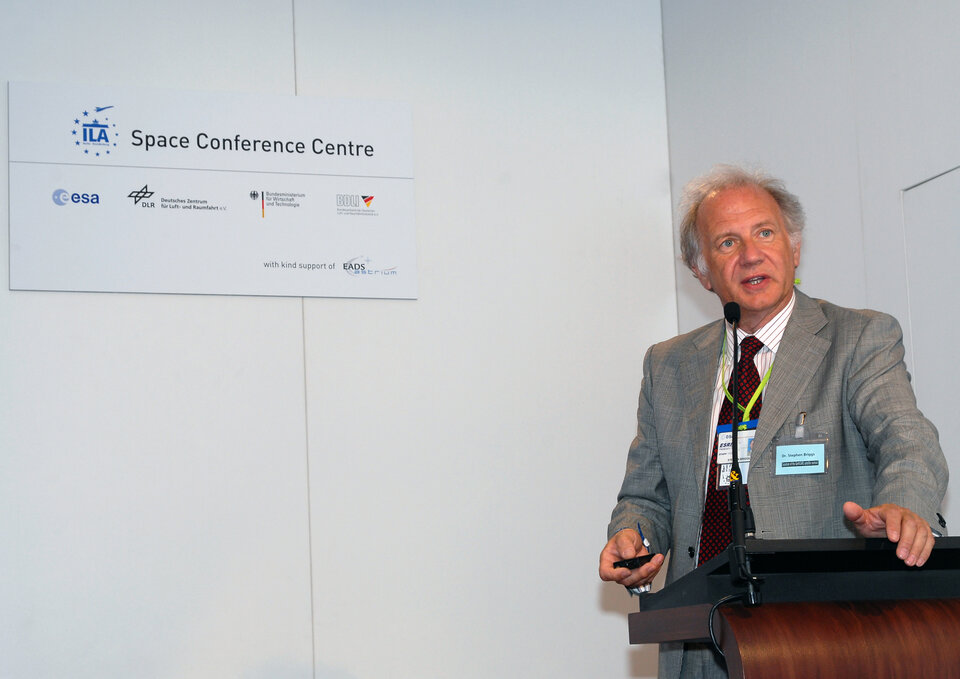

    Stephen Briggs
    Dr Stephen Briggs

    "Satellite data are critical in providing the basic information for modelling and predicting climate change," Briggs said. "The new initiative will ensure that ESA’s potential in this area is fully realised."

    The fleet of ESA’s EO satellites has gathered enormous amounts of data relevant for providing this information. Archived over 30 years and increasing daily, these data will form the basis for extracting the variables most relevant to climate change.

    ESA and its member states will process the information in a form readily usable by the scientific community and governmental bodies in order to achieve their policies and to support the Intergovernmental Panel on Climate Change (IPCC) and United Nations’ conventions.
    Rate this

    Views

    Share

    • Currently 0 out of 5 Stars.
    • 1
    • 2
    • 3
    • 4
    • 5
    Rating: 0/5 (0 votes cast)

    Thank you for rating!

    You have already rated this page, you can only rate it once!

    Your rating has been changed, thanks for rating!

    26
    Tweet
    • Related articles
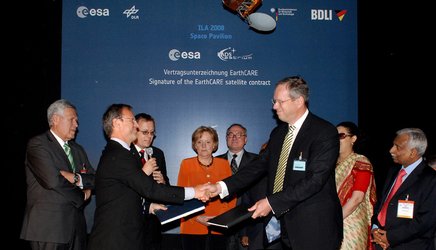
      • EarthCARE satellite contract signed
        • ‘Space for Europe, Space for the Earth’ at the Berlin Air and Space Show, ILA 2008
          • ESA leads endeavour to save Earth Science data
          • In depth
            • Earth Explorers overview
            • Related links
            • Berlin Air Show ILA 2010
            • (German Aerospace Center) DLR
            • IPCC

    Connect with us

    • RSS
    • Youtube
    • Twitter
    • Flickr
    • G+
    • Facebook
    • Livestream
    • Subscribe
    • App Store
    • LATEST ARTICLES
    • · ESA astronaut Timothy Peake set fo…
    • · Space drives e-mobility
    • · Proba-V opens its eyes
    • · First new Galileo satellite arrive…
    • · Next destination: space
    • FAQ

    • Jobs at ESA

    • Site Map

    • Contacts

    • Terms and conditions