• → European Space Agency

      • Space for Europe
      • Space News
      • Space in Images
      • Space in Videos
    • About Us

      • Welcome to ESA
      • DG's News and Views
      • For Member State Delegations
      • Business with ESA
      • ESA Exhibitions
      • ESA Publications
      • Careers at ESA
    • Our Activities

      • Space News
      • Observing the Earth
      • Human Spaceflight
      • Launchers
      • Navigation
      • Space Science
      • Space Engineering
      • Operations
      • Technology
      • Telecommunications & Integrated Applications
    • For Public

    • For Media

    • For Educators

    • For Kids

    • ESA

    • Observing the Earth

    • Understanding Our Planet

    • Securing Our Environment

    • Benefiting Our Economy

    • About Observing the Earth

      • How does Earth Observation work?
      • How to get Earth observation data
      • Integrating Earth Observation in your job
      • Earth Observation users speak
    • EO programmes
    • The Living Planet
    • GMES
    • ESA's Earth Observing missions
    • Envisat overview
    • ERS overview
    • Earth Explorers overview
    • Sentinels overview
    • MSG overview
    • MetOp overview
    • Proba-1 overview
    • Third Party Missions overview
    • Opportunities with us

      • Education & training
      • International cooperation
      • Milestones & announcements
    • Multimedia

      • Image Gallery
      • Video Gallery
      • Online resources
      • RSS feeds
    • Services
    • Subscribe

    ESA > Our Activities > Observing the Earth

    Low-ozone event over Northern Hemisphere on 31 January 2002

    European low-ozone event reveals worrying trend

    6 February 2002

    For several days last week, the protective ozone layer over Europe thinned considerably. Scientists monitoring ozone coverage using a rapid mapping technique based on data from the GOME (Global Ozone Monitoring Experiment) instrument aboard ESA's ERS-2 satellite detected finger-like ozone thinning over Europe.

    "From 28-30 January, we observed a pronounced 'streamer event'," explains DLR's Thilo Erbertseder, "where streamers of tropical air pushing up from the equatorial regions spread over southern Spain, France and Germany. Ozone levels in tropical air are much lower than those over more northern regions, and the end result was to decrease total ozone coverage to a low level of only 250 Dobson units."
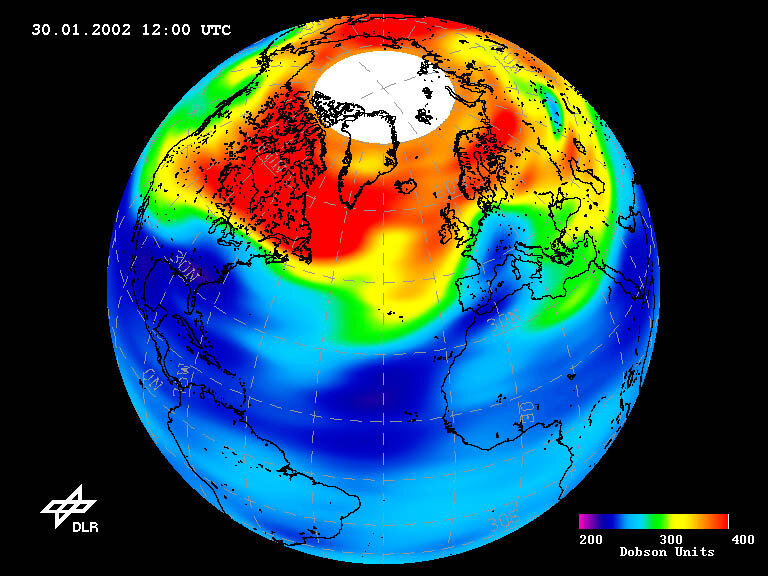
    Low-ozone event over Northern Hemisphere on 30 January 2002
    30 January 2002

    The immediate effect of the low-ozone event was to increase exposure to harmful ultraviolet rays from the sun by 20-30% under clear skies. However, this type of event is alarming for another reason. "The occurrence of mini ozone holes and streamers is highest over Europe," adds Erbertseder, "and the frequency is increasing due to changes in stratospheric meteorology. The continual decline in ozone levels due to chemical depletion and the increase in in frequency of mini ozone holes over Europe is resulting in an increase in harmful biologically active UV radiation."


    Low-ozone event over Northern Hemisphere on 29 January 2002
    29 January 2002

    GOME has revealed that mini-hole and low-ozone events have been increasing in frequency lately. Very low ozone total column densities over Europe of below 200 Dobson Units were measured on 30 November 1999 and on 8 November 2001. The most recent event was accompanied by unusually warm weather in Central Europe.

    The GOME data is provided shortly after acquisition by DLR/ESA and was further processed at the German Aerospace Centre's Cluster of Applied Remote Sensing, using a technique called Kalman filtering, which is particularly useful for revealing smaller-scale structures in time and space from satellite measurements.

    Rate this

    Views

    Share

    • Currently 0 out of 5 Stars.
    • 1
    • 2
    • 3
    • 4
    • 5
    Rating: 0/5 (0 votes cast)

    Thank you for rating!

    You have already rated this page, you can only rate it once!

    Your rating has been changed, thanks for rating!

    27
    Tweet
    • Related news
      • New mini ozone hole over Europe
        • Measuring the ozone hole with ERS/GOME
          • Thanks to ESA, KNMI offers a UV forecasting Service
            • Watching the Antarctic ozone hole
            • Related links
            • Observing the Earth
            • ERS homepage
            • GOME homepage
            • GOME at DLR
            • KNMI
            • University of Bremen
            • Videos
            • Measuring the ozone hole with ERS/GOME

    Connect with us

    • RSS
    • Youtube
    • Twitter
    • Flickr
    • G+
    • Facebook
    • Livestream
    • Subscribe
    • App Store
    • LATEST ARTICLES
    • · ESA astronaut Timothy Peake set fo…
    • · Space drives e-mobility
    • · Proba-V opens its eyes
    • · First new Galileo satellite arrive…
    • · Next destination: space
    • FAQ

    • Jobs at ESA

    • Site Map

    • Contacts

    • Terms and conditions
