International summer school on Envisat data assimilation
The First Envisat Data Assimilation Summer School has just been held at ESRIN, ESA's Space Research Institute just outside Rome. Sponsored by ESA and the World Climate Research Programme the two-week summer school was attended by 57 young scientists from 17 countries.
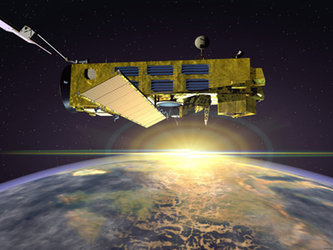
The idea for the summer school arose from discussions between ESA staff and Alan O’Neill of the Data Assimilation Research Centre, University of Reading, UK. Its aim is to help train a new generation of scientists in the broad range of skills needed to exploit the exciting new data now being received from satellites, particularly ESA’s Envisat, launched in February 2002.
The summer school was especially timely because it was held just after routine processing of Envisat data became fully operational. Of the 10 instruments on board Envisat, three – MIPAS, SCHIAMACHY and GOMOS – are now producing valuable information about the structure and evolution of the Earth’s atmosphere, including the distribution of temperature with height and latitude, and the distributions of important trace gases in the atmosphere such as ozone.
A priority of the school was to show how the powerful technique of data assimilation could be used to maximize the value of these new data products. Data assimilation is a key technique to synthesise the complementary information coming from these instruments and to produce a consistent accurate three-dimensional picture of the evolution of the atmosphere.
Such a picture is needed to understand how the complex meteorological and chemical processes in the atmosphere work and interact. This will enable more reliable computer models to be built to forecast how natural causes or the effects of human-induced pollution will change the atmosphere in the future.
All the lecturers at the summer school are leading experts in their fields, which include the design of satellite instruments, data analysis, atmospheric modelling and data assimilation. A key feature of the course was the reinformcement of the material presented during the morning lectures by practical, computer-based exercises in the afternoon.
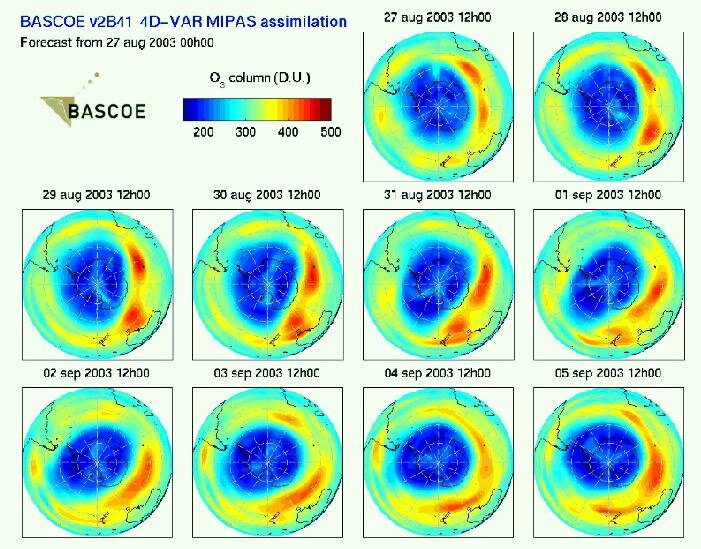
One practical involved analysing the current state of the ozone hole using data from instruments on board ESA’s ERS-2 and Envisat satellites. Students found that the ozone hole was already well developed in late August 2003, and that ozone forecasts made using data assimilation techniques predicted that further deepening of the ozone hole would occur.
Students agreed that the school was very beneficial, not least because it gave them the opportunity to learn from each other and to make valuable contacts with other researchers at a crucial stage of their careers.
Chao Fu, a Canadian PhD carrying out research at York University in Toronto said, “The quality of the teaching is excellent and the lecturers are all experts in their field. I have learnt much about how data assimilation works.”
Another participant, Corinne Vigouroux from the Belgian Institute for Space Aeronomy stated, “In my job I use ground-based measurements of greenhouse gas concentrations. Here at the summer school, I have been able to see the bigger picture, to see what other people are doing, what they need from my work, and how it can be useful to a wider community.”
Lecturers and students expressed the hope that the school will not be a ‘one-off’ but the first of many. Says Claus Zehner of ESA's Earth observation research and development section, “Envisat can supply us with a wealth of information that has not previously been available. Inviting young scientists to attend a summer school to teach them about the new data and how to use them is an important way to ensure further exploitation of this unique mission.”