• → European Space Agency

      • Space for Europe
      • Space News
      • Space in Images
      • Space in Videos
    • About Us

      • Welcome to ESA
      • DG's News and Views
      • For Member State Delegations
      • Business with ESA
      • ESA Exhibitions
      • ESA Publications
      • Careers at ESA
    • Our Activities

      • Space News
      • Observing the Earth
      • Human Spaceflight
      • Launchers
      • Navigation
      • Space Science
      • Space Engineering
      • Operations
      • Technology
      • Telecommunications & Integrated Applications
    • For Public

    • For Media

      • Media
      • ESA TV
      • Videos for professionals
      • Photos
    • For Educators

    • For Kids

    • ESA

    • SMOS

    • Earth Explorers

    • Observing the Earth

    • Living Planet

    • SMOS at a glance
    • An Earth Explorer
    • Mapping soil moisture and ocean salinity
    • Improving our understanding of the water cycle
    • Introducing a novel use of technology
    • Facts and figures
    • About the satellite

      • Platform
      • Instrument
    • About the launch

      • Launch site
      • Launcher
    • SMOS in orbit

      • After liftoff
      • Data
    • Meet the team

      • Achim Hahne, Project Manager
      • Susanne Mecklenburg, Mission Manager
      • Matthias Drusch, Mission Scientist
      • Jordi Font, Co-Lead Investigator
      • Yann Kerr, Co-Lead Investigator
      • Manuel Martin-Neira, Instrument Principal Engineer
      • Guillermo Buenadicha, Payload Operations Engineer
      • Andrés Borges, EADS CASA Espacio Payload Project Manager
      • Roger Jegou, Launch Campaign Manager
      • Norrie Wright, Payload Data Ground Segment Manager
    • Multimedia
    • Image gallery
    • Videos
    • Online resources

    ESA > Our Activities > Observing the Earth > SMOS

    In preparation for data from SMOS

    SMOS Workshop
    9 November 2007

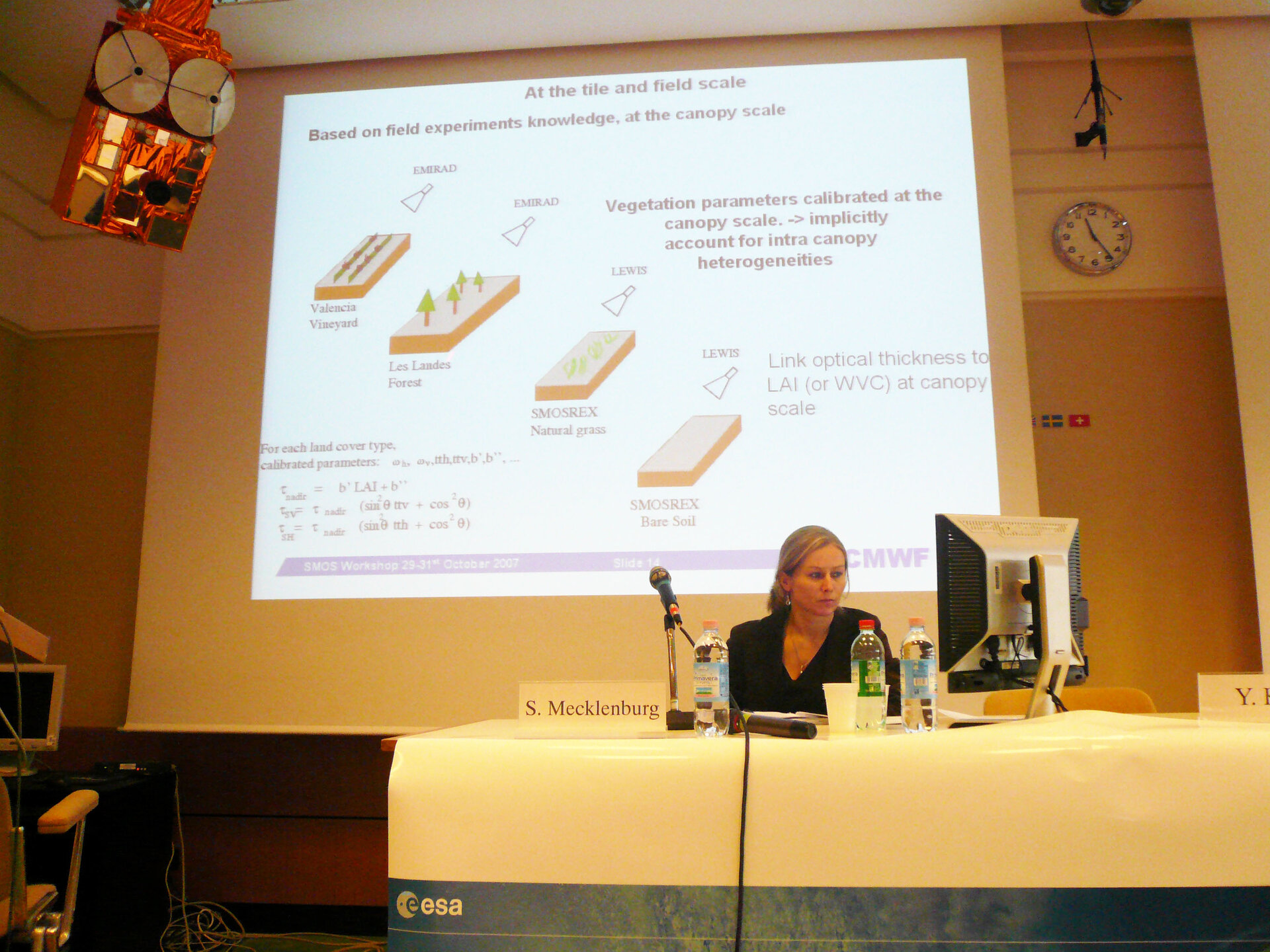
    Around 90 scientists from all over the world recently met at ESA's facilities in Frascati, Italy to discuss the preparations being made to receive data from ESA's water mission SMOS.

    Initially, data from the Soil Moisture and Ocean Salinity (SMOS) mission will be made available to selected 'Cal/Val Teams' of scientists. These scientists, selected through a dedicated Announcement of Opportunity released by ESA two years ago, will assist the Agency in assessing the quality of the eventual SMOS data products.

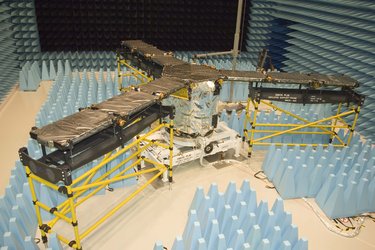
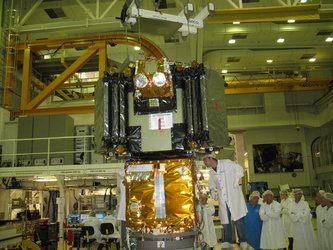
    SMOS is designed to measure moisture in the soil and salt in the oceans to improve our understanding of the Earth's water cycle and ocean circulation patterns. With launch scheduled for next year, the SMOS payload has recently undergone an intensive testing programme at ESA's test facilities in the Netherlands and is currently being integrated with the satellite platform in Cannes, France.


    SMOS payload meets Proteus

    In line with the diverse goals of the mission, the community of scientists interested in SMOS data also cover a wide range of disciplines. There are scientists interested in the novel instrument technology, its performance and in particular its long-term stability and how this can be measured by independent means. In addition, there are geologists, geographers and hydrologists preparing to compare SMOS measurements with their readings from soil moisture probes and river-catchment models. There is also the community of oceanographers trying to filter out the faint salinity signal from interfering variables like sea-surface temperature and ocean roughness. Finally, a new topic of interest is arising – that being how SMOS data will contribute to the measurement of ice fields on land and in the sea.

    During what was the 7th SMOS Workshop, the participants were informed of updates from ESA's SMOS project teams regarding the mission development status and general information about the level-1 and level-2 data processors. After which, the community discussed topics such as key validation sites, instrumentation and modelling, airborne campaigns and also exchanged information on common areas of interest. For instance, radiofrequency interference was discussed with the scientists from the US Aquarius and Hydros projects.

    TheESA’s Soil Moisture and Ocean Salinity (SMOS) satellite
    SMOS

    Everyone participating agreed that the three-day workshop had provided the forum for an invaluable exchange of information between ESA and the science community and all now look forward to the launch of SMOS and further calibration and validation activities.
    Rate this

    Views

    Share

    • Currently 0 out of 5 Stars.
    • 1
    • 2
    • 3
    • 4
    • 5
    Rating: 0/5 (0 votes cast)

    Thank you for rating!

    You have already rated this page, you can only rate it once!

    Your rating has been changed, thanks for rating!

    37
    Tweet
    • Related articles
      • SMOS instrument and platform unite
        • ESA's water mission instrument passes test programme
          • First images from airborne version of SMOS
            • Sixth SMOS Workshop – science community prepares for data
              • The link between moisture in the soil and salt in the oceans explained
                • Antarctic DOMEX experiment contributes to SMOS mission preparations
                • In depth
                  • SMOS
                    • Campaigns

    Connect with us

    • RSS
    • Youtube
    • Twitter
    • Flickr
    • G+
    • Facebook
    • Livestream
    • Subscribe
    • App Store
    • LATEST ARTICLES
    • · The fast winds of Venus are gettin…
    • · ExoMars 2016 set to complete const…
    • · Herschel ends operations as orbiti…
    • · Europe’s largest spaceship reache…
    • · ATV ready to nose up to Station
    • FAQ

    • Jobs at ESA

    • Site Map

    • Contacts

    • Terms and conditions