

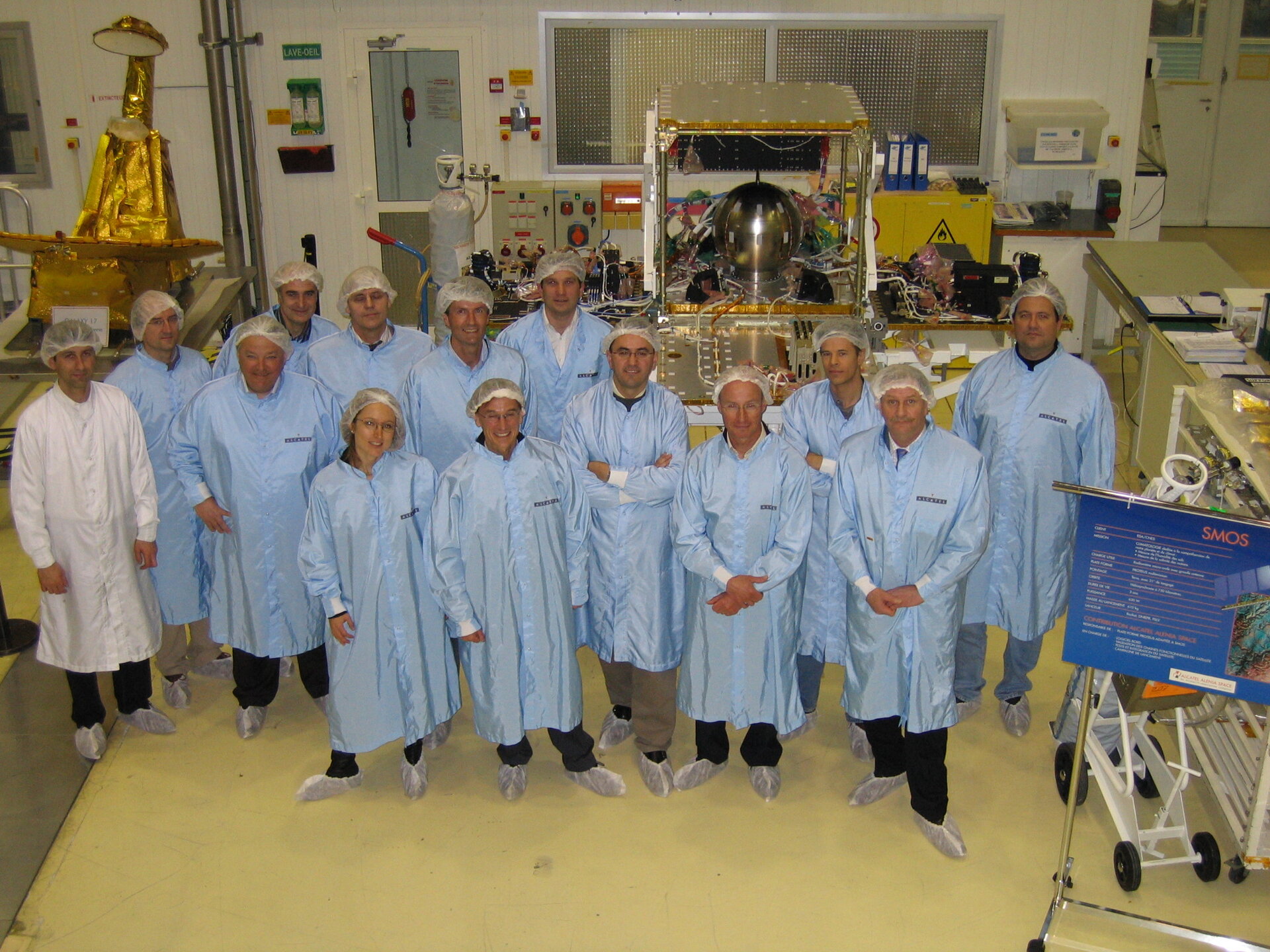
SMOS platform takes shape
With the launch of the SMOS satellite planned for next year, the platform on which the Microwave Interferometric Radiometer with Aperture Synthesis (MIRAS) payload will be carried has been undergoing an important period of preparation at the Alcatel Alenia Space facilities in Cannes, France.
The spacecraft bus called PROTEUS, which stands for Plateforme Reconfigu-rable pour l’Observation, les Télecommunications et les Usages Scientifiques, has now completed full mechanical integration. All that remains is to attach the special harness to interface with the SMOS payload and the final integration activities – this will be done towards the end of the year.
PROTEUS is a generic platform developed by the French space agency CNES (Centre National d'Etudes Spatiales) and Alcatel Alenia Space. Thanks to its well defined interfaces the PROTEUS spacecraft bus is easily tailored to specific mission requirements, such as type of orbit, pointing, mass and payload power consumption. Although the spacecraft bus is small, measuring just one cubic metre it acts as a service module accommodating all the subsystems that are required for the satellite to function.
First initiated in 1996, the platform has already been used to carry the JASON-1 mission, which was launched in 2001 and CALIPSO, launched just over a month ago. A Proteus platform will also carry the COROT mission, which is due to launch later this year. SMOS will therefore be the fourth mission to use the platform and the full mechanical integration recently completed marks another milestone in the development of the mission.
| PROTEUS technical details | |
|---|---|
| Mass | Platform: up to 300 kg, payloads up to 350 kg |
| Orbits | Any LEO from 20° to Sun synchronous orbit, 700 km to 1500 km |
| Launchers | Any small launcher (500 / 700 kg class) fairing diameter > 2 metres |
| Power | Up to 300 W platform + 350 W payload |
| Orbital capacity | Up to 120 m/s for a 500 kg spacecraft |
| Autonomy | 1 ground station, operated during working days only - 1 week autonomy in routine |
| Pointing | Any pointing |
| Pointing accuracy | 0.05° bias + 0.05° 3 per axis + 1 .E-3°/s low frequency stability |
| Payload interfaces | Dedicated MIL STD 1553 bus 160 kbps + dedicated Telemetry/Telecommand chains |
| Data storage | 500 Mbits Bus + 2 Gbits Payload, End of Life |
| Telemetry/Telecommand | S band, 800 kbps TM, 4 kbps TC, CCSDS standards |
| Orbitography | Use of an on board GPS receiver: no ground station angular measurements, nor ranging |
| Lifetime | 3 years. All elements subject to aging + radiations sized to 5 years |
The image at the top shows the mechanical structure of the platform behind the team of engineers who worked on the integration programme. Here the four lateral panels are open where four small reaction wheels for generating torque for attitude adjustment surround the hydrazine tank mounted in the centre of the base structure. The generic harness, which includes heaters for thermal control, has already been integrated.
On the right, three 2-axis gyroscopes are used to measure the change in the orientation of the spacecraft and thus provide the accurate attitude knowledge needed to fulfil stability and pointing requirements. On the same panel, there is telemetry and telecommand equipment.
On the top, the electrical on-board command and data handling architecture is centralised in a Data Handling Unit, which manages the satellite operational modes and interfaces with the payload central processor unit.


