• → European Space Agency

      • Space for Europe
      • Space News
      • Space in Images
      • Space in Videos
    • About Us

      • Welcome to ESA
      • DG's News and Views
      • For Member State Delegations
      • Business with ESA
      • ESA Exhibitions
      • ESA Publications
      • Careers at ESA
    • Our Activities

      • Space News
      • Observing the Earth
      • Human Spaceflight
      • Launchers
      • Navigation
      • Space Science
      • Space Engineering
      • Operations
      • Technology
      • Telecommunications & Integrated Applications
    • For Public

    • For Media

    • For Educators

    • For Kids

    • ESA

    • Space for our climate

    • Observing the Earth

    • About climate change
    • Space and Earth Monitoring

      • Land

        • Overview
        • Rivers & lakes
        • Volcanoes
        • Coastal zones
        • Wetlands & deserts
      • Oceans

        • Overview
        • Wind & waves
        • Ocean colour & algae blooms
        • Sea Surface Temperature
        • El Niño
      • Ice

        • Overview
        • Ice and climate
      • Atmosphere

        • Overview
        • Water vapour & clouds
        • Aerosols
        • Ozone hole
        • Climate change
      • Biosphere

        • Overview
        • Forests
        • Carbon cycle
    • International treaties implementation

      • Overview
      • Wetlands convention
      • Combat Desertification convention
      • Kyoto Protocol
    • About Observing the Earth

      • How does Earth Observation work?
      • How to get Earth observation data
      • Integrating Earth Observation in your job
    • EO programmes
    • The Living Planet
    • GMES
    • ESA's Climate Change Initiative (CCI)
    • Multimedia
    • Image Gallery
    • Video Gallery

    ESA > Our Activities > Observing the Earth > Space for our climate

    Satellites reveal Russian fires worst in 14 years

    13 September 2010

    More wildfires have burned around the Russian capital this year than in the last decade and a half, according to sensors aboard ESA’s observation satellites. The forest and peat bog fires ignited this summer amid an unprecedented heat wave of up to 40ºC.

    Working like thermometers in the sky, the Along Track Scanning Radiometer and the Advanced Along Track Scanning Radiometer on ESA’s ERS-2 and Envisat satellites measure thermal-infrared radiation to take the temperature of Earth’s land surface.

    Flames reach temperatures that are detected by these sensors and confirm the presence of fire.

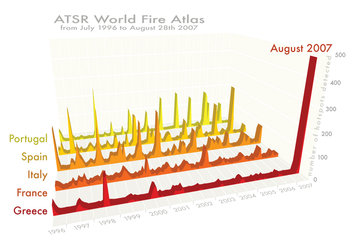
    Data gathered from fires across Russia from July 1996 to the present were used to plot the number of fires occurring monthly. The region near Moscow showed around six times the number of fires this August compared to previous years.
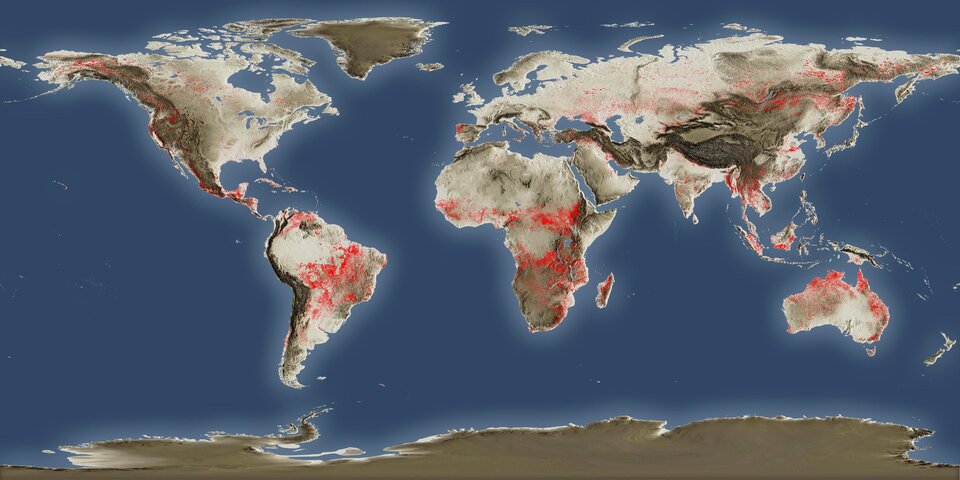
    World's hot spots
    Extent of fire damage seen in red

    Data from these sensors are compiled to create ESA’s ATSR World Fire Atlas which is available online to users within six hours. The atlas – the longest worldwide fire record available – also provides the time, date, longitude and latitude of the hot spots.

    The atlas is an important scientific resource because fires have a significant impact on global atmospheric pollution, with biomass burning contributing to the global budgets of greenhouse gases such as like carbon dioxide.

    The data are used for research in atmospheric chemistry, land-use change, global change ecology, meteorology and fire prevention and management.

    Rate this

    Views

    Share

    • Currently 0 out of 5 Stars.
    • 1
    • 2
    • 3
    • 4
    • 5
    Rating: 0/5 (0 votes cast)

    Thank you for rating!

    You have already rated this page, you can only rate it once!

    Your rating has been changed, thanks for rating!

    48
    Tweet
    • Related news
      • ESA satellite assesses damage of Norway’s largest fire
        • Greeks get space-based help in wake of deadly fires
          • Greece suffers more fires in 2007 than in last decade, satellites reveal
            • European hot spots and fires identified from space
              • Fires on Canary Islands force thousands to flee
              • Related Missions
                • Envisat overview
                  • ERS overview
                  • In depth
                  • ATSR World Fire Atlas
                  • Climate Change Initiative (CCI)
                  • Space for our climate

    Connect with us

    • RSS
    • Youtube
    • Twitter
    • Flickr
    • G+
    • Facebook
    • Livestream
    • Subscribe
    • App Store
    • LATEST ARTICLES
    • · Proba-V opens its eyes
    • · First new Galileo satellite arrive…
    • · Next destination: space
    • · Leak repaired on International Spa…
    • · After Chelyabinsk: European expert…
    • FAQ

    • Jobs at ESA

    • Site Map

    • Contacts

    • Terms and conditions