• → European Space Agency

      • Space for Europe
      • Space News
      • Space in Images
      • Space in Videos
    • About Us

      • Welcome to ESA
      • DG's News and Views
      • For Member State Delegations
      • Business with ESA
      • ESA Exhibitions
      • ESA Publications
      • Careers at ESA
    • Our Activities

      • Space News
      • Observing the Earth
      • Human Spaceflight
      • Launchers
      • Navigation
      • Space Science
      • Space Engineering
      • Operations
      • Technology
      • Telecommunications & Integrated Applications
    • For Public

    • For Media

      • Media
      • ESA TV
      • Videos for professionals
      • Photos
    • For Educators

    • For Kids

    • ESA

    • Observing the Earth

    • Living Planet

    • Meteorological missions

    • MetOp

    • MetOp at a glance
    • Overview
    • Why we need MetOp
    • Facts & figures
    • History
    • Satellite

      • About the satellite
      • Payload Module
      • Service Module
    • Instruments

      • Overview
      • Technical summary
    • Launch

      • Launch sequence
      • Launcher
    • Mission operations

      • Operations
      • Orbit
    • Resources

      • Publications
      • General links
      • Glossary
      • Acronym list
    • Multimedia
    • MetOp images
    • MetOp videos
    • MetOp animations
    • Help
    • Services
    • Subscribe

    ESA > Our Activities > Observing the Earth > The Living Planet Programme > Meteorological missions > MetOp

    Payload Module command, control and communication

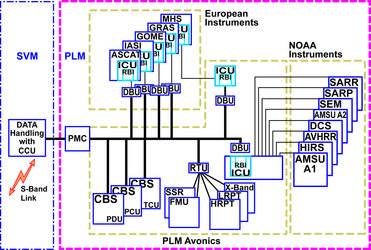
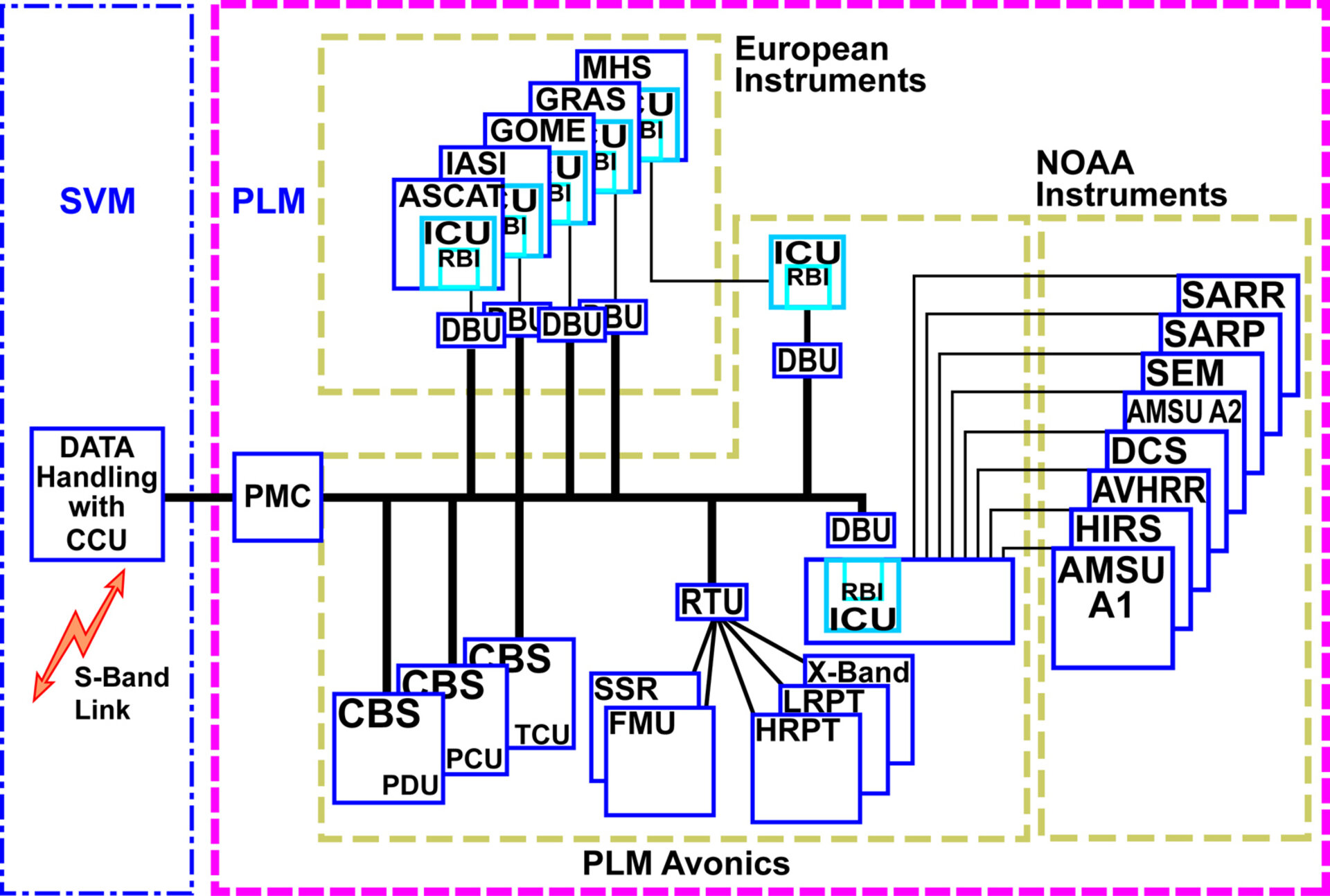
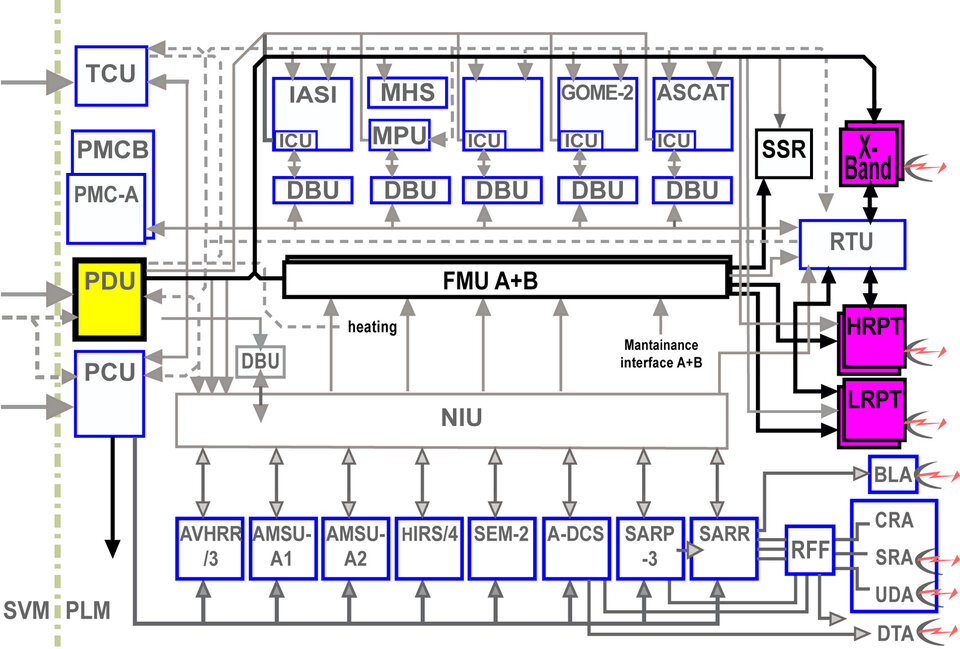
    Schematic drawing of command & control

    Payload Module command and control is performed through:

    - Payload Module Computer (PMC)
    - Standard Bus Couplers (CBSs)
    - Remote Terminal Unit (RTU)
    - Digital Bus Units (DBUs)
    - Standard Remote Bus Interface ASICs (RBIs)
    - Intelligent Control Units (ICUs)

    The PMC controls all PLM equipment and instruments via an ESA standard On Board Data Handling (OBDH) bus.

    PLM equipment is controlled via:

    • non-intelligent CBSs for power units
    • an RTU for control of the other PLM equipment
    • Intelligent Control Units (ICUs) for de-centralised instrument control

    To safeguard a common hardware interface to the OBDH bus, standard DBUs are used, and are equiped with standard Remote Bus Interface (RBI) chips inside the various ICUs.

    For the National Oceanic and Atmospheric Administration (NOAA) instruments a dedicated NOAA Interface Unit (NIU) and for the Microwave Humidity Sounder (MHS) a MHS Protocol Unit (MPU) have been introduced to adapt the dedicated instrument interfaces to the OBDH standard and to provide the ICU functionality. These units also adapt the respective instruments measurement data interface to the ESA standard and are therefore also part of the measurement data chain.
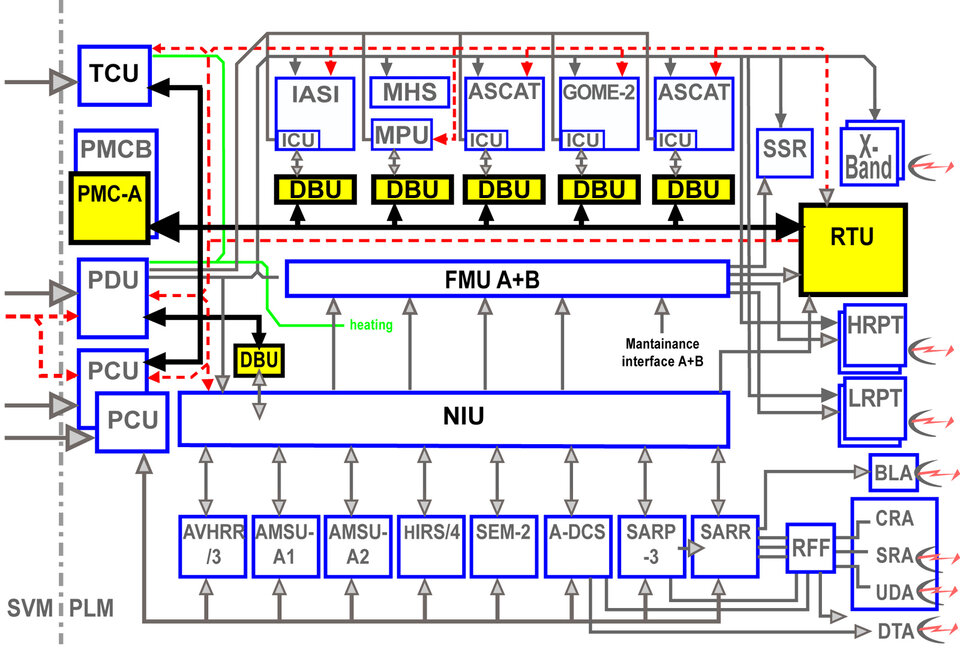
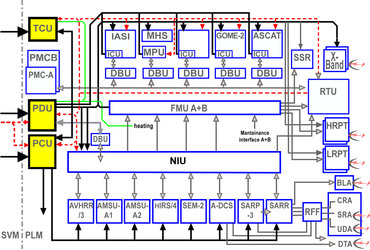
    Overview of the command and control elements of the PLM.


    Payload Module ground communication: Measurement data transmission to ground

    Three independent Radio Frequency (RF) links transmit measurement data to the ground:

    • X-band Global Data, 70 Mbps at 7.8 GHz
    • L-band HRPT, 3.5 Mbps at 1.7 GHz
    • VHF band LRPT, 72 Kbps at 137 MHz

    X-band is used to dump global data once per orbit to a northern ground station. The system supports scenarios with only one station like Svalbard (N) as well as a two station scenario with an European station like Kiruna (S) in combination with an American station like Fairbanks (Alaska).
    Schematic drawing of independent RF links

    To support local users with local measurement data in a similar way to the TIROS satellites, MetOp is equipped with a Low (LRPT) and a (HRPT) High Resolution Picture Transmission link. Both data streams provide real-time data only, i.e. only measurement data from the area the satellite is scanning during fly-over can be acquired. HRPT contains the complete instrument data, LRPT provides HIRS/4,AMSU A1/A2, MHS, SEM and data from only three compressed channels of the Advanced Very High Resolution Radiometer (AVHRR) instrument.
    Last update: 21 June 2006

    Rate this

    Views

    Share

    • Currently 0 out of 5 Stars.
    • 1
    • 2
    • 3
    • 4
    • 5
    Rating: 0/5 (0 votes cast)

    Thank you for rating!

    You have already rated this page, you can only rate it once!

    Your rating has been changed, thanks for rating!

    35
    Tweet
    • In depth
      • Payload Module
        • Structural support
          • Thermal control
            • Measurement data acquisition, handling, storage
              • Electrical power
                • Command and control

    Connect with us

    • RSS
    • Youtube
    • Twitter
    • Flickr
    • G+
    • Facebook
    • Livestream
    • Subscribe
    • App Store
    • LATEST ARTICLES
    • · Rare merger reveals secrets of gal…
    • · Watching for hazards: ESA opens as…
    • · ESA astronaut Timothy Peake set fo…
    • · Space drives e-mobility
    • · Proba-V opens its eyes
    • FAQ

    • Jobs at ESA

    • Site Map

    • Contacts

    • Terms and conditions