Measuring atmospheric temperature and humidity with GRAS
In the third of a series of short articles looking at the new European instruments carried on MetOp, we take a look at GRAS – the Global Navigation Satellite System Receiver for Atmospheric Sounding, which will provide unprecedented observations of atmospheric temperature and humidity to improve weather forecasting and climate change monitoring.
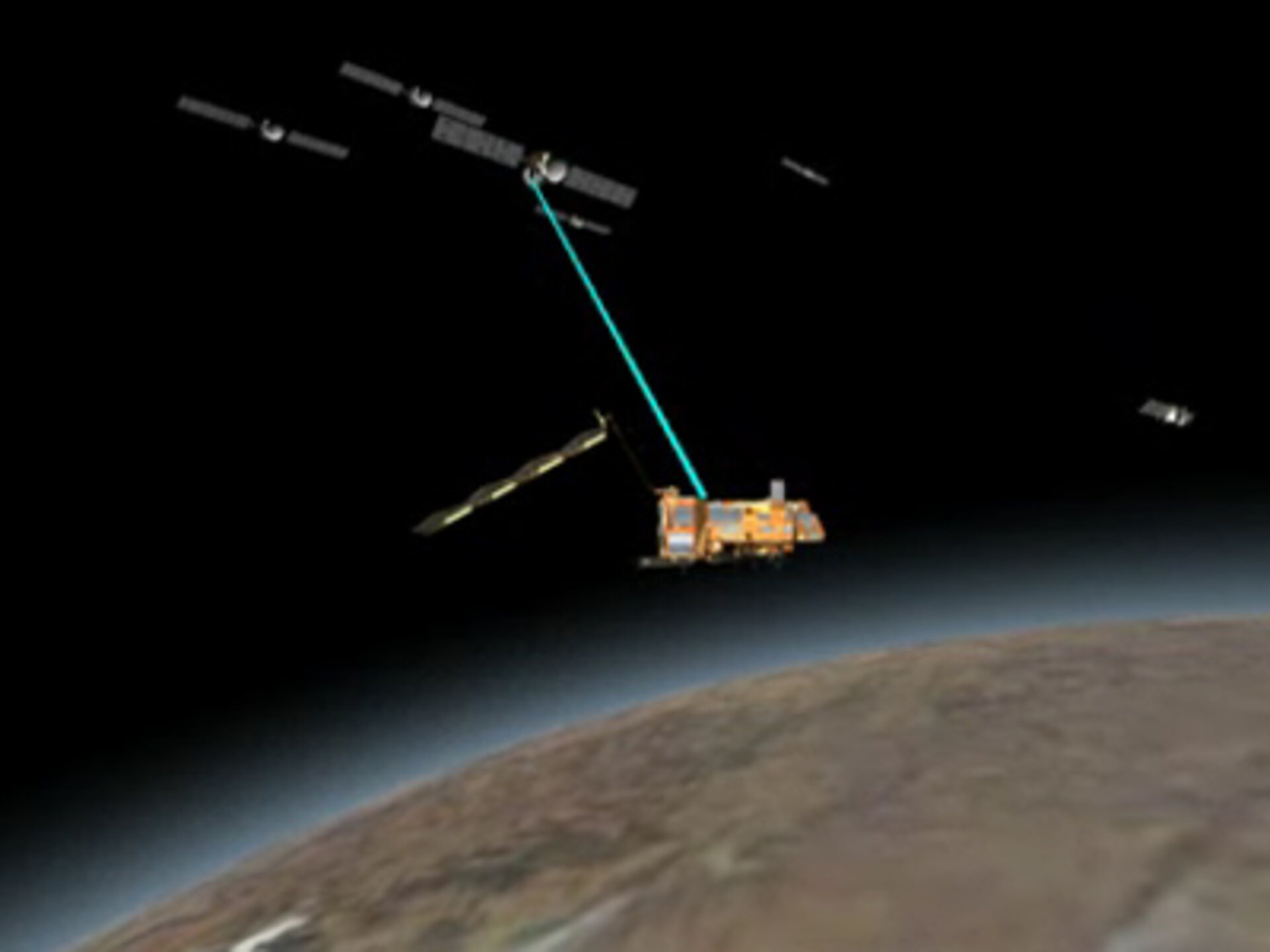
Developed on the basis of earlier ESA studies, GRAS uses radio occultation to measure vertical profiles of temperature and humidity by tracking signals received from a constellation of GPS navigation satellites while they are setting or rising behind the Earth's atmosphere, as shown in the animation above. The yellow line between the MetOp satellite and a GPS navigation satellite shows an occultation. The straight blue lines tracking the other GPS satellites are not occulted.

Radio occultation remote sensing is based on the fact that when radio waves pass through the atmosphere, either during a rising or setting event as seen by the receiver, they are refracted along the atmospheric path. The degree of refraction depends on gradients of air density, which in turn depends on temperature and water vapour present. Therefore, measurement of the refracted angle contains information about these atmospheric variables.
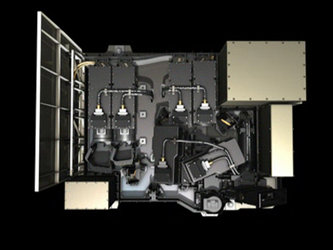
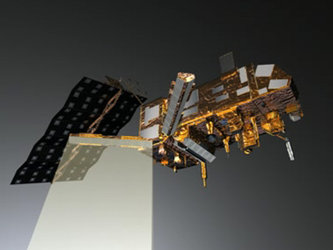
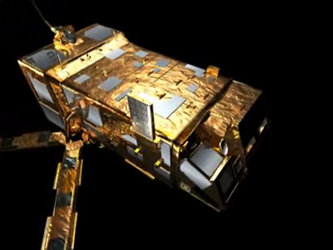
The GRAS instrument is made up of three antennae and one receiver positioned separately on the satellite. Two of the antennae are sited to look tangentially through the Earth's atmosphere while a smaller antenna is used to determine the precise position of MetOp by continuously tracking other GPS satellites. A single receiver processes the signals coming from the three antennae.
By processing the navigation signals received by GRAS, around 500 highly accurate profiles of atmospheric temperature, humidity and pressure can be derived every day. GRAS observations are high vertical resolution and high accuracy combined with global coverage. This, together with the fact that the signals are transparent to clouds and rain, allow, in particular, sampling over the oceans, which are currently poorly observed.
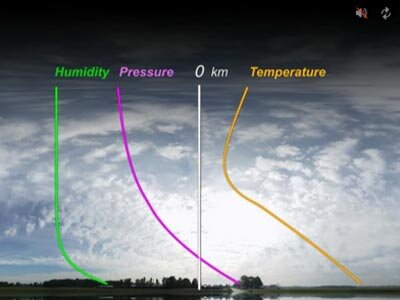
Assimilation of GRAS observations into Numerical Weather Prediction models is the most important operational application objective for data produced by this instrument. Another key aspect of the GRAS products is their use for climate monitoring thanks to their very high accuracy and auto-calibration principle.
GRAS is highly complementary to other instruments on board MetOp, in particular the IASI (Infrared Atmospheric Sounding Interferometer), the MHS (Microwave and Humidity Sounder) and the AMSU-A (Advanced Microwave Sounding Units).
MetOp's European instruments:
ASCAT (Advanced Scatterometer) to measure wind speed and direction over the ocean.
GOME-2 (Global Ozone Monitoring Experiment-2) to measure concentrations of atmospheric ozone and other gases.
GRAS (Global Navigation Satellite System Receiver for Atmospheric Sounding) to measure atmospheric temperature and humidity.
IASI (Infrared Atmospheric Sounding Interferometer) to measure atmospheric temperature and moisture, and trace gases such as carbon monoxide, nitrogen oxides, methane, ozone.
MHS (Microwave Humidity Sounder) to measure atmospheric humidity and temperature.