GRAS performance
| Measured temperature accuracy | 1K |
|---|---|
| Number of occultation channels (set + rise) | 4 |
| Number of navigation channels | 8 |
| Number of occultations per day | 500 |
| Horizontal resolution | 100 to 300 km |
|
Vertical resolution Fresnel zone (stratosphere, troposphere) |
300 to 1500 m |
| High Vertical resolution (troposphere) | 100 m |
| Navigation solution accuracy | 100 m |
| USO frequency stability | 1 x 10-12 |
| Bending angle budget @ 30 km | 0.42 mrad |
| Mass | 26 kg |
|---|---|
| Power | 37 W |
| Data rate (mean, max) |
27 kb/s 60 kb/s |
| Occultation antennas | |
| Gain | 9 to 10 dBi |
| Elevation angle | -25.5 to -28.3° |
| Azimuth angle | ± 55° |
| Navigation antenna | |
| Gain | -4 to +7 dBi |
| Elevation angle | 15 to 90° |
| Azimutz angle | 360° |
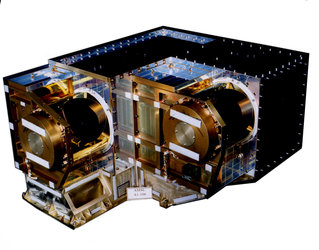
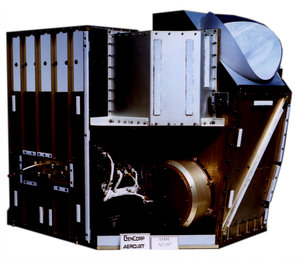
keep text in case it is needed later on. The mass budget for the whole GRAS instrument is around 30 kg, including the harness and deployment mechanism for the anti-velocity antenna. The power consumption in full operation (navigation and occultation signals) is 38 W. The average GRAS data rate is 22 kbit/s, with peaks of up to 60 kbit/s.
The meteorological community calls for a 1° Kelvin accuracy in the temperature profiles provided by the instrument. This requirement is met in the stratosphere using the Geometrical Optics method. For the troposphere, where the temperature gradient is higher, a more advanced technique such as Back Propagation method will be used.
The best performance will be obtained between 5 km and 30 km altitude.
The horizontal resolution is of the order of 100 km to 300 km; inherent to the limb-sounding technique. A key element to reach these performances is the high value of the occultation antennas gain (10dB).