GOME-2 spectrometer
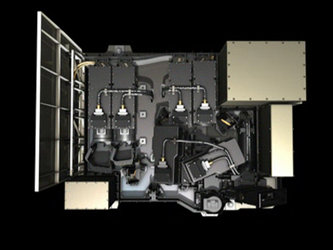
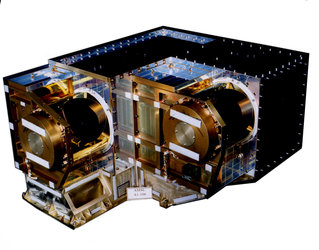
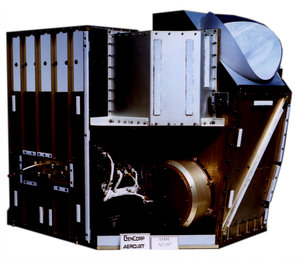
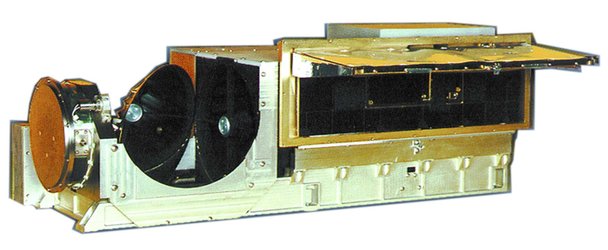
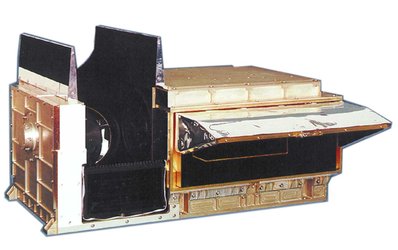
Underneath the thermal insulation cover there is a complex set of telescopes and prisms through which incoming light is initially separated into four main bandwidths. Different gases in the atmosphere absorb different wavelengths of light. The GOME-2 spectrometer is used to split the light into different wavelengths to reveal absorption lines, which correspond to certain gases present the observed sample. GOME-2 covers the 240-790 nm wavelength regions, i.e. wavelengths covering ultraviolet and visible light.
A Scan Mirror directs the light emitted from the Sun-illuminated atmosphere into a telescope. The telescope is designed to match the two directions of the field of view (0.286° across-track and 2.75° along-track) to the two directions of the entrance slit of 0.2 x 9.6 mm2. In addition, the Scan Mirror can point to two internal calibration light sources and the Sun diffuser.
| 1 - Disperser | 14 - 401 – 600 nm |
|---|---|
| 2 - Calibration slit | 15 - 240 – 315 nm |
| 3 - Detector | 16 - 311 - 403 nm |
| 4 - Double Brewster Prism | 17 - Electronics box |
| 5 - Telescope mirror | 18 - Channel # 1 |
| 6 - Predisperser Prism | 19 - Channel # 2 |
| 7 - Channel seperator | 20 - Grating # 1 |
| 8 - Grating # 3 | 21 - Grating # 2 |
| 9 - Grating # 4 | 22 - Calibration lamp |
| 10 - Beam splitter | 23 - Calibration Unit (CU) |
| 11 - Channel # 3 | 24 - Sun diffuser |
| 12 - Channel # 4 | 25 - Telescope mirrors |
| 13 - 590 -790 nm | 26 - Scan mirror |
Behind the entrance slit, the light is collimated by an off-axis parabolic mirror (f = 200 mm) onto the double Brewster / pre-disperser prism configuration. These prisms generate the s- and p-polarised light beams which are directed onto dispersers and through to detectors. This additional spectrometer is part of the Polarisation Unit (PU).
Light passing through the pre-disperser prism is also directed into the main spectrometer. A second off-axis parabolic mirror (f = 25 mm) focuses the dispersed beam onto the channel separator prism. The pair of parabolas forms a relay system with a magnification of 0.625. The band separator is a quartz prism, the first surface of which is partially coated with a reflective coating (for channel 2) and a transmission coating (for channel 1). The light for channels 3 and 4 passes the prism edge, and a dichroic filter separates it into the two channels. To avoid the slow but steady outgassing of this coating, experienced with GOME-1, it was manufactured using plasma ion-assisted deposition technique to provide high-temperature stability.
All refractive optics are made of quartz (Suprasil 1) and are multilayer-coated for maximum efficiency and low stray-light. The off-axis parabolas are made of aluminum, nickel-coated and machined with a single-point diamond turning technique. Polishing then achieves a surface quality compliant with the low-stray-light application in the ultraviolet.
The four holographic gratings (7, 8, 19, 20) have demanding requirements in terms of stray-light reduction and diffraction efficiency, and so only master gratings can be used. The stray-light performance of the UV channel requires that the grating blanks have a micro-roughness of better than 0.5 nm root mean squared. The groove density is determined by the angles of incidence, which are adjusted to the required densities of 3600 l/mm (channel 1), 2400 l/mm (channel 2) and 1200 l/mm (channels 3 & 4). Particular care is taken to avoid and shield against false light generated with the recording set-up. The symmetrical photoresist groove profile is transformed to a sawtooth-like shape by ion-beam etching. Due to the high spectrometer angles of 45 to 50°, the efficiency very much depends on the shape of the groove profile. The polarisation sensitivity of the GOME-2 gratings is considerably lower than for GOME-1. The dispersed light is focused by a four-lens objective onto a silicon linear detector array in the Focal-Plane Assembly.