• → European Space Agency

      • Space for Europe
      • Space News
      • Space in Images
      • Space in Videos
    • About Us

      • Welcome to ESA
      • DG's News and Views
      • For Member State Delegations
      • Business with ESA
      • ESA Exhibitions
      • ESA Publications
      • Careers at ESA
    • Our Activities

      • Space News
      • Observing the Earth
      • Human Spaceflight
      • Launchers
      • Navigation
      • Space Science
      • Space Engineering
      • Operations
      • Technology
      • Telecommunications & Integrated Applications
    • For Public

    • For Media

    • For Educators

    • For Kids

    • ESA

    • Observing the Earth

    • Understanding Our Planet

    • Securing Our Environment

    • Benefiting Our Economy

    • About Observing the Earth

      • How does Earth Observation work?
      • How to get Earth observation data
      • Integrating Earth Observation in your job
      • Earth Observation users speak
    • EO programmes
    • The Living Planet
    • GMES
    • ESA's Earth Observing missions
    • Envisat overview
    • ERS overview
    • Earth Explorers overview
    • Sentinels overview
    • MSG overview
    • MetOp overview
    • Proba-1 overview
    • Third Party Missions overview
    • Opportunities with us

      • Education & training
      • International cooperation
      • Milestones & announcements
    • Multimedia

      • Image Gallery
      • Video Gallery
      • Online resources
      • RSS feeds
    • Services
    • Subscribe

    ESA > Our Activities > Observing the Earth

    Watching the Antarctic ozone hole

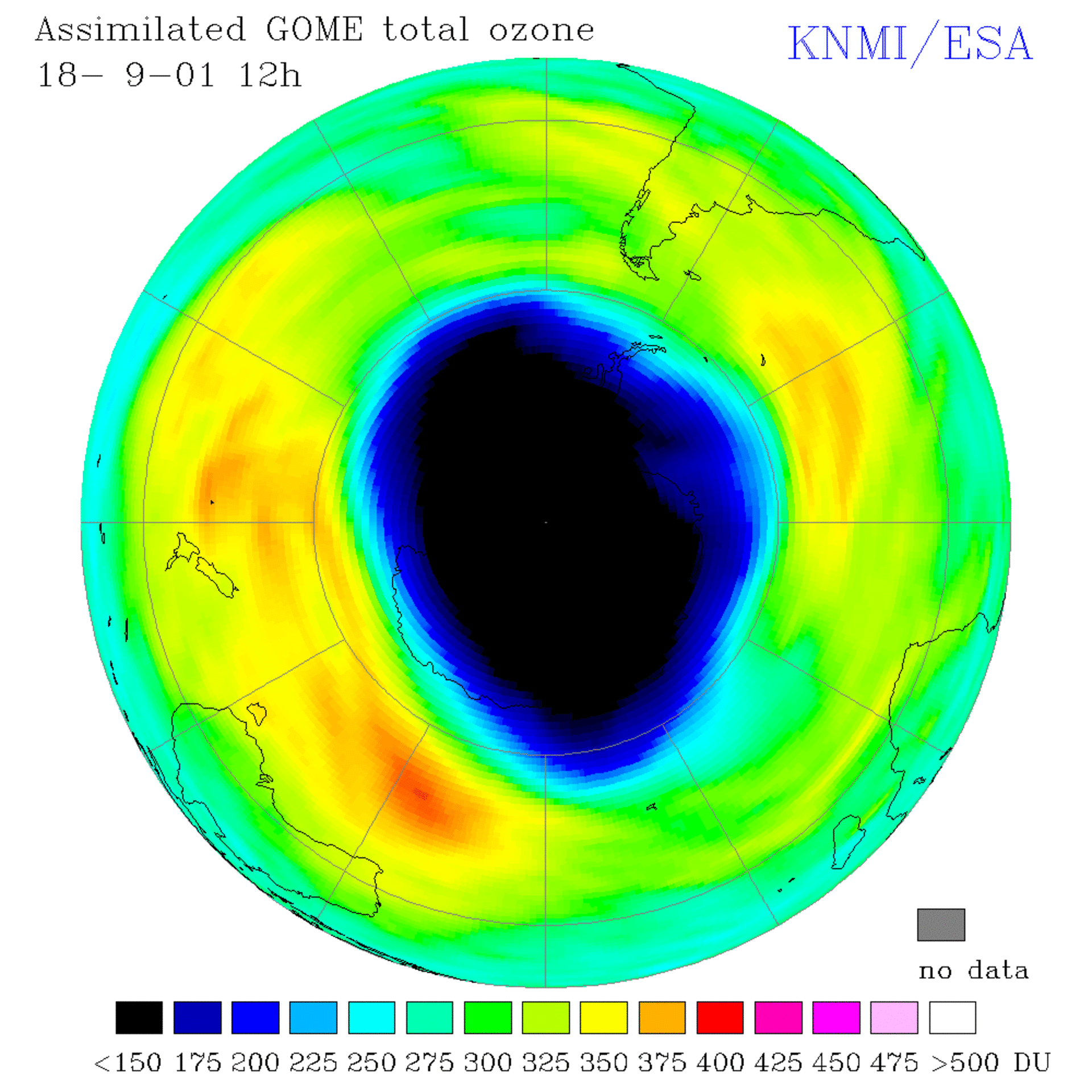
    Ozone hole over the south pole 18 September 2001
    18 September 2001

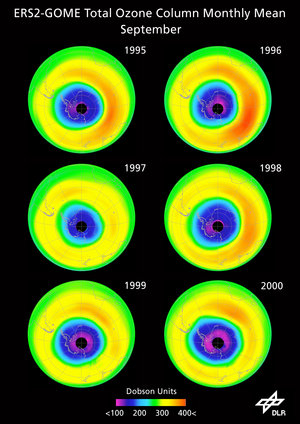
    Scientists at the Royal Netherlands Meteorological Institute (KNMI) are tracking a developing ozone hole over the Antarctic using data from the GOME instrument aboard ESA's ERS-2 satellite.

    Their maps and atmospheric profiles show that the hole appeared and began to grow in mid-August, and has now spread to cover an area of about 25 million km², with nearly 25 million tonnes of ozone lost. This extraordinary view of the emerging phenomenon in the Antarctic atmosphere is a product of a unique service developed by KNMI and ESA scientists, which harnesses satellite monitoring to high-speed computing to deliver global ozone maps processed in only a few hours.

    Ozone helps to shield the Earth's surface from the harmful ultraviolet light rays of the sun. It is destroyed by chemical reactions with chemicals in the atmosphere - the halogen gases chlorine and bromine, and man-made CFCs. In the months of Antarctic winter, a giant swirl of circulating wind develops around the South Pole, trapping a mass of air at its heart - the eye of the storm - over Antarctica. As this still 'island' of air chills, clouds form releasing halogens. When the sun's warmth returns in Spring, its energy 'activates' these halogen atoms, which then voraciously react with the ozone, destroying it, and opening the so-called hole. In fact, the 'hole' is a thinning of the ozone layer, rather than its complete destruction.
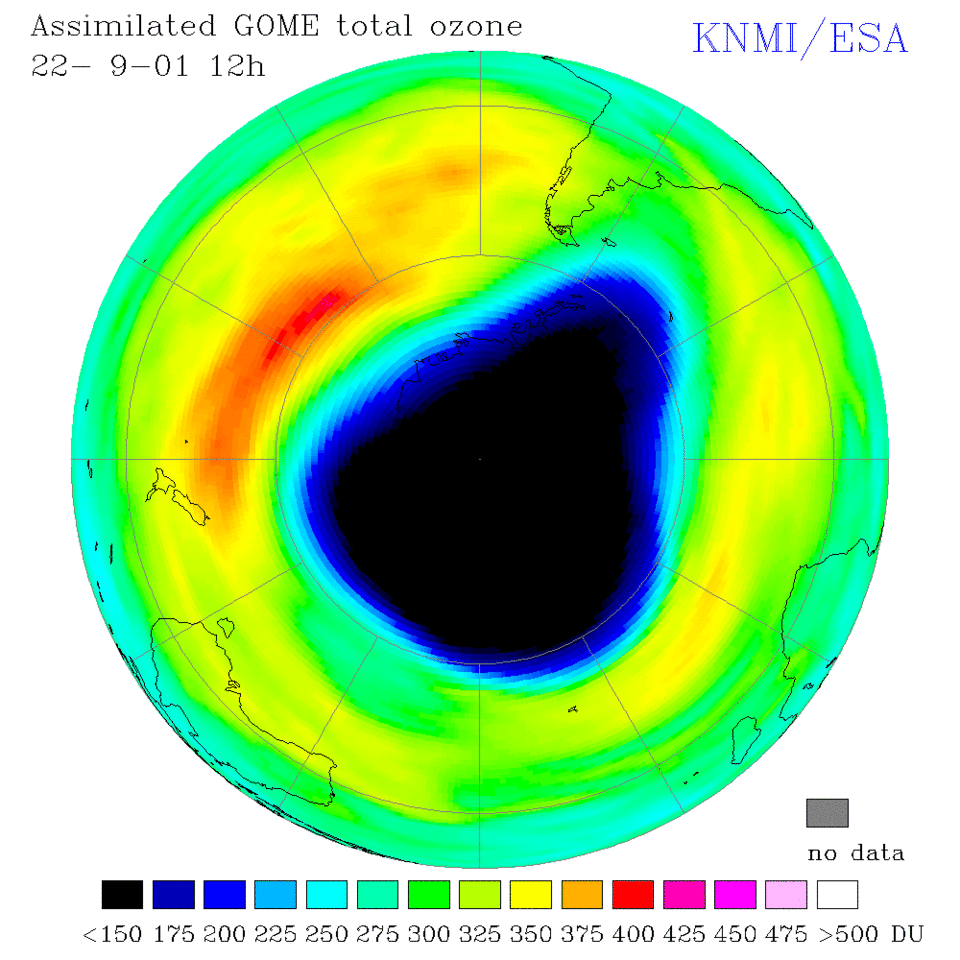

    Predicted ozone hole for 22 September 2001
    Predicted ozone hole for 22 September 2001

    The development of the ozone hole over the Antarctic was first spotted in the early 1980s, when its depth and extent grew rapidly, but looking back through earlier data suggests that it first appeared in 1976. The unusual atmospheric conditions over Antarctica amplify the effect of the mechanism which causes ozone depletion, so the Antarctic hole is really an early warning signal of what could happen world wide if levels of halogens and CFCs in our atmosphere continue to climb unchecked.

    Monitoring the Antarctic ozone hole was only one of the reasons for developing the rapid delivery service. "The main reason for making this service available is to enable the creation of improved weather forecasts," says Ronald van der A, a senior project scientist at KNMI. "Ozone moves with the wind in the high atmosphere - we call it a stratospheric tracer. Because we can generate these three-dimensional profiles quickly, we can create moving maps from a series of snapshots, and so start to model the behaviour of the stratosphere much more accurately. We can also see events developing quickly, so if we spot a hole appearing, we can alert local scientists who can then monitor the event hour by hour using equipment carried aboard specially-launched balloons, called sondes."

    Scientists emerging from their winter isolation at Antarctic bases to launch sondes will monitor the growth of the hole alongside their colleagues at KNMI who are using the GOME fast delivery service. The next few weeks will tell whether the 2001 hole overtakes previous years in extent or depth.
    Rate this

    Views

    Share

    • Currently 0 out of 5 Stars.
    • 1
    • 2
    • 3
    • 4
    • 5
    Rating: 0/5 (0 votes cast)

    Thank you for rating!

    You have already rated this page, you can only rate it once!

    Your rating has been changed, thanks for rating!

    26
    Tweet
    • Related news
      • Thanks to ESA, KNMI offers a UV forecasting Service
        • Measuring the ozone hole with ERS/GOME
          • Satellite sniffs out chemical traces of atmospheric pollution
            • New European capabilities for monitoring the ozone hole presented in Gothenburg, 16-20 October
            • Related links
            • KNMI
            • GOME monitoring of depth and size of Antarctic ozone hole
            • Ozone profiles on-line
            • GOME homepage
            • GOME at DLR
            • ERS homepage
            • Earthnet
            • Videos
            • Click to start video    
              Envisat's GOMOS Ozone measurements
            • Click to start video    
              Envisat's GOMOS Ozone measurements
            • Click to start video    
              ERS Ozone Measurements 2001
            • Click to start video    
              ERS Ozone measurements 2001

    Connect with us

    • RSS
    • Youtube
    • Twitter
    • Flickr
    • G+
    • Facebook
    • Livestream
    • Subscribe
    • App Store
    • LATEST ARTICLES
    • · ESA astronaut Timothy Peake set fo…
    • · Space drives e-mobility
    • · Proba-V opens its eyes
    • · First new Galileo satellite arrive…
    • · Next destination: space
    • FAQ

    • Jobs at ESA

    • Site Map

    • Contacts

    • Terms and conditions