Fractal Resampling
Enhancing Observability on Ground for the same or even less bandwidth
On-board observability depends on the sampling rate used to perform on-board measurements. The fractal resampling technique allows high sampling on board while sending very little data that can account for the most interesting information. This separation between data and information allows gaining on-board observability while reducing bandwidth requirements. The fractal resampling technique is currently used to enable data plotting for online applications.
Keywords: compression, observability
Results
Fractal resampling has been prototyped to demonstrate its feasibility. At the moment it is being used as a lossy compression technique to enable web plotting clients.
Technology
The Fractal Resampling technology takes inspiration from the way 3D fractal terrain is generated in video games. We reverse the process starting with a given time series (e.g. in fractal terrain terms, the time series is the “mountain”). The ESA Patent Group has decided to protect this Fractal Resampling technique by filing a patent application in the European Patent Office.
Development Team
Fractal Resampling has been developed by our group.
Description
It is a common error to equate data with information. This misconception results on the belief that a lot of data is needed to have a lot of information. We make a clear distinction between data and information that allows to retain almost all information with much less data. We define both concepts in the housekeeping telemetry context:
- Data: measurements performed by sensors or instruments, usually at a periodic sampling rate.
- Information: subset of data needed to gain knowledge or make decisions.
For many practical spacecraft operations scenarios the noise associated with a given measurement does not bring extra knowledge and will not change any decision; therefore the noise could be removed safely without information loss.
The Fractal Resampling reduces the amount of data while keeping almost the same information. It works by removing the points that do not provide additional information but contribute to the amount of data that needs to be transferred. As input, Fractal Resampling requires the maximum allowed error. For instance, in the figure below, the maximum allowed error is 0.42 degrees Celsius. This means that when connecting the remaining points (after resampling) with straight lines, the error at any of the missing points is guaranteed to be less than or equal to 0.42 degrees Celsius.
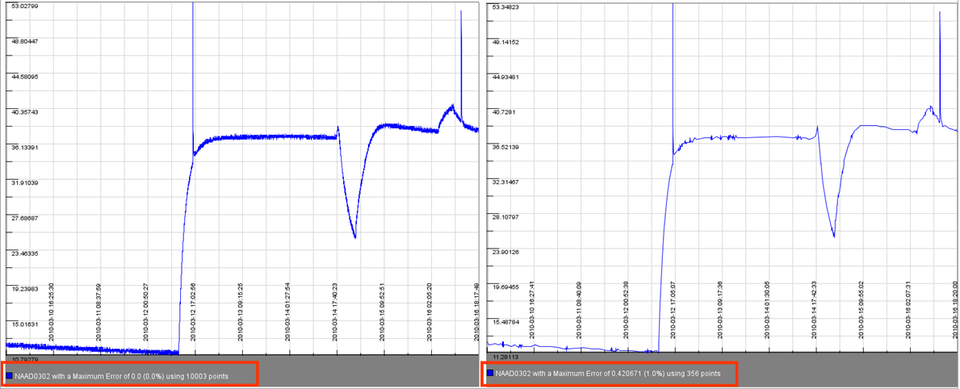
The Fractal Resampling technique is inspired by the method that some simulators and video games use to randomly generate terrain, in either 3D or 2D planes. A silhouette of a mountain in a 2D plane looks similar to a time-series.
Although DrMUST has been designed with the goal of supporting anomaly investigation; it can also be used to perform system or subsystem characterization. This process helps engineers in identifying potential areas of concern when operating the spacecraft in different modes.
The applications of the Fractal Resampling technique are the following:
- Better Observability: currently, housekeeping telemetry come in packets sampled at regular intervals. In order to capture short-lived events, sometimes a parameter or packet needs to be sampled and down-linked at very high frequency even if most of the samples would not be relevant. However, this high sampling rate is limited by the available bandwidth. The fractal-inspired resampling allows better observability with much less samples. This translates to having higher-fidelity information on ground. The benefits are twofold: better observability and reduced bandwidth requirements.
- Lossy Compression: Finding the optimal sampling of a time series guaranteeing a maximum error often results in an important reduction in the number of samples. In this sense, the Fractal Resampling can be seen as a lossy compression technique. The advantage as compared with other lossy compression techniques is that for any point in the time-series, the maximum error can be guaranteed.
- Others: noise removal, storage reduction.