Proba-2 shows solar eruption that touched Earth
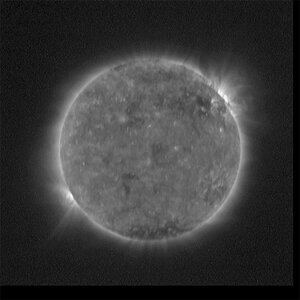
Polar skies glowed with ghostly auroras last week during the biggest geomagnetic storm of 2010. The event owed its origin to a solar eruption a few days earlier – revealed here in high-speed detail by ESA’s small Sun-watcher Proba-2.
Eruptions like this one have several components, most notably solar flares and Coronal Mass Ejections (CMEs). Solar flares are caused by sudden impulsive releases of magnetic energy from the surface of the Sun.
The flare seen here took place at 11:54 CET on Saturday 3 April. It was officially classed as ‘weak’, though still involved temperatures of tens of millions of degrees and around the same energy the human race consumes on Earth per year.

Significantly, this eruption was lined up with Earth, sending a vast number of charged particles hurtling towards us. Travelling at around 500 km per second, the front of this CME reached Earth the following Monday, 5 April.
The resulting geomagnetic storm was the most powerful in more than three years. It provoked dazzling auroras but no damage was reported to potentially susceptible systems such as satellites and GPS, communications and electrical power infrastructure.
Solar flares are rarely visible in ordinary light, but are often spectacular at extreme ultraviolet wavelengths. The ESA-NASA SOHO mission has been a solar flare ‘watchdog’ producing remarkable images for approaching 15 years, but last year a new ‘pup’ made it to Earth orbit: ESA’s small satellite Proba-2.
Measuring only a cubic metre, the satellite is crammed with technology demonstrations but also carries science payloads: its SWAP (Sun Watcher using APS detectors and imaging processing) instrument is only the size of a large shoebox, but gathers images much more frequently than SOHO’s equivalent sensor.

“SWAP acquired an image every 100 seconds during the flare while SOHO manages one around every 15 minutes,” said David Berghmans of the Royal Observatory of Belgium (ROB), overseeing SWAP operations. “This means we have about 40 images compared to five to six for SOHO, allowing us to see clearly the full range of phenomena associated with such an event.”

Most notably, during the onset of the flare itself, a faint puff of material can be seen erupting in a downward direction from it – this is the CME beginning its journey Earthward. It is followed by a spreading ‘EIT wave’ as the area around the flare goes dark then, finally, glowing loops of cooling plasma as the Sun’s magnetic field knits itself back together again.
As well as SWAP, Proba-2 also carries a second Sun-monitoring payload run contributed by ROB: LYRA (Large Yield Radiometer) is a solar radiometer measuring solar radiance at key ultraviolet wavelengths. SWAP and LYRA observed the flare simultaneously, the latter instrument recording a dramatic four-fold radiation peak.
"LYRA adds an extra dimension to solar monitoring," said Jean-François Hochedez of ROB, LYRA Principal Investigator. "It records at high frequency the extreme ultraviolet brightness radiated by the relatively 'cool' solar corona, seen by the SWAP imager, but also phenomena occurring at lower temperatures in the dense chromosphere just above the surface. In addition it examines the rapid variability of the very hot corona - its two metallic filter channels sample extreme ultraviolet pass bands but also the soft X-ray range where the ten million degree corona expresses itself."