Following a technology investigation and feasibility analysis, specific projects are being selected to validate enabling technologies to support innovative operations concepts. Operational validation is usually performed across more than one mission and for several months. The output of a project includes documentation, architecture, software and operational assessment. In specific cases it can be a stand-alone product.
ESA > Our Activities > Operations
MUST
Mission Utility & Support Tools
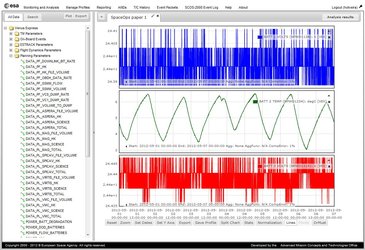
MUST is a system that provides high-performance access to telemetry, telecommand history, events and ancillary mission data. A suite of MUST client applications allows fast data analysis, exportation, enhanced visualisation, alarming through SMS and r...
WebMUST
A web-based client for MUST
The need for accessing spacecraft mission data from outside operations centres and sharing it with different teams and organizations has risen in recent years. Traditionally, clients for monitoring and analysis of spacecraft data are mostly based on r...
APSI
Advanced Planning & Scheduling Initiative
APSI was a research project funded by ESA under the lead of the Advanced Mission Concepts and Technologies Office. The goal of APSI is twofold. On one hand, it aims to create a software framework to improve the cost-effectiveness and flexibility of th...
DrMUST
Automating the first steps of Anomaly Investigation
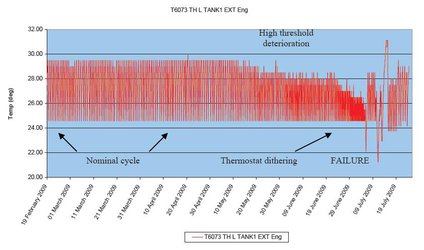
Once engineers have realised that an anomaly has happened, they face the problem of identifying the possible causes and other effects of this anomaly. DrMUST performs pattern matching to find similar behaviours across history (years) and correlation a...
ORATOR
Online Report Automation Tool
Flight Control Teams (FCT) regularly produce mission operations reports. Creating these reports can be cumbersome and time-consuming. The ORATOR reporting tool facilitates this process by automatically extracting required data from the MUST databases...
MEXAR2 and RAXEM
Advanced Planning for Spacecraft Data Downlink and Telecommands Uplink
Spacecraft like Mars Express (MEX) are not constantly in contact with ground stations; therefore data generated onboard must be stored, waiting to be downloaded during a future ground station pass. The goal of the mission planner is to schedule these...
Novelty Detection
A New Telemetry Monitoring Paradigm
Being able to quickly identify anomalous behaviour allows to reduce downtimes and keep our spacecrafts healthy. The current approach built in our Mission Control System is to use out-of-limits checks. However, many behaviours are anomalous even if the...
SEISOP
Space Environment Information System for Operations
SEISOP is a decision-support system that provides flight control teams with useful space weather and spacecraft information (past, current and forecasts). This information increases the ability to protect spacecraft components from hazardous events an...
Packet Compression
Simple Lossless Packet Compression
It is commonly believed that HKTM packets do not compress well. However, we have developed a lossless compression technique that provides massive data reduction. It is so simple that it can be implemented on-board. The packet compression technique gro...
Fractal Resampling
Enhancing Observability on Ground for the same or even less bandwidth
On-board observability depends on the sampling rate used to perform on-board measurements. The fractal resampling technique allows high sampling on board while sending very little data that can account for the most interesting information. This separa...
Last update: 24 October 2012