High-power multicarrier facility inaugurated in Spain
To keep pace with our information-hungry world, telecommunication satellites must handle an ever-increasing number of higher-powered radio signals. An experimental facility – inaugurated on Tuesday at ESA’s specialised laboratory in Spain – can test satellite components for future missions accordingly.
The new Multicarrier facility, allowing components to be subjected to up to 3600 W of power, is installed at the High Power Radio Frequency (RF) Laboratory in Valencia, Spain, which is operated by ESA together with the Valencia Space Consortium (VSC).
The facility was formally inaugurated by Philippe Perol, ESA Director of Technical and Quality Management, and Alejandro Font de Mora, Valencian Regional Minister of Education and President of VSC.
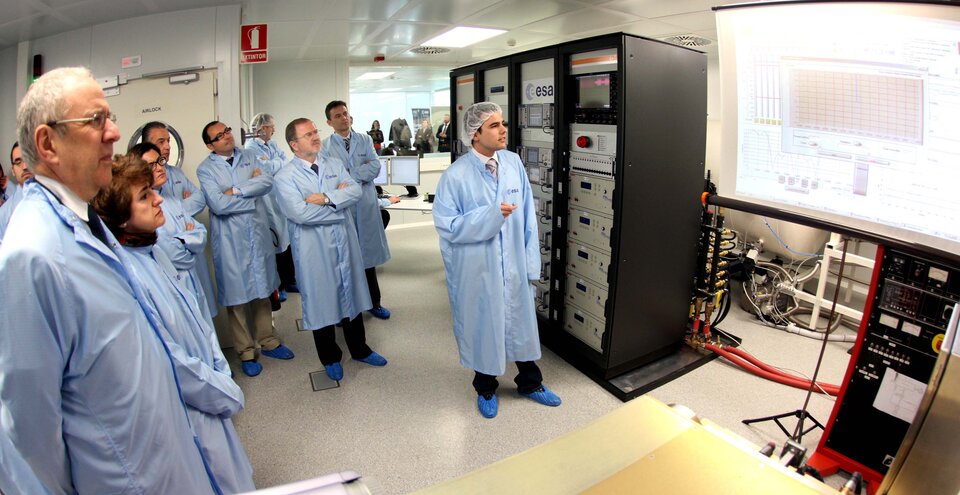
Mr Perol noted that, “With this new facility, ESA confirms the commitment to develop the Laboratory in Valencia and give it new state-of-the-art capabilities.
“This laboratory has already demonstrated in its first months of operation a significant increase of testing activities for ESA programmes such as Galileo, Sentinel-1 and Alphasat.”
The Minister stressed the participation of a Valencian company in the facility – they have been actively involved in developing the control software. “This collaboration,” Mr de Mora pointed out, “confirms that having located the ESA Laboratory in Valencia has generated a growing interest among the region's entrepreneurs for this project.”
“In this sense, we will support the initiatives that ESA has to continue investing in Valencia.”
“With the Multicarrier, we will be able to validate key components for telecommunication satellites to deal with higher power and to investigate new technologies,” explained David Raboso, Manager of the High Power RF Laboratory.
“This in turn will bring more affordable and better quality TV, multimedia and voice channels to previously unreached regions of our planet.”
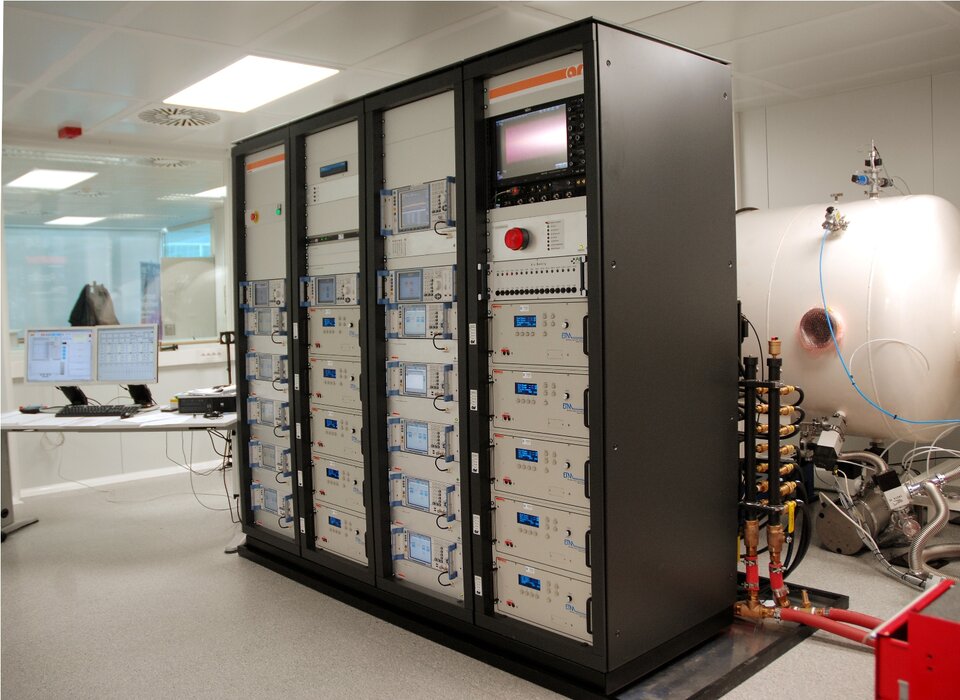
The €1.5 million facility was developed over the last two years by a consortium of companies led by AR Benelux and including TNO in the Netherlands, Apollo from Canada and Aurora Software and Testing of Valencia (a spin-off from the Universitat Politècnica de València (UPV) and the Universitat de València), responsible for the advanced control software.
The new facility includes 10 RF signal generators within the frequency range 10.7–11.7 GHz and their power amplifiers. Signals are grouped in a single output so that the total power reaches more than 3600 W. Satellite components are connected to the facility to ensure they can withstand this power in space.
The power generated allows for a generous safety margin, explained David: “Once the tested parts are in space we cannot go there to fix them.”
“We need to generate so many signals because that is the real-life situation,” commented UPV Professor Vicente Boria, Laboratory Co-Manager and President of the VSC Executive Committee.
“In today’s satellites, signals go through a single component: they all need to pass through the antenna to be sent to the ground.
“If the various signals are in phase then there will be a peak power that might be dangerous for the mission if the components can’t withstand it.”
Other existing testbeds in Europe generate just one signal, compared to the multiple signals of the Multicarrier. Water-cooling dissipates up to 30 kW of generated heat. This advanced refrigeration system helps to control the RF signal phase and power to a more precise degree.
About the High Power RF Laboratory
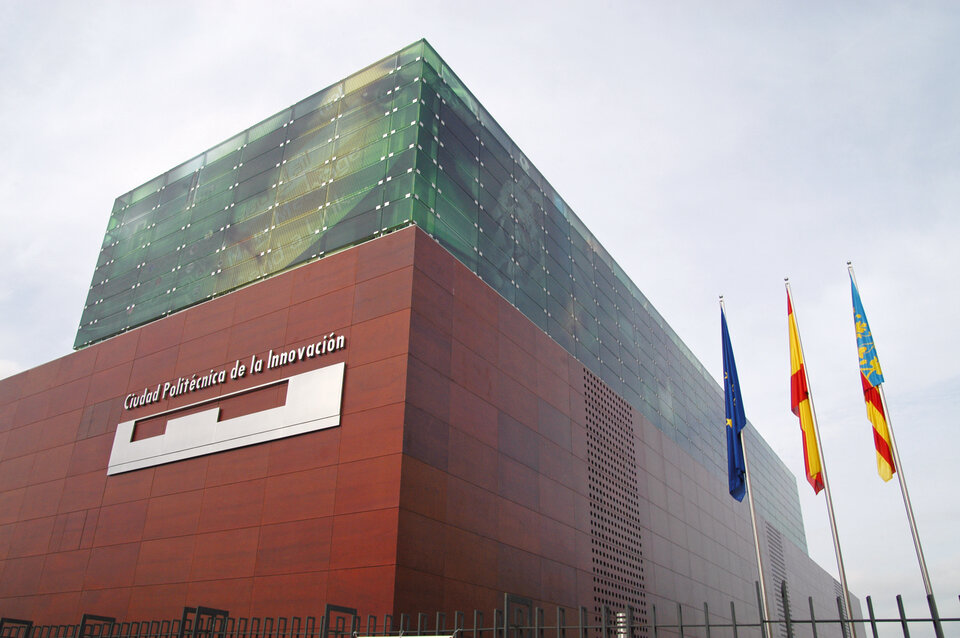
The High Power RF Laboratory is part of ESA’s RF Payload System Laboratories. It is tasked with investigating complex effects associated with prolonged high-powered RF operation in vacuum conditions.
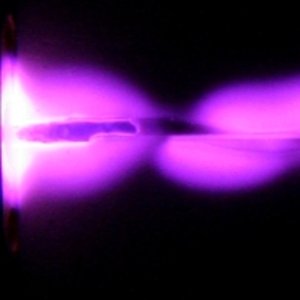
High power RF phenomena such as ‘multipactor breakdown’ – where induced electric current damages RF devices – and ‘corona discharge’ – where residual gases are ionised by RF signals – are complex effects linked to the power applied to RF hardware. They can limit a system’s performance or lead to total breakdown.
The detailed knowledge of such effects gathered by the High Power RF Laboratory is vital for satellite telecommunications or powerful radar systems used for observing Earth.