How Hubble got its wings: 6. Hubble's second-generation arrays
The team deduced the causes of these problems from Hubble telemetry, and designed corrections into the second set of solar generators, being prepared for deployment.
“It was only later, in the post-flight investigation, that we could see it for ourselves, but we were confident we were correct,” said Lothar.
The bi-stem booms were enclosed in a kind of Chinese-lantern shield, while the old compensation mechanism used to keep the blanket taut was replaced by a kind of 'bed-spring' system with a set of limit straps as a back-up to ensure the blanket kept together and functioning.
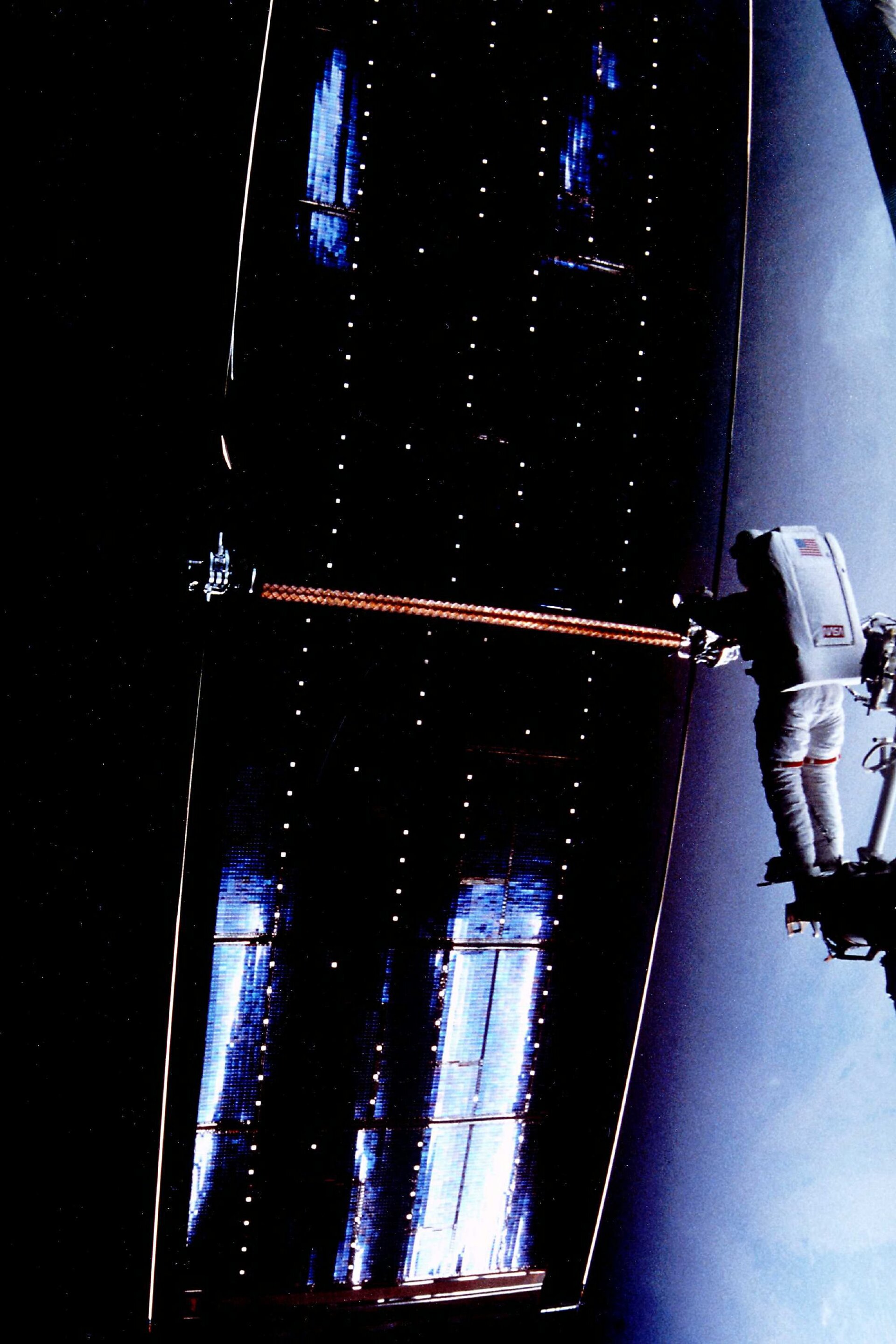
The second set of solar arrays flew up on the first Hubble Servicing Mission, in December 1993. Of the original pair, one was indeed out of shape: its failed compensation mechanism made one boom bent like a bow.
“When we tried to retract that array, the bent boom split and couldn't be fully retacted,” said Lothar. “So instead astronaut Kathy Thornton released it into free space. It drifted for a couple of years before burning up into the atmosphere. The other wing retracted like clockwork, and was taken back to Earth.
“Everything we got back turned out to be 100% as expected, as we pictured it. There was severe darkening of the silicone adhesive due to ultraviolet exposure, thousands of tiny impacts due to natural and man-made debris – helping to gather statistics on them – and cracks due to thermal cycling. But the biggest surprise was that there were no big surprises.”
7. Arrays coming apart?
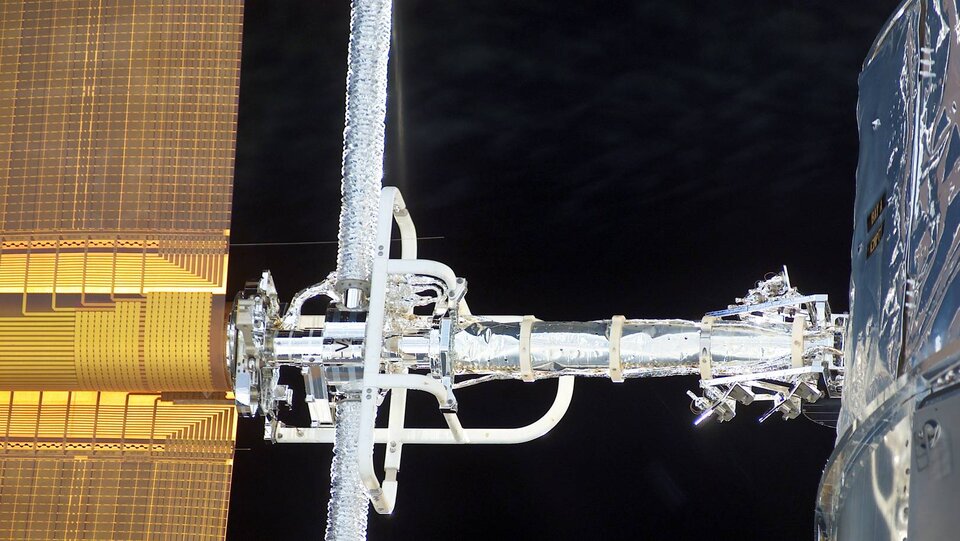
ESA’s second set of solar arrays did duty on Hubble for more than eight years. In December 1999 an emergency Servicing Mission (3A) was tasked to replace failed Hubble gyroscopes.
The European solar array team expected to have an easy babysitting task, but noticed some alarming changes in the solar arrays during a routine inspection. Demonstrating the dynamic nature of low-orbit conditions, wire-like hinge pins holding different segments of the solar blankets together had come loose, extending up to 50 cm out from the array edge.
The ESA solar array team began emergency testing with the original, rejected solar array, which had been kept in storage in NASA’s Goddard base in Washington DC. Could these hinge pins penetrate the spacesuit of an astronaut? Might the solar panels fall apart when they were retracted?
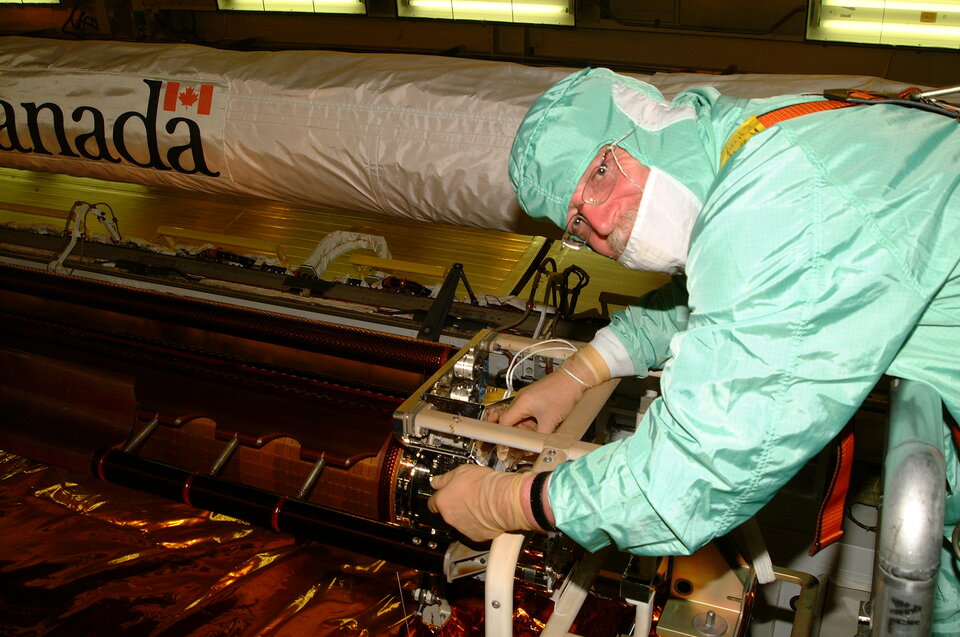
A rapid 38 hours of experimentation demonstrated that the astronauts were safe, and the array’s power bridge pieces were strong enough to hold the structure together for the remaining mission life and for the planned retraction during the upcoming Servicing Mission 3B retraction.
“While the other team members were busy with the moving hinge pins, I was tasked with a different problem,” said Lothar.
“Close-up examination showed one of the array compensator springs had broken, and we needed to know if it was a fatigue or not. If it was, then all the other array compensators might soon fail in the same way and the blankets might curve inwards, hammock-like.
“But when looking at the location where the spring was broken I was convinced that it was not fatigue, but I somehow had to provide some evidence.
“Fortunately, statistical analysis based on particle-impact survey results from the first post-flight solar array investigation assured me it had almost certainly been caused by a micrometeoroid impact, and I could assure mission controllers that no further corrective action would be needed.
“When the arrays finally came back to Earth in 2002, I got into the Shuttle cargo bay the instant I could, and double-checked I was indeed correct.”
8. Recovery after eight years in orbit
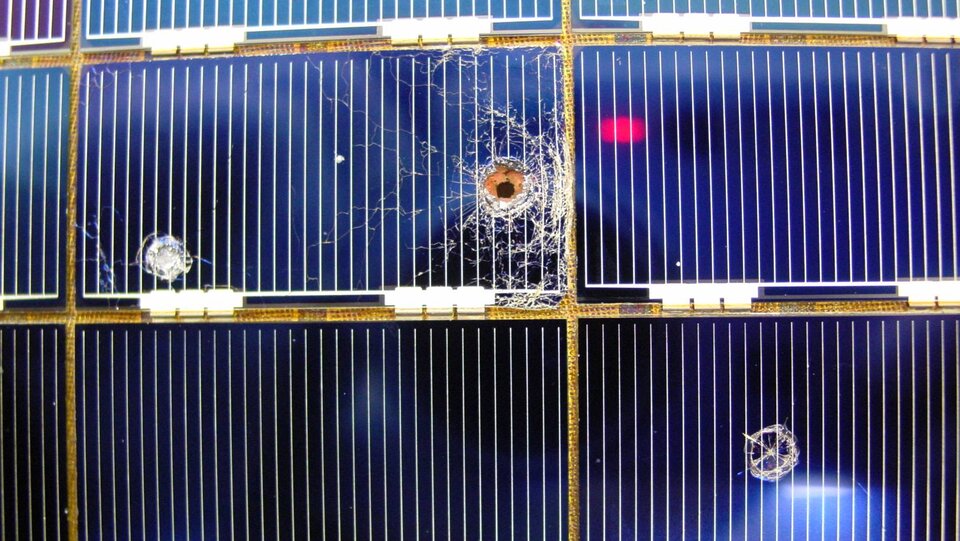
The second set of solar arrays underwent examination in the same detailed way, Lothar added: “In principle we could have relaunched them – there was barely any power degradation, and not one interconnector showed any sign of fatigue.
“There were plenty of impacts, it was true, but only four full penetrations per square metre of all three 0.7 mm-thick blankets, while the largest hole was only 5 mm in diameter.
“This was despite the fact that these arrays had by then exceeded their design lifetime by far.”
9. European-built Solar Array Drive Mechanism
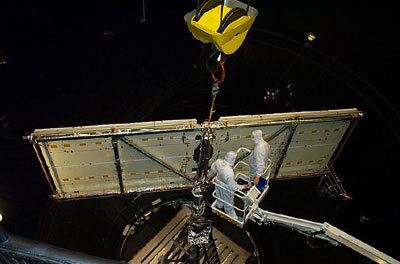
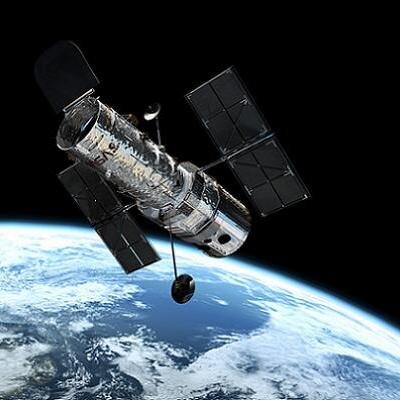
The second-generation solar arrays were replaced by US-made models during the 2002 Servicing Mission. These were rigid solar wings derived from Iridium satellite spares, because by this stage the idea of one day retrieving them on the Shuttle had been abandoned.
But the Solar Array Drive Mechanism (SADM) and electronics controlling these solar wings remain European. They are, in fact, the only European hardware still aboard today’s Hubble.
“This mechanism was built by what was originally Dornier, now EADS Astrium, in Friedrichstafen,” added Lothar. “It had stringent design requirements, including pointing stability and minimal disturbance torque.
“Whenever Hubble images a target the telescope needs to orient towards it, and at the same time the solar arrays need to move based on ground-based computer calculations to produce the optimal amount of power during the observation.”
So ESA and Astrium’s solar array team remained on call at NASA Goddard during the last Servicing Mission in May 2009. The arrays need to be carefully controlled when astronauts come calling. Firstly to avoid contact, and secondly because, in the past, the air coming out of the airlock before spacewalks has been enough to blow the arrays out of position.
10. Hubble’s solar array legacy

How influential was the Hubble experience on ESA’s solar generator technology? “Well, there is no need for retractable flexible blankets anymore, and today’s solar cells– driven largely by the needs of the highly competitive telecom market – are much more advanced, up to 30% efficiency,” Lothar recounted.
“At the same time, for low-orbit missions European industry still relies on the same interconnection techniques honed in the Hubble days.
“And our Hubble experience laid the groundwork for operating solar arrays for 10 years’ lifetime and above at these altitudes.
“In terms of missions to come, ESA is partnering with European academia and industry to develop very flexible ultra-thin – 20 micron – solar cells with efficiencies in the 33% range. This might result in a rebirth of flexible blanket generators in the future.”
With the Shuttle era due to end, the very last mission to Hubble will almost certainly be an unmanned one, most likely a robotic system that will attach a propulsion stage for safely deorbiting the venerable space observatory – hopefully still a fair few years away yet.