B
Baffle
A device used to prevent stray light.
Baryons
The class of subatomic particles in which protons and neutrons are included. The baryons form the atomic nucleus, along with another class of particles – the mesons. We, and everything we can see around us, are made of baryonic matter.
Big Bang
The Big Bang theory is the most accepted theory so far to describe the origin and evolution of the Universe. According to it, all the matter and energy in the Universe was originally contained in a very small 'point' – technically called a 'singularity' – at an almost infinite temperature and density. About 10 to 20 billion years ago this tiny Universe started to expand, and has not stopped expanding since. This theory was first drafted by Russian physicist George Gamow in the late forties, although only when the cosmic microwave background was discovered in 1964 did the astronomical community start to take it seriously. As of today, apart from the cosmic microwave background, two other pillars support the Big Bang theory: the current expansion of the Universe and the measured abundance of light elements.
Big Crunch
See Critical density
Billion
One billion equals one million million (UK/Europe), and 1000 million (US).
Binary star
Pair of stars bound together by mutual gravitation and orbiting their common centre of mass.
Black hole
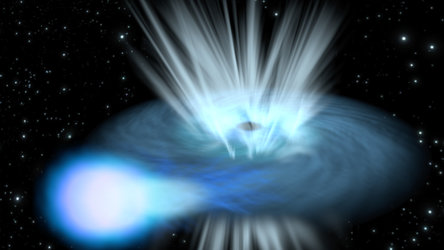
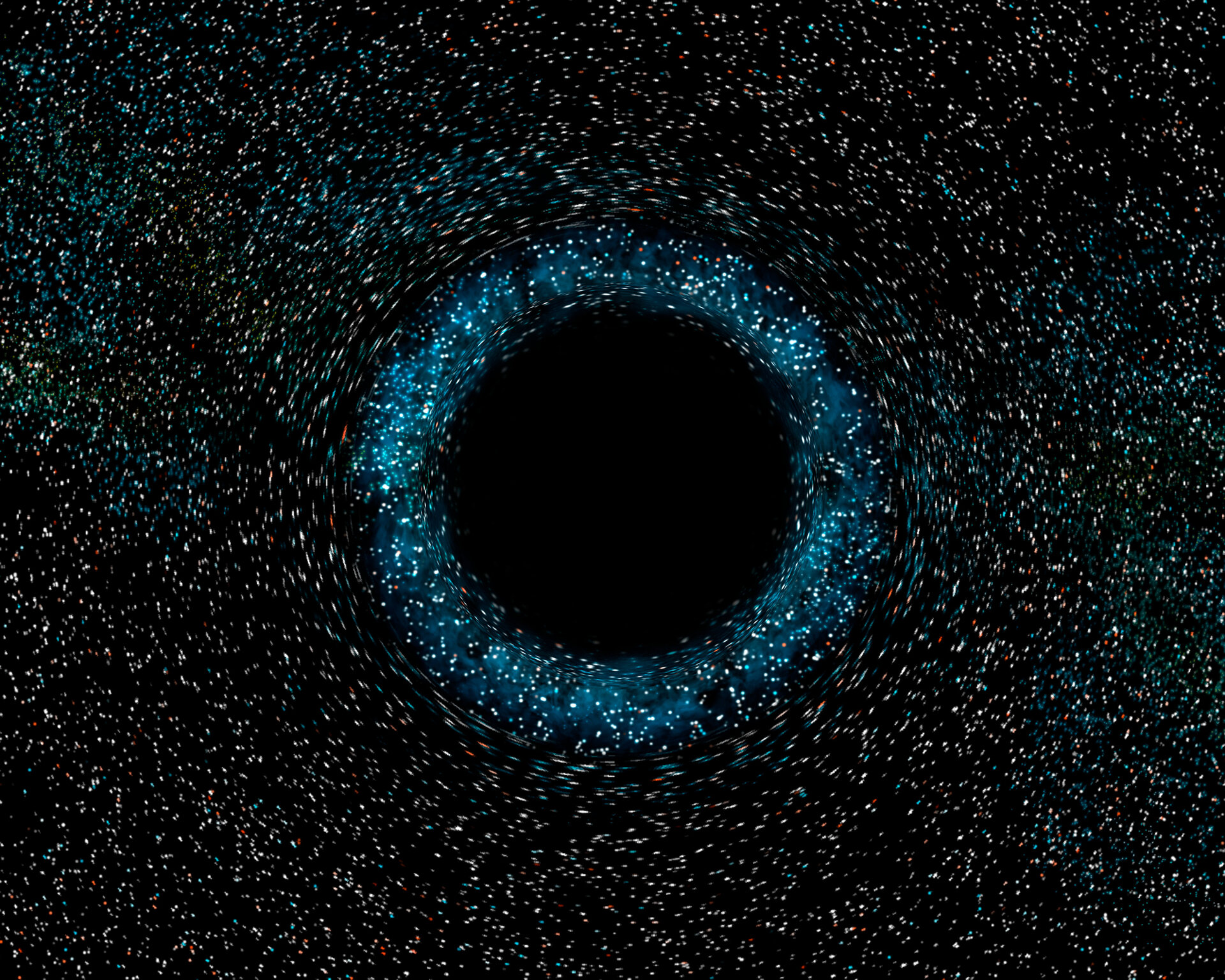
An object with so much mass concentrated in it, and therefore such a strong gravitational pull that nothing, not even light can escape from it. One way in which black holes are believed to form is when massive stars collapse at the end of their lives.
Blazar
Type of active galaxy named after an object in the constellation of Lacerta, the BL Lacertae object. They form a subset of the quasar population. The emission of blazars is highly variable. The activity may be caused by jets of gas being expelled from the central region of the active galaxy, i.e. the supermassive black hole in the active galactic nucleus.
Blueshift
When a distant object moves toward the observer the lines in its spectrum shift to shorter (bluer) wavelengths. This is because of the apparent compression of the wave of light. As a result of this compression the wavelength shortens and thus shifts towards the blue side of the electromagnetic spectrum. The blueshift of an astronomical object is an indication of the speed at which this object is approaching the observer.
Bolometer
A kind of detector mainly used to measure infrared radiation. A bolometer works by heating up as it absorbs the radiation that reaches it. The increase in temperature is measured by an internal electrical resistance, and is a measure of the amount of radiation absorbed.
Bremsstrahlung
The German word 'Bremsstrahlung' means 'braking radiation'. A fast, charged particle, for example an electron, is slowed down when it passes through matter. The energy lost by the particle is emitted as electromagnetic radiation, or Bremsstrahlung.
Brown dwarf
A kind of 'failed' star: a small and opaque object whose mass is not sufficient to start, in its core, the nuclear reaction to transform hydrogen into helium. A brown dwarf cannot therefore produce enough energy to shine as a star. A brown dwarf's mass is not more than 0.08 solar masses.