• → European Space Agency

      • Space for Europe
      • Space News
      • Space in Images
      • Space in Videos
    • About Us

      • Welcome to ESA
      • DG's News and Views
      • For Member State Delegations
      • Business with ESA
      • ESA Exhibitions
      • ESA Publications
      • Careers at ESA
    • Our Activities

      • Space News
      • Observing the Earth
      • Human Spaceflight
      • Launchers
      • Navigation
      • Space Science
      • Space Engineering
      • Operations
      • Technology
      • Telecommunications & Integrated Applications
    • For Public

    • For Media

      • Media
      • ESA TV
      • Videos for professionals
      • Photos
    • For Educators

    • For Kids

    • ESA

    • ESA Science

    • Cassini-Huygens

    • Unique insights into a ringed world

      • Striking sights of a ringed world...
      • Solving the puzzles of Saturn and Titan
    • About Cassini-Huygens

      • Cassini-Huygens mission facts
      • The mission
      • Cassini spacecraft
      • Cassini instruments
      • Huygens spacecraft
      • Huygens instruments
      • The launcher
    • About Saturn

      • Facts about Saturn
      • Saturn's rings
      • Saturn's moons
      • Saturn's atmosphere
      • Saturn's magnetosphere
    • About Titan

      • Facts about Titan
      • Titan's atmosphere
      • Titan's surface
      • Life on Titan?
    • Meet the team

      • International collaboration
      • Huygens Mission Team
      • Cassini Project Team
      • ASI Programme Manager
      • Huygens investigators
      • Cassini orbiter investigators (1)
      • Cassini orbiter investigators (2)
    • Multimedia
    • VideoTalk
    • Cassini-Huygens images
    • Cassini-Huygens videos
    • Titan virtual tour
    • Hygens probe descent - multilingual CD-rom
    • Download wallpapers
    • Download screensavers
    • 3D Flash 'model'
    • SOI animation
    • Waiting for Titan - the human side of Huygens
    • Services
    • Comments

    ESA > Our Activities > Space Science > Cassini-Huygens

    Communicating from space: gaining a grip on antennas

    Cassini-Huygens approaches Saturn
    28 June 2004

    Staying in touch with spacecraft after launch, such as Cassini-Huygens or ESA’s Mars Express, needs sophisticated communication systems, including 'high-gain' and 'low-gain' antennas.

    Technical terms like these can sound fearsome, but they are easily explained.

    First of all, an antenna is simply a device that can send and receive radio waves. Anything can do this as long as it is capable of conducting electricity. Because metal is so good at doing this, even a paper-clip could be used to transmit and receive radio waves.

    However, such a tiny system would be of little use to transmit vital scientific data over millions of miles of space. So, engineers build more-complicated antennas, and this is where things start to get confusing.

    Car aerials are among the simplest antennas. They can receive (or transmit) signals equally in all directions except straight up and down. By building more complicated antennas, engineers can control the direction in which the radio wave is sent.

    This is where the term ‘gain’ is used. Gain of an antenna system is the increase or ‘amplification’ in signal power, usually expressed in decibels. This is the ratio of the power transmitted along the direction of the signal beam and that of a signal of the same total power sent in all directions.


    'Exploded' view showing Mars Express high-gain antenna

    So although it can be defined mathematically, it is really just a way of telling how tightly a particular antenna can focus its radio beam. So, a high-gain antenna is particularly good at transmitting signals in a narrow beam whereas a low-gain antenna tends to send its signal in a much wider sweep of directions.

    Because a low-gain antenna spreads its power out over a wider volume in space, the signal received by a ground station is weaker. This signal cannot carry as much information as a high-gain signal where the available power is concentrated to beam the signal accurately back to its target. Dish-shaped antennas are particularly good at focusing radio beams and so make excellent high-gain antennas.
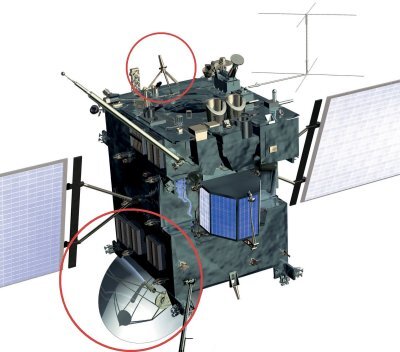
    Close-up of Rosetta's antennas

    Spacecraft always carry both high- and low-gain antennas. Although the high-gain antenna is used to return the majority of the data collected, if the spacecraft has to turn even a little, the high-gain signal could miss the Earth. The low-gain antenna does not suffer from such a problem because it transmits over a wider volume.

    So even though they transmit and receive at slower rates, low-gain antennas are used to take over as back-ups when the high-gain antenna cannot be used. Spacecraft normally carry two of them on opposite sides. That way, they provide total coverage around the spacecraft.

    Low-gain antennas are essential in critical situations. For example, if a spacecraft lost the ability to point itself, the low-gain antenna will always receive signals from Earth, allowing engineers to begin fixing the problem.

    So if you ask the question, “Which is best to have on a spacecraft: a high-gain or a low-gain antenna?” the answer is clearly, “Both!”
    Rate this

    Views

    Share

    • Currently 5 out of 5 Stars.
    • 1
    • 2
    • 3
    • 4
    • 5
    Rating: 5/5 (1 votes cast)

    Thank you for rating!

    You have already rated this page, you can only rate it once!

    Your rating has been changed, thanks for rating!

    228
    Tweet
    • At Saturn and Titan
    • More about...
    • More on Cassini-Huygens spacecraft
    • More on Cassini instruments
    • Related articles
      • Life on Titan?
        • Christiaan Huygens: Discoverer of Titan
          • Jean-Dominique Cassini: Astrology to astronomy
          • Related links
          • NASA JPL Cassini-Huygens site
          • Italian Space Agency (ASI)

    Connect with us

    • RSS
    • Youtube
    • Twitter
    • Flickr
    • G+
    • Facebook
    • Livestream
    • Subscribe
    • App Store
    • LATEST ARTICLES
    • · The fast winds of Venus are gettin…
    • · ExoMars 2016 set to complete const…
    • · Herschel ends operations as orbiti…
    • · Europe’s largest spaceship reache…
    • · ATV ready to nose up to Station
    • FAQ

    • Jobs at ESA

    • Site Map

    • Contacts

    • Terms and conditions