• → European Space Agency

      • Space for Europe
      • Space News
      • Space in Images
      • Space in Videos
    • About Us

      • Welcome to ESA
      • DG's News and Views
      • For Member State Delegations
      • Business with ESA
      • ESA Exhibitions
      • ESA Publications
      • Careers at ESA
    • Our Activities

      • Space News
      • Observing the Earth
      • Human Spaceflight
      • Launchers
      • Navigation
      • Space Science
      • Space Engineering
      • Operations
      • Technology
      • Telecommunications & Integrated Applications
    • For Public

    • For Media

    • For Educators

    • For Kids

    • ESA

    • ESA Science

    • Cassini-Huygens

    • Unique insights into a ringed world

      • Striking sights of a ringed world...
      • Solving the puzzles of Saturn and Titan
    • About Cassini-Huygens

      • Cassini-Huygens mission facts
      • The mission
      • Cassini spacecraft
      • Cassini instruments
      • Huygens spacecraft
      • Huygens instruments
      • The launcher
    • About Saturn

      • Facts about Saturn
      • Saturn's rings
      • Saturn's moons
      • Saturn's atmosphere
      • Saturn's magnetosphere
    • About Titan

      • Facts about Titan
      • Titan's atmosphere
      • Titan's surface
      • Life on Titan?
    • Meet the team

      • International collaboration
      • Huygens Mission Team
      • Cassini Project Team
      • ASI Programme Manager
      • Huygens investigators
      • Cassini orbiter investigators (1)
      • Cassini orbiter investigators (2)
    • Multimedia
    • VideoTalk
    • Cassini-Huygens images
    • Cassini-Huygens videos
    • Titan virtual tour
    • Hygens probe descent - multilingual CD-rom
    • Download wallpapers
    • Download screensavers
    • 3D Flash 'model'
    • SOI animation
    • Waiting for Titan - the human side of Huygens
    • Services
    • Comments

    ESA > Our Activities > Space Science > Cassini-Huygens

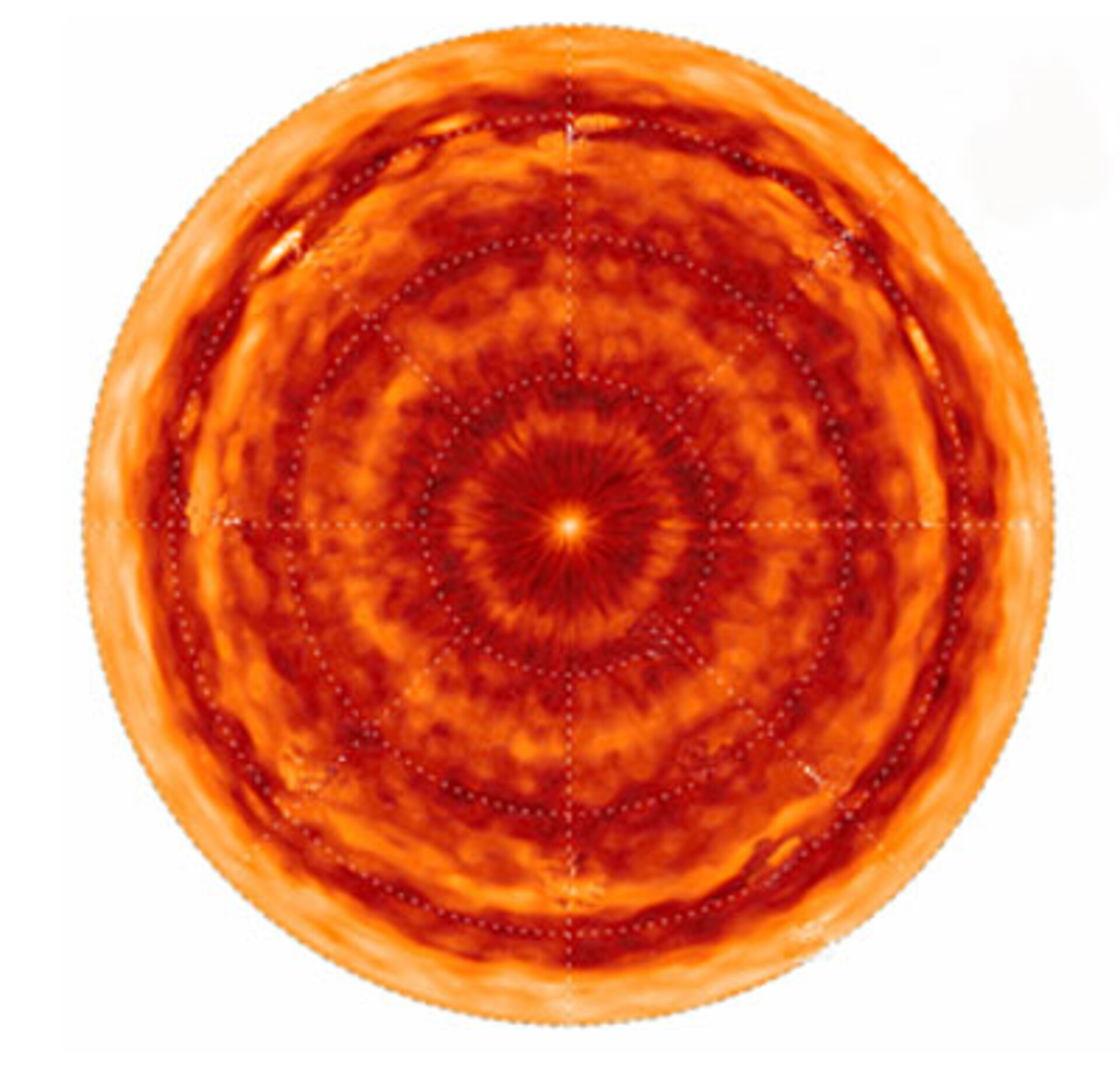
    Hot cyclones churn at both ends of Saturn

    Saturn's north pole hot spot and hexagon
    Saturn's north pole hot spot and hexagon
    3 January 2008

    Despite more than a decade of winter darkness, Saturn's north pole is home to an unexpected hot-spot, remarkably similar to the one at the planet's sunny south pole. Now, the first detailed views of the gas giant's high latitudes from the Cassini spacecraft reveal a matched set of hot cyclonic vortices, one at each pole.
    For more information follow this link
    Rate this

    Views

    Share

    • Currently 0 out of 5 Stars.
    • 1
    • 2
    • 3
    • 4
    • 5
    Rating: 0/5 (0 votes cast)

    Thank you for rating!

    You have already rated this page, you can only rate it once!

    Your rating has been changed, thanks for rating!

    49
    Tweet
    • At Saturn and Titan
    • Related articles
      • Cassini captures best view yet of Saturn's ring currents
        • Planetary scientists close in on Saturn’s elusive rotation
          • Images of Saturn’s small moons tell the story of their origins
            • Organic ‘building blocks’ discovered in Titan’s atmosphere
              • Cassini-Huygens - celebrating 10 years since launch
                • Cassini’s new view of land of lakes and seas
                  • Cassini on the trail of a runaway mystery
                    • Cassini on the trail of a runaway mystery - more images
                      • Saturn’s moon Iapetus is the Yin-Yang of the Solar System
                        • Fasten your seat belts, turbulence ahead - lessons from Titan
                          • Possible origin of Saturn's mysterious G ring
                          • The latest on titan
                            • Two more active moons around Saturn

    Connect with us

    • RSS
    • Youtube
    • Twitter
    • Flickr
    • G+
    • Facebook
    • Livestream
    • Subscribe
    • App Store
    • LATEST ARTICLES
    • · ESA astronaut Timothy Peake set fo…
    • · Space drives e-mobility
    • · Proba-V opens its eyes
    • · First new Galileo satellite arrive…
    • · Next destination: space
    • FAQ

    • Jobs at ESA

    • Site Map

    • Contacts

    • Terms and conditions