• → European Space Agency

      • Space for Europe
      • Space News
      • Space in Images
      • Space in Videos
    • About Us

      • Welcome to ESA
      • DG's News and Views
      • For Member State Delegations
      • Business with ESA
      • ESA Exhibitions
      • ESA Publications
      • Careers at ESA
    • Our Activities

      • Space News
      • Observing the Earth
      • Human Spaceflight
      • Launchers
      • Navigation
      • Space Science
      • Space Engineering
      • Operations
      • Technology
      • Telecommunications & Integrated Applications
    • For Public

    • For Media

    • For Educators

    • For Kids

    • ESA

    • ESA Science

    • Cassini-Huygens

    • Unique insights into a ringed world

      • Striking sights of a ringed world...
      • Solving the puzzles of Saturn and Titan
    • About Cassini-Huygens

      • Cassini-Huygens mission facts
      • The mission
      • Cassini spacecraft
      • Cassini instruments
      • Huygens spacecraft
      • Huygens instruments
      • The launcher
    • About Saturn

      • Facts about Saturn
      • Saturn's rings
      • Saturn's moons
      • Saturn's atmosphere
      • Saturn's magnetosphere
    • About Titan

      • Facts about Titan
      • Titan's atmosphere
      • Titan's surface
      • Life on Titan?
    • Meet the team

      • International collaboration
      • Huygens Mission Team
      • Cassini Project Team
      • ASI Programme Manager
      • Huygens investigators
      • Cassini orbiter investigators (1)
      • Cassini orbiter investigators (2)
    • Multimedia
    • VideoTalk
    • Cassini-Huygens images
    • Cassini-Huygens videos
    • Titan virtual tour
    • Hygens probe descent - multilingual CD-rom
    • Download wallpapers
    • Download screensavers
    • 3D Flash 'model'
    • SOI animation
    • Waiting for Titan - the human side of Huygens
    • Services
    • Comments

    ESA > Our Activities > Space Science > Cassini-Huygens

    Red spot on Titan

    Red spot on Titan baffles scientists

    26 May 2005

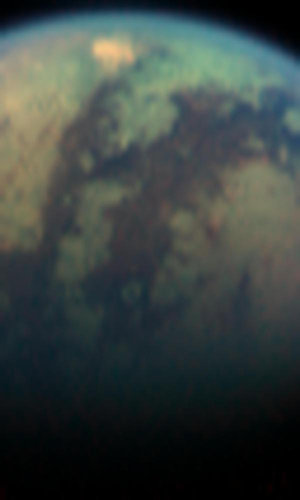
    The NASA/ESA/ASI Cassini spacecraft has identified an unusual bright spot on Saturn's moon Titan that is mystifying scientists. The spot is approximately the size of Ireland, and is just south-east of the bright region called Xanadu.

    The 483-kilometre-wide region may be a 'hot' spot, an area possibly warmed by a recent asteroid impact or by a mixture of water ice and ammonia from a warm interior, oozing out of an ice volcano on to colder surrounding terrain.

    Other possibilities for the unusual bright spot include landscape features holding clouds in place or unusual materials on the surface. This bright patch may also be due to an impact event, landslide, cryovolcanism or atmospheric processes.
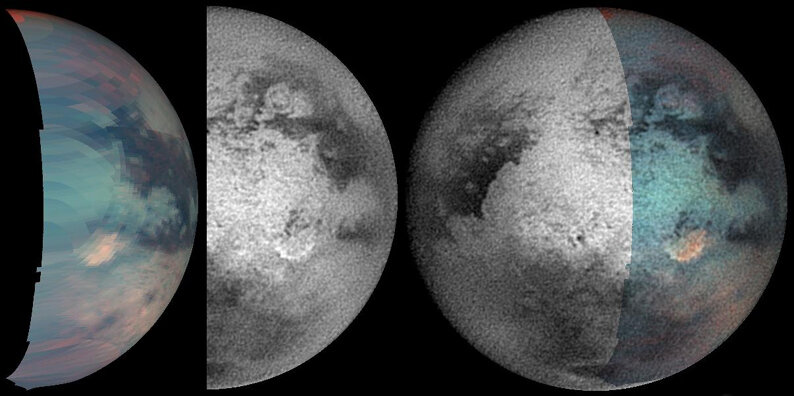
    Titan's odd spot observed by different instruments

    When Cassini flew by Titan on 31 March and 16 April, its Visual and Infrared Mapping Spectrometer (VIMS) instrument first observed the spot at infrared wavelengths, the brightest area ever observed on Titan.

    Cassini's imaging cameras then saw a bright, 550-kilometre-wide semi-circle at visible wavelengths at this same location on the fly-bys of December 2004 and February 2005.

    It seems clear that both instruments are detecting the same basic feature on or controlled by Titan's surface. Its distinct colour and brightness suggest that it may have formed relatively recently.

    Other bright spots have been seen on Titan, but all have been transient features that move or disappear within hours, and have different spectral (colour) properties than this feature. This spot is persistent in both its color and location.

    It is possible that the VIMS is seeing a cloud that is topographically controlled by something on the surface, and that this semi-circular feature is causing this cloud. If the spot is a cloud, then its longevity and stability imply that it is controlled by the surface. Such a cloud might result from airflow across low mountains or outgassing caused by geologic activity.

    The spot could be reflected light from a patch of terrain made up of some exotic surface material. Titan's surface seems to be mostly dirty ice so the bright spot might be a region with different surface composition, or maybe a thin surface deposit of non-icy material.

    Scientists have also considered that the spot might be mountains. If so, they would have to be much higher than the 100-metre-high hills Cassini's radar altimeter has seen so far. Scientists doubt that Titan's crust could support such high mountains.

    The VIMS instrument will be able to test the hot spot hypothesis on the 2 July 2006 Titan fly-by, when they take night-time images of the same area. If the spot glows at night, researchers will know it is hot.


    For more information:

    Jean-Pierre Lebreton, ESA Huygens Mission Manager
    E-mail: jplebret @ rssd.esa.int
    Rate this

    Views

    Share

    • Currently 0 out of 5 Stars.
    • 1
    • 2
    • 3
    • 4
    • 5
    Rating: 0/5 (0 votes cast)

    Thank you for rating!

    You have already rated this page, you can only rate it once!

    Your rating has been changed, thanks for rating!

    61
    Tweet
    • At Saturn and Titan
    • Huygens raw images
    • First image of Titan
      First image of Titan
    • Sounds of Titan
    • Related articles
      • Tethys drifts above Saturn
        • The fountains of Enceladus...
          • Ringside view of Dione
            • Unusual eclipse of Saturn's moon Rhea by Dione
              • Red spot on Titan baffles scientists
                • Dark-stained Iapetus
                  • First measurement of Titan’s winds from Huygens
                    • Radio astronomers confirm Huygens entry in the atmosphere of Titan
                      • Islands, rivers and methane springs - latest images of Titan
                        • Huygens lands in Titanian mud
                          • View from ten kilometres high
                          • Related links
                          • NASA JPL Cassini-Huygens site
                          • Italian Space Agency (ASI)
                          • Huygens DISR team

    Connect with us

    • RSS
    • Youtube
    • Twitter
    • Flickr
    • G+
    • Facebook
    • Livestream
    • Subscribe
    • App Store
    • LATEST ARTICLES
    • · ESA astronaut Timothy Peake set fo…
    • · Space drives e-mobility
    • · Proba-V opens its eyes
    • · First new Galileo satellite arrive…
    • · Next destination: space
    • FAQ

    • Jobs at ESA

    • Site Map

    • Contacts

    • Terms and conditions