• → European Space Agency

      • Space for Europe
      • Space News
      • Space in Images
      • Space in Videos
    • About Us

      • Welcome to ESA
      • DG's News and Views
      • For Member State Delegations
      • Business with ESA
      • ESA Exhibitions
      • ESA Publications
      • Careers at ESA
    • Our Activities

      • Space News
      • Observing the Earth
      • Human Spaceflight
      • Launchers
      • Navigation
      • Space Science
      • Space Engineering
      • Operations
      • Technology
      • Telecommunications & Integrated Applications
    • For Public

    • For Media

    • For Educators

    • For Kids

    • ESA

    • ESA Science

    • Cassini-Huygens

    • Unique insights into a ringed world

      • Striking sights of a ringed world...
      • Solving the puzzles of Saturn and Titan
    • About Cassini-Huygens

      • Cassini-Huygens mission facts
      • The mission
      • Cassini spacecraft
      • Cassini instruments
      • Huygens spacecraft
      • Huygens instruments
      • The launcher
    • About Saturn

      • Facts about Saturn
      • Saturn's rings
      • Saturn's moons
      • Saturn's atmosphere
      • Saturn's magnetosphere
    • About Titan

      • Facts about Titan
      • Titan's atmosphere
      • Titan's surface
      • Life on Titan?
    • Meet the team

      • International collaboration
      • Huygens Mission Team
      • Cassini Project Team
      • ASI Programme Manager
      • Huygens investigators
      • Cassini orbiter investigators (1)
      • Cassini orbiter investigators (2)
    • Multimedia
    • VideoTalk
    • Cassini-Huygens images
    • Cassini-Huygens videos
    • Titan virtual tour
    • Hygens probe descent - multilingual CD-rom
    • Download wallpapers
    • Download screensavers
    • 3D Flash 'model'
    • SOI animation
    • Waiting for Titan - the human side of Huygens
    • Services
    • Comments

    ESA > Our Activities > Space Science > Cassini-Huygens

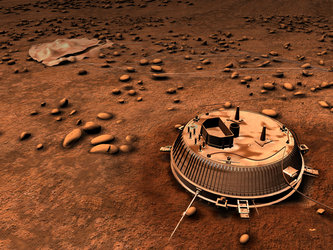
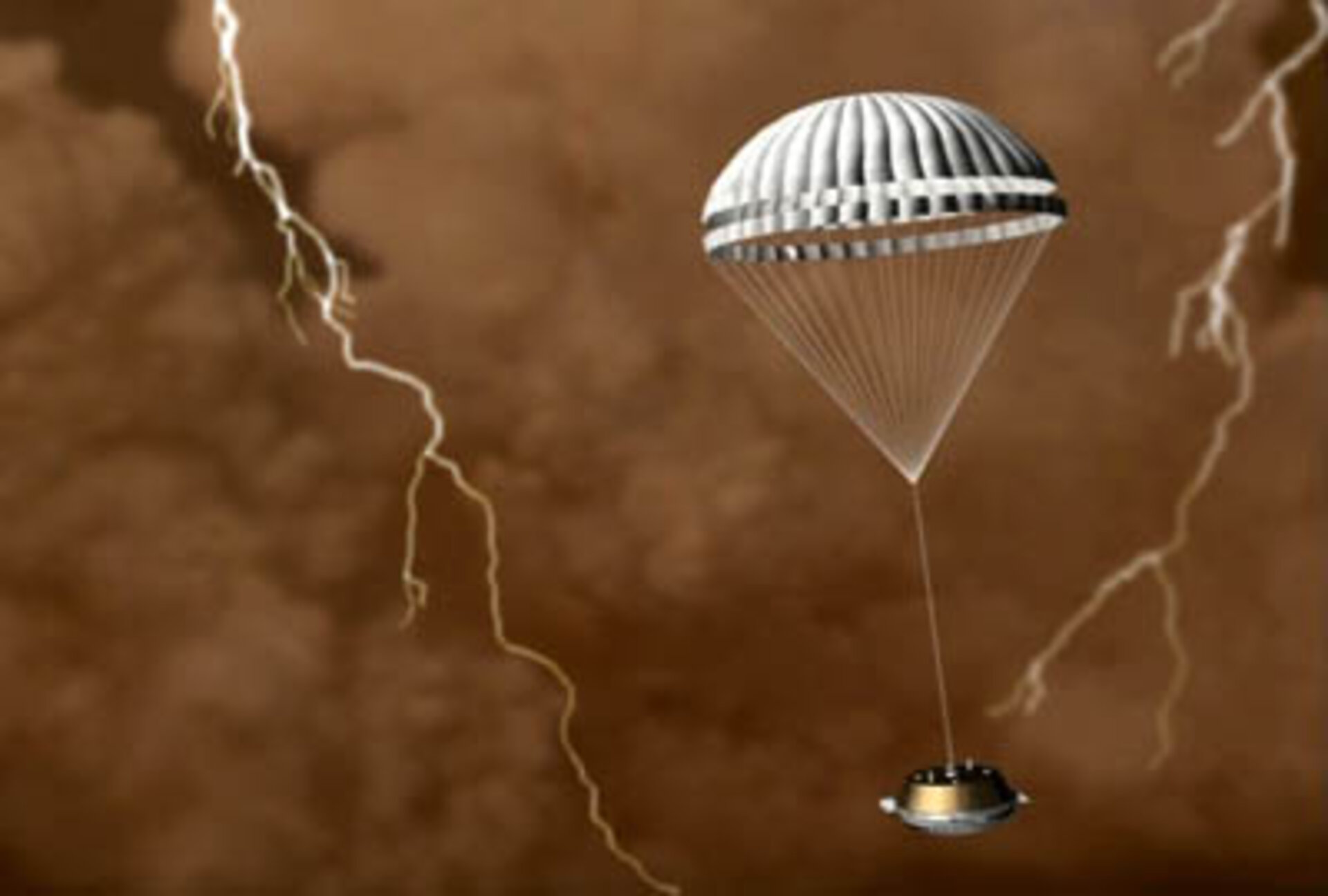
    Huygens probe descending through Titan's atmosphere

    The sounds of Titan

    21 October 2004

    The sound of alien thunder, the patter of methane rain and the crunch (or splash) of a landing, all might be heard as Huygens descends to the surface of Titan on 14 January 2005.

    What’s more, they will be recorded by a microphone on the probe and relayed back so that everyone on Earth can hear the sounds of Titan. Although the Russians took a microphone to Venus in the 1970s, few scientific results came out if that endeavour. A similar microphone for Mars was destroyed when NASA’s Mars Polar Lander crashed a few years ago.

    The new microphone is part of the Huygens Atmospheric Structure Instrument (HASI), one of six multi-functional experiments carried on the Huygens probe. It is designed to help track down lightning by listening for the clap of thunder usually associated with such an event.

    Although there is only a small chance that the spacecraft will pass near a thunderstorm, it is an extremely important investigation to carry out. It may help us to understand if thunderstorms are an important energy source for organic chemistry on Titan.

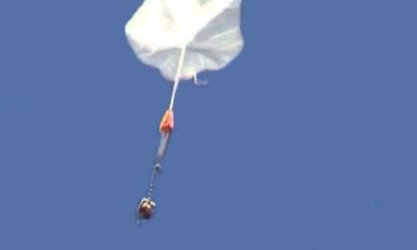
    Landing of the balloon
    A mock-up of Huygens with HASI instrument was tested on Earth

    This may hold clues about how life began on Earth. Titan’s atmosphere is laced with chemicals and many scientists think these are the same as those that formed the building blocks of life on Earth, 4000 million years ago. But how did they join together on Earth to ultimately become DNA?

    One possibility is that sudden discharges of energy, as occur in lightning, could have forced the simple chemicals together, making more complicated ones. So Huygens will listen for thunder and ‘sniff’ for chemicals that might have been produced in lightning strikes.

    In fact, a second microphone experiment can also be found on Huygens. It is part of the Surface Science Package (SSP) and contributes to an experiment to measure the speed of sound in Titan’s atmosphere.

    These results present an exciting possibility because if the HASI microphone does hear thunder, electrodes on the same instrument will register the lightning’s electrical discharge and scientists will be able to calculate how close Huygens passed to the storm.

    Huygens probe descending through Titan's atmosphere
    Huygens probe descending through Titan's atmosphere

    If Huygens actually passes through a storm, the microphone will detect the splash of the rain onto the spacecraft casing. Unlike on Earth, this rain will not be water but probably liquid methane.

    Marcello Fulchignoni, of the Universitè Denis Diderot, Paris, is the principal investigator of HASI. He says, “Combined with the camera images, temperature and pressure profiles, and altitude data, the ‘soundtrack’ will provide a fascinating look at the details of the mission’s descent. We will be working hard to bring the voice of Huygens to the public as soon as we can after the descent.”
    Rate this

    Views

    Share

    • Currently 0 out of 5 Stars.
    • 1
    • 2
    • 3
    • 4
    • 5
    Rating: 0/5 (0 votes cast)

    Thank you for rating!

    You have already rated this page, you can only rate it once!

    Your rating has been changed, thanks for rating!

    41
    Tweet
    • At Saturn and Titan
    • At Saturn and Titan
    • More about...
    • More on Cassini-Huygens spacecraft
    • More on Huygens instruments
    • In depth
    • Status reports
    • Related articles
      • Surviving extreme conditions in space
        • How to drop in on Titan
          • What is 'red shift'?
            • Observations: Very Long Baseline Interferometry (VLBI)
            • Related links
            • NASA JPL Cassini-Huygens site
            • Italian Space Agency (ASI)

    Connect with us

    • RSS
    • Youtube
    • Twitter
    • Flickr
    • G+
    • Facebook
    • Livestream
    • Subscribe
    • App Store
    • LATEST ARTICLES
    • · Proba-V opens its eyes
    • · First new Galileo satellite arrive…
    • · Next destination: space
    • · Leak repaired on International Spa…
    • · After Chelyabinsk: European expert…
    • FAQ

    • Jobs at ESA

    • Site Map

    • Contacts

    • Terms and conditions