• → European Space Agency

      • Space for Europe
      • Space News
      • Space in Images
      • Space in Videos
    • About Us

      • Welcome to ESA
      • DG's News and Views
      • For Member State Delegations
      • Business with ESA
      • ESA Exhibitions
      • ESA Publications
      • Careers at ESA
    • Our Activities

      • Space News
      • Observing the Earth
      • Human Spaceflight
      • Launchers
      • Navigation
      • Space Science
      • Space Engineering
      • Operations
      • Technology
      • Telecommunications & Integrated Applications
    • For Public

    • For Media

    • For Educators

    • For Kids

    • ESA

    • Space Science

    • Our Universe
    • About Space Science
    • ESA's 'Cosmic Vision'
    • Science missions
    • Mission navigator
    • Target groups
    • For Media
    • For Scientists
    • For Kids
    • Multimedia
    • Science images
    • Science videos
    • Animations
    • Downloads
    • Sounds from space
    • Resources
    • Reference section
    • Services
    • FAQs
    • Glossary
    • Help
    • Portal terms of use
    • Comments
    • Follow us
    • RSS feeds
    • ESA Sci on Twitter
    • ESA Space Science Images on Flickr
    • ESA 3D on Flickr

    ESA > Our Activities > Space Science

    Cassiopeia A - The colourful aftermath of a violent stellar death

    Hubble’s view of supernova explosion Cassiopeia A
    30 August 2006

    A new image taken with the NASA/ESA Hubble Space Telescope provides a detailed look at the tattered remains of a supernova explosion known as Cassiopeia A (Cas A) - the youngest known remnant from a supernova explosion in the Milky Way.

    The image is a composite made from 18 separate images taken using Hubble’s Advanced Camera for Surveys (ACS), and it shows the Cas A remnant as a broken ring of bright filamentary and clumpy stellar ejecta, showing the complex and intricate structure of the star’s shattered fragments.

    Zooming on Cas A, blinking
    Zooming on Cassiopeia A

    These huge swirls of debris glow with the heat generated by the passage of a shockwave from the supernova blast.

    The various colours of the gaseous shards indicate differences in chemical composition.

    Bright green filaments are rich in oxygen, red and purple are sulphur, and blue are composed mostly of hydrogen and nitrogen.
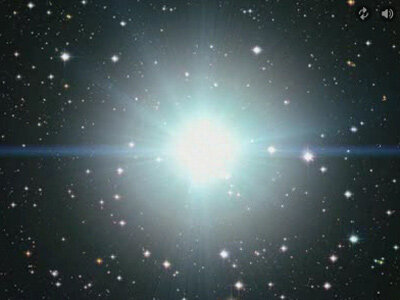

    Artist’s impression of supernova explosion
    Artist’s impression of supernova explosion

    A supernova such as the one that resulted in Cas A is the explosive demise of a massive star that collapses under the weight of its own gravity.
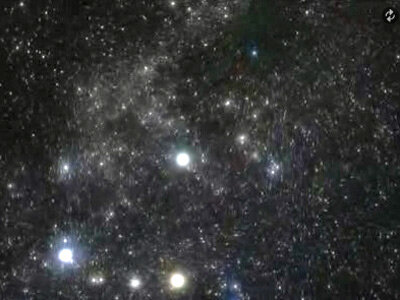
    View of the region around Cassiopeia A
    View of the region around Cassiopeia A

    The collapsed star then blows its outer layers into space in an explosion that can briefly outshine its entire parent galaxy.

    Cas A is relatively young, estimated to be only about 340 years old. Hubble has observed it on several occasions to look for changes in the rapidly expanding filaments.

    In the latest observing campaign, two sets of images were taken, separated by nine months. Even in that short time, Hubble's razor-sharp images can observe the expansion of the remnant.

    Comparison of the two image sets shows that a faint stream of debris seen along the upper left side of the remnant is moving with high speed - up to 50 million kilometres per hour (fast enough to travel from Earth to the Moon in 30 seconds!).
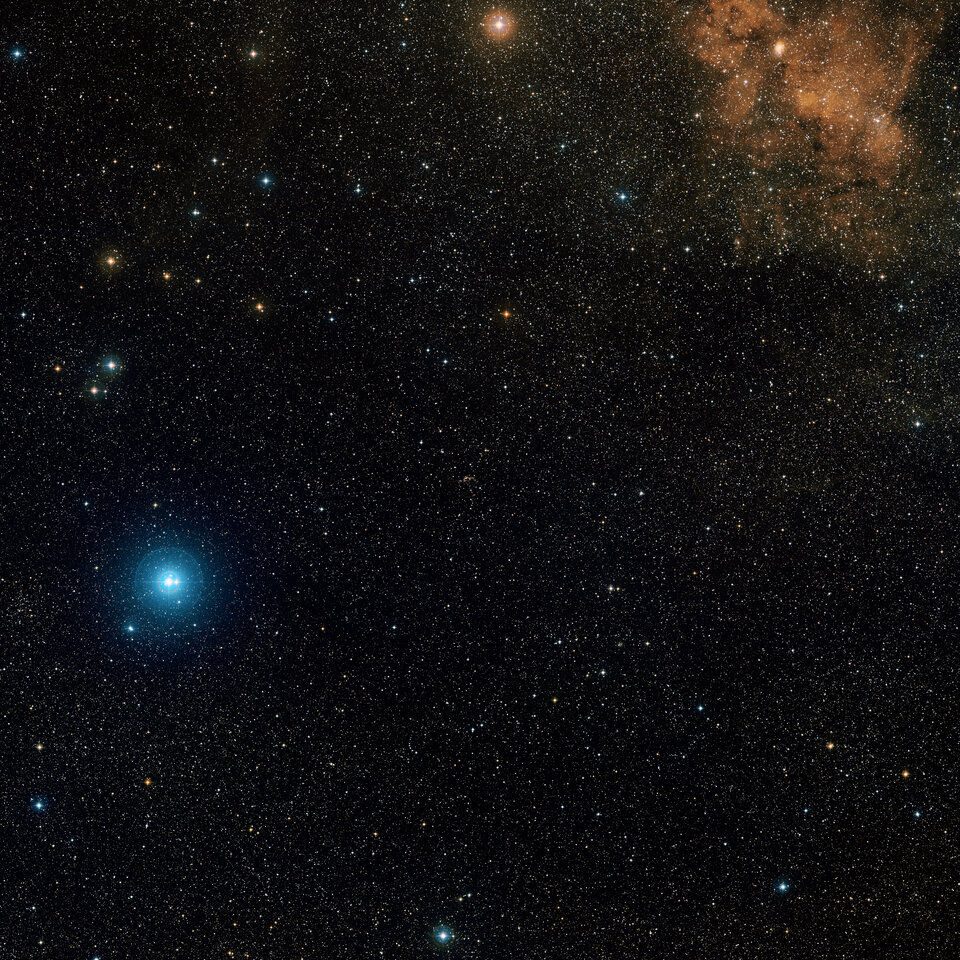
    Region around Cassiopeia A

    Cas A is located ten thousand light-years away from Earth in the constellation of Cassiopeia.

    Supernova explosions are the main source of elements more complex than oxygen, which are forged in the extreme conditions produced in these events.

    The analysis of such a nearby, relatively young and fresh example is extremely helpful in understanding the evolution of the Universe.

    Notes for editors

    The Hubble Space Telescope is a project of international cooperation between ESA and NASA.

    For more information

    Robert A. Fesen, Dartmouth College, Hanover, New Hampshire, USA
    Email: fesen @ snr.dartmouth.edu

    Lars Lindberg Christensen, Hubble/ESA, Garching, Germany
    Email: lars @ eso.org

    Ray Villard, Space Telescope Science Institute, Baltimore, USA
    Email: villard @ stsci.edu

    Keith Noll, Space Telescope Science Institute, Baltimore, USA
    Email: noll @ stsci.edu
    Rate this

    Views

    Share

    • Currently 0 out of 5 Stars.
    • 1
    • 2
    • 3
    • 4
    • 5
    Rating: 0/5 (0 votes cast)

    Thank you for rating!

    You have already rated this page, you can only rate it once!

    Your rating has been changed, thanks for rating!

    79
    Tweet
    • More about...
      • So, how did everything start?
        • Hubble overview
        • Related articles
          • Hubble sees faintest stars in a globular cluster
            • Hubble captures a 'quintuple' quasar
              • Hubble provides spectacular view of ongoing comet break-up
                • Hubble’s view of Cigar Galaxy on sixteenth mission anniversary
                  • Hubble panoramic view of Orion Nebula
                    • The Crab Nebula: largest Hubble mosaic ever made
                      • 'Big baby' galaxy found in newborn Universe
                        • Mysterious disk of blue stars around a black hole
                          • Black hole without a home
                            • Hubble celebrates 15th anniversary with spectacular new images
                              • Young stars sculpt gas with powerful outflows
                                • Hubble panoramic view of Orion Nebula
                                • Related links
                                • Hubble - 15 Years of Discovery

    Connect with us

    • RSS
    • Youtube
    • Twitter
    • Flickr
    • G+
    • Facebook
    • Livestream
    • Subscribe
    • App Store
    • ESA Science Twitter

    Follow ESA science

    • LATEST ARTICLES
    • · Proba-V opens its eyes
    • · First new Galileo satellite arrive…
    • · Next destination: space
    • · Leak repaired on International Spa…
    • · After Chelyabinsk: European expert…
    • FAQ

    • Jobs at ESA

    • Site Map

    • Contacts

    • Terms and conditions