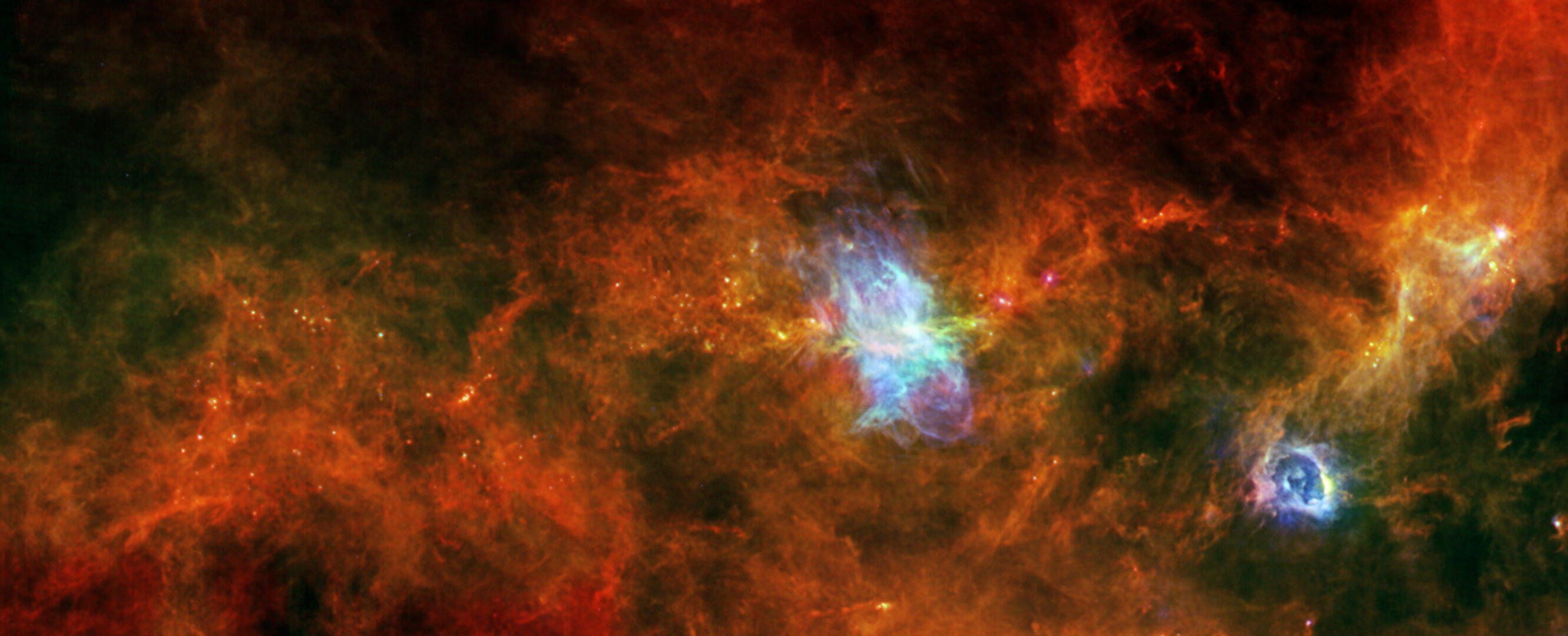
Flying along the Vela ridge
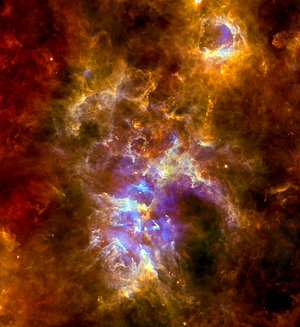
A beautiful blue butterfly flutters towards a nest of warm dust and gas, above an intricate network of cool filaments in this image of the Vela C region by ESA’s Herschel space observatory.
Vela C is the most massive of the four parts of the Vela complex, a massive star nursery just 2300 light-years from the Sun. It is an ideal natural laboratory for us to study the birth of stars.
Herschel’s far-infrared detectors can spot regions where young high- and low-mass stars have heated dense clumps of gas and dust, where new generations of stars may be born.
The eye is immediately drawn to two prominent features in this image: a delicate blue and yellow butterfly shape just right of centre that appears to be flying towards a nest of coiled blue material in the lower right.
These regions stand out from their surroundings because their dust has been heated by young hot stars. A cluster of very hot, massive stars are strung out along the butterfly’s ‘body’, their radiation heating up the surrounding dust seen as yellow in this scene.
These heavy stars will follow ‘live fast, die young’, burning brightly for only a short time in cosmic terms. Those with more than eight times the mass of our own Sun will explode as cataclysmic supernovas within 10 million years of forming.
A particularly dense trunk of cool gas and dust weaves its way through the centre of the image, surrounded by a complex network of wispy red filaments.
Deeply embedded inside the filaments are numerous point-like sources, particularly evident towards the left of the scene: these are protostars, the seeds of new stars that will soon also light up the Vela region of the sky.

- Image of the week archive
http://www.esa.int/Our_Activities/Space_Science/Image_of_the_week_archive - Herschel: ESA's giant infrared observatory
http://www.esa.int/Our_Activities/Space_Science/Herschel - Herschel overview
http://www.esa.int/Our_Activities/Space_Science/Herschel - Other Herschel First Science Stories
http://www.esa.int/Our_Activities/Space_Science/Other_Herschel_First_Science_Stories2 - Online Showcase of Herschel Images OSHI
http://oshi.esa.int/
Inside Herschel
http://www.youtube.com/watch?v=j9_VBKn8Jq4&feature=PlayList&p=CD471914889C152B&index=1
Herschel mission objectives
http://www.youtube.com/watch?v=YyEpV1_CH4w&feature=PlayList&p=CD471914889C152B&index=5- Blowing bubbles in the Carina Nebula
http://www.esa.int/Our_Activities/Space_Science/Herschel/Blowing_bubbles_in_the_Carina_Nebula - Cygnus-X: the cool swan glowing in flight
http://www.esa.int/Our_Activities/Space_Science/Herschel/Cygnus-X_the_cool_swan_glowing_in_flight - Herschel spots comet massacre around nearby star
http://www.esa.int/Our_Activities/Space_Science/Herschel/Herschel_spots_comet_massacre_around_nearby_star - Fledgling stars flicker in the heart of Orion
http://www.esa.int/Our_Activities/Space_Science/Herschel/Fledgling_stars_flicker_in_the_heart_of_Orion - A New View of an Icon
http://www.esa.int/Our_Activities/Space_Science/Herschel/A_New_View_of_an_Icon - Herschel and Planck win the French Grand Prix
http://www.esa.int/Our_Activities/Space_Science/Herschel/Herschel_and_Planck_win_the_French_Grand_Prix - Herschel finds a hole in space
http://www.esa.int/Our_Activities/Space_Science/Herschel/Herschel_finds_a_hole_in_space - Observations: Seeing in infrared wavelengths
http://www.esa.int/About_Us/ESOC/Observations_Seeing_in_infrared_wavelengths - Why infrared astronomy is a hot topic
http://www.esa.int/Our_Activities/Space_Science/Herschel/Why_infrared_astronomy_is_a_hot_topic - This article in depth
http://sci.esa.int/science-e/www/object/index.cfm?fobjectid=50534 - Herschel in depth
http://sci.esa.int/science-e/www/area/index.cfm?fareaid=16 - Herschel first science results in depth
http://sci.esa.int/science-e/www/object/index.cfm?fobjectid=46985 - Herschel Science Centre
http://herschel.esac.esa.int/
ESA Space Science Image of the Week on Flickr
http://www.flickr.com/photos/europeanspaceagency/sets/72157629888534136/
ESA 3D on Flickr
http://www.flickr.com/ESAin3D
ESA Sci on Twitter
http://www.twitter.com/esascience