• → European Space Agency

      • Space for Europe
      • Space News
      • Space in Images
      • Space in Videos
    • About Us

      • Welcome to ESA
      • DG's News and Views
      • For Member State Delegations
      • Business with ESA
      • ESA Exhibitions
      • ESA Publications
      • Careers at ESA
    • Our Activities

      • Space News
      • Observing the Earth
      • Human Spaceflight
      • Launchers
      • Navigation
      • Space Science
      • Space Engineering
      • Operations
      • Technology
      • Telecommunications & Integrated Applications
    • For Public

    • For Media

      • Media
      • ESA TV
      • Videos for professionals
      • Photos
    • For Educators

    • For Kids

    • ESA

    • Space Science

    • Our Universe
    • About Space Science
    • ESA's 'Cosmic Vision'
    • Science missions
    • Mission navigator
    • Target groups
    • For Media
    • For Scientists
    • For Kids
    • Multimedia
    • Science images
    • Science videos
    • Animations
    • Downloads
    • Sounds from space
    • Resources
    • Reference section
    • Services
    • FAQs
    • Glossary
    • Help
    • Portal terms of use
    • Comments
    • Follow us
    • RSS feeds
    • ESA Sci on Twitter
    • ESA Space Science Images on Flickr
    • ESA 3D on Flickr

    ESA > Our Activities > Space Science

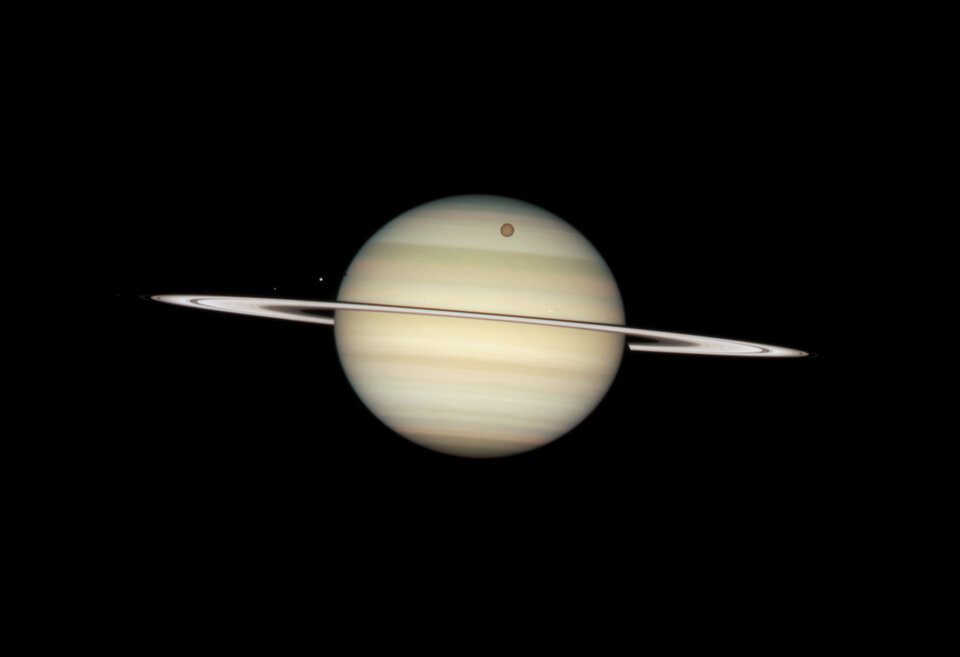
    Four of Saturn's moons parade by their parent

    Moon transit at Saturn
    17 March 2009

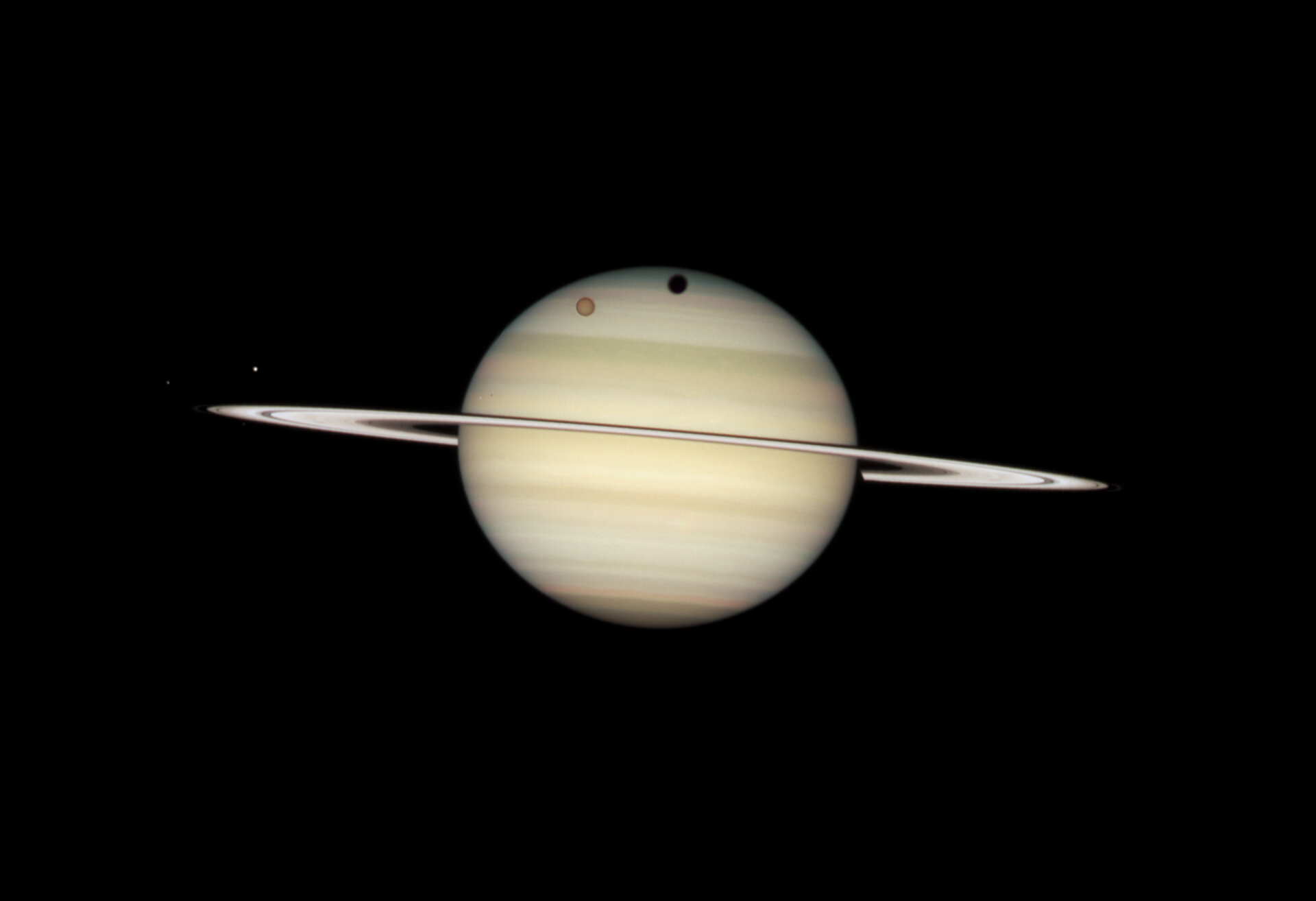
    A new Hubble image shows four of Saturn's moons circling the ringed planet.

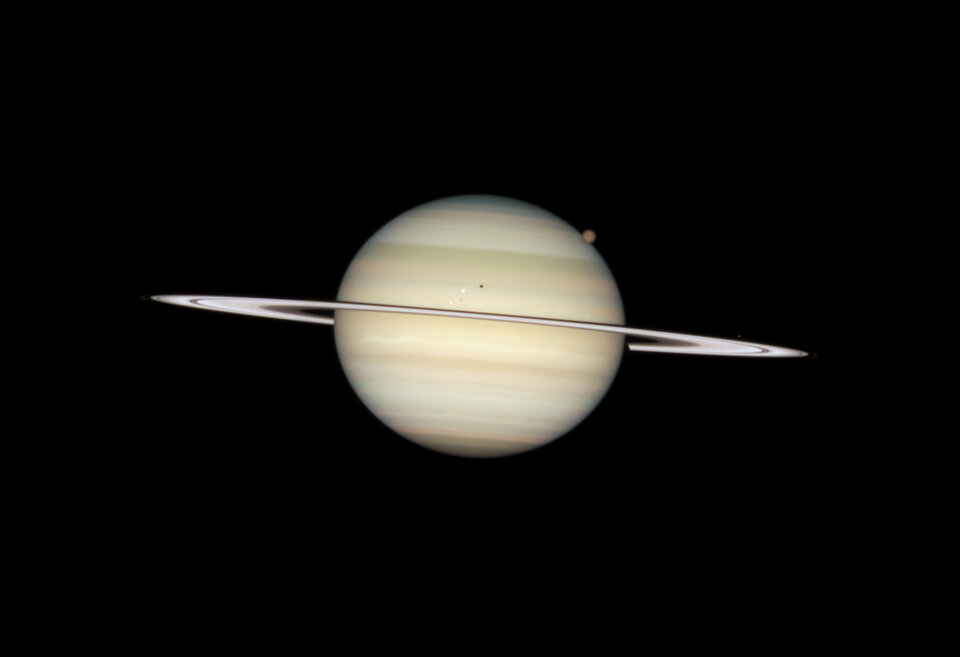
    On 24 February 2009, the NASA/ESA Hubble Space Telescope captured a photo sequence of four moons of Saturn passing in front of their parent planet. The moons, from far left to right, are the white icy moons Enceladus and Dione, the large orange moon Titan, and icy Mimas. Due to the angle of the Sun, they are each preceded by their own shadow.

    These rare moon transits only happen when the tilt of Saturn's ring plane is nearly edge-on as seen from the Earth. Saturn's rings will be perfectly edge on to our line of sight on 10 August and 4 September 2009. Unfortunately, Saturn will be too close to the Sun to be seen by viewers on Earth at that time. This ring-plane crossing occurs every 14-15 years. In 1995-96 Hubble witnessed the previous ring plane crossing, as well as many moon transits, and helped to discover several new moons of Saturn.
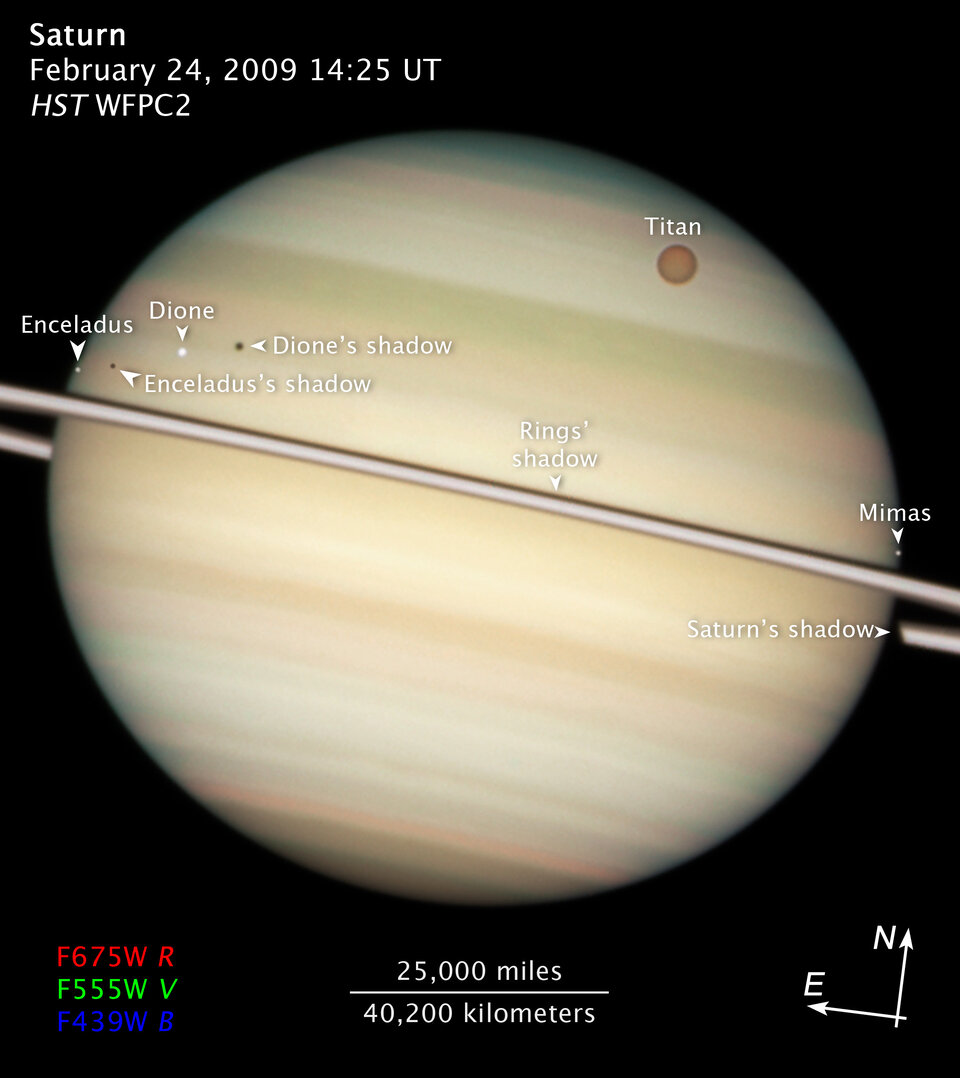
    Zooming in on Saturn's moon transit
    Zooming in on Saturn and four of its moons

    Early 2009 was a favourable time for viewers with small telescopes to watch moon and shadow transits crossing the face of Saturn. Titan, Saturn's largest moon, crossed Saturn on four separate occasions: 24 January, 9 February, 24 February and 12 March, although not all events were visible from all locations on Earth.

    Italian Galileo Galilei — often referred to as the father of astronomy — was the first to observe Saturn through a telescope in 1610. Dutch mathematician and astronomer Christian Huygens discovered Titan in 1655 and, 350 years later, the ESA probe named for him touched down on Titan (on 14 January 2005), giving the world its first views of the surface of the mysterious, icy world. Giovanni Domenico Cassini, a French/Italian astronomer, discovered Dione (in addition to others) and the German-born Englishman, William Herschel, discovered Mimas and Enceladus.
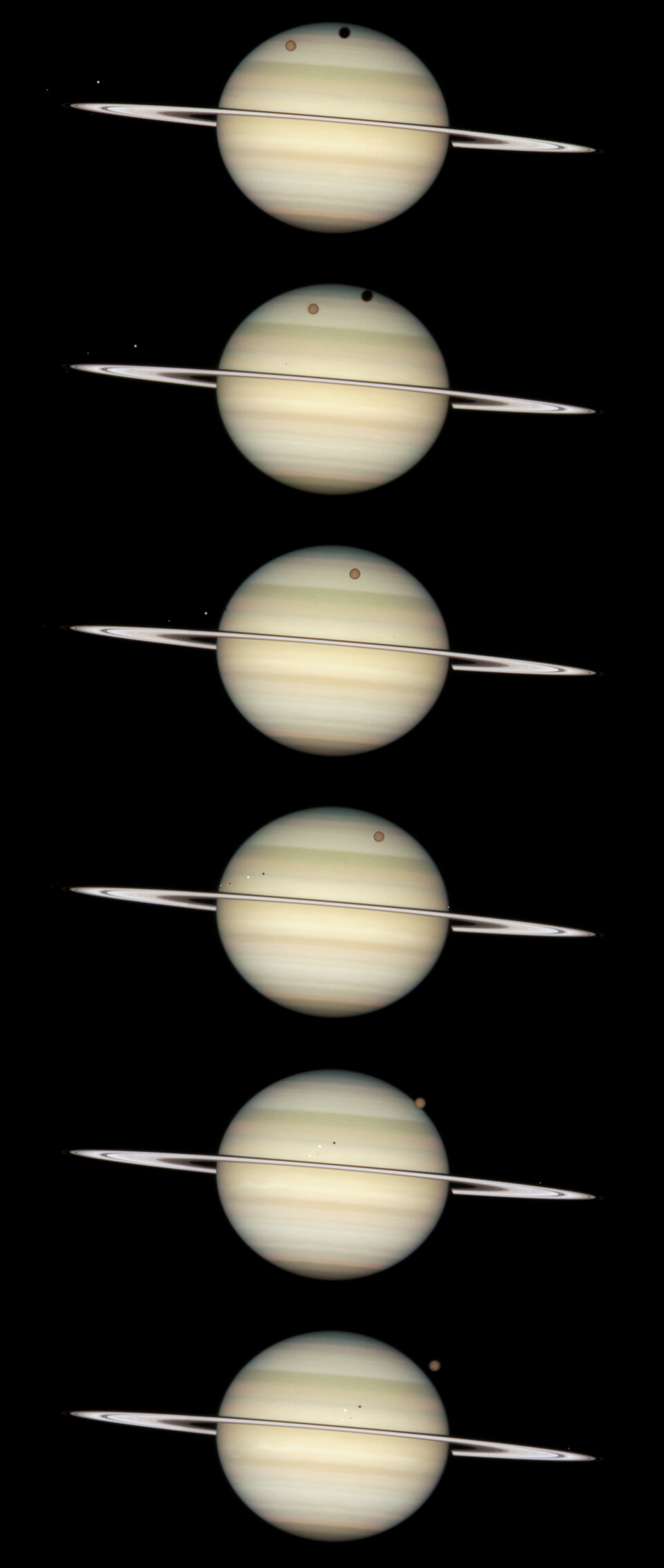

    Transit sequence of Saturnian moons

    These pictures were taken with Hubble's Wide Field Planetary Camera 2 on 24 February 2009, when Saturn was at a distance of roughly 1.25 thousand million kilometres from Earth. Hubble can see details as small as 300 kilometres across on Saturn. The dark band running across the face of the planet slightly above the rings is the shadow of the rings cast on the planet.

    Notes for editors:

    The Hubble Space Telescope is a project of international cooperation between ESA and NASA.

    For more information :

    Colleen Sharkey
    Hubble/ESA, Garching, Germany
    E-mail: csharkey @ eso.org

    Ray Villard
    Space Telescope Science Institute, Baltimore, Md.
    E-mail: villard @ stsci.edu

    Keith Noll
    Space Telescope Science Institute, Baltimore, Md.
    E-mail: noll @ stsci.edu

    Saturn's moon transit - another view
    Moon transit at Saturn - another view
    Moon transit at Saturn - another view
    Moon transit at Saturn - another view
    Moon transit at Saturn - another view

    Rate this

    Views

    Share

    • Currently 0 out of 5 Stars.
    • 1
    • 2
    • 3
    • 4
    • 5
    Rating: 0/5 (0 votes cast)

    Thank you for rating!

    You have already rated this page, you can only rate it once!

    Your rating has been changed, thanks for rating!

    45
    Tweet
    • More about
    • Hubble overview
    • Hubblecast
    • Related articles
      • Hubble provides new evidence for dark matter around small galaxies
        • Stars forced to relocate near the Southern Fish
          • Exceptionally deep view of strange galaxy
            • Hubble finds carbon dioxide on an extrasolar planet
              • Hubble captures views of mammoth stars
                • Hubble directly observes planet orbiting star Fomalhaut
                  • Hubble is back in business, and scores a perfect ‘10’
                  • In depth
                  • Hubble in depth

    Connect with us

    • RSS
    • Youtube
    • Twitter
    • Flickr
    • G+
    • Facebook
    • Livestream
    • Subscribe
    • App Store
    • ESA Science Twitter

    Follow ESA science

    • LATEST ARTICLES
    • · Rare merger reveals secrets of gal…
    • · Watching for hazards: ESA opens as…
    • · ESA astronaut Timothy Peake set fo…
    • · Space drives e-mobility
    • · Proba-V opens its eyes
    • FAQ

    • Jobs at ESA

    • Site Map

    • Contacts

    • Terms and conditions