• → European Space Agency

      • Space for Europe
      • Space News
      • Space in Images
      • Space in Videos
    • About Us

      • Welcome to ESA
      • DG's News and Views
      • For Member State Delegations
      • Business with ESA
      • ESA Exhibitions
      • ESA Publications
      • Careers at ESA
    • Our Activities

      • Space News
      • Observing the Earth
      • Human Spaceflight
      • Launchers
      • Navigation
      • Space Science
      • Space Engineering
      • Operations
      • Technology
      • Telecommunications & Integrated Applications
    • For Public

    • For Media

    • For Educators

    • For Kids

    • ESA

    • Launch Special

    • Herschel

    • Planck

    • ESA Science

    • About Herschel

      • Herschel at a glance
      • Science objectives
      • Herschel highlights
      • History of infrared astronomy
    • The infrared Universe

      • Why the infrared?
      • More about the infrared
      • The infrared revolution
    • Spacecraft and telescope

      • Vital stats
      • The largest infrared space telescope
      • Instruments
      • Cutting-edge spacecraft
    • The mission

      • Journey
      • Early operations
      • Operating Herschel
    • Meet the team

      • Herschel Project Scientist: An interview with Göran Pilbratt
      • Herschel and Planck Programme Manager: An interview with Thomas Passvogel
    • Multimedia
    • Herschel images
    • Herschel videos

    ESA > Our Activities > Space Science > Herschel

    Herschel instruments are 'good to go'

    Herschel alignment measurements
    14 April 2009

    Herschel’s three scientific instruments have passed their functional tests and are 'good to go'. This marks another milestone in the steady progress being made in preparing the satellite for launch.
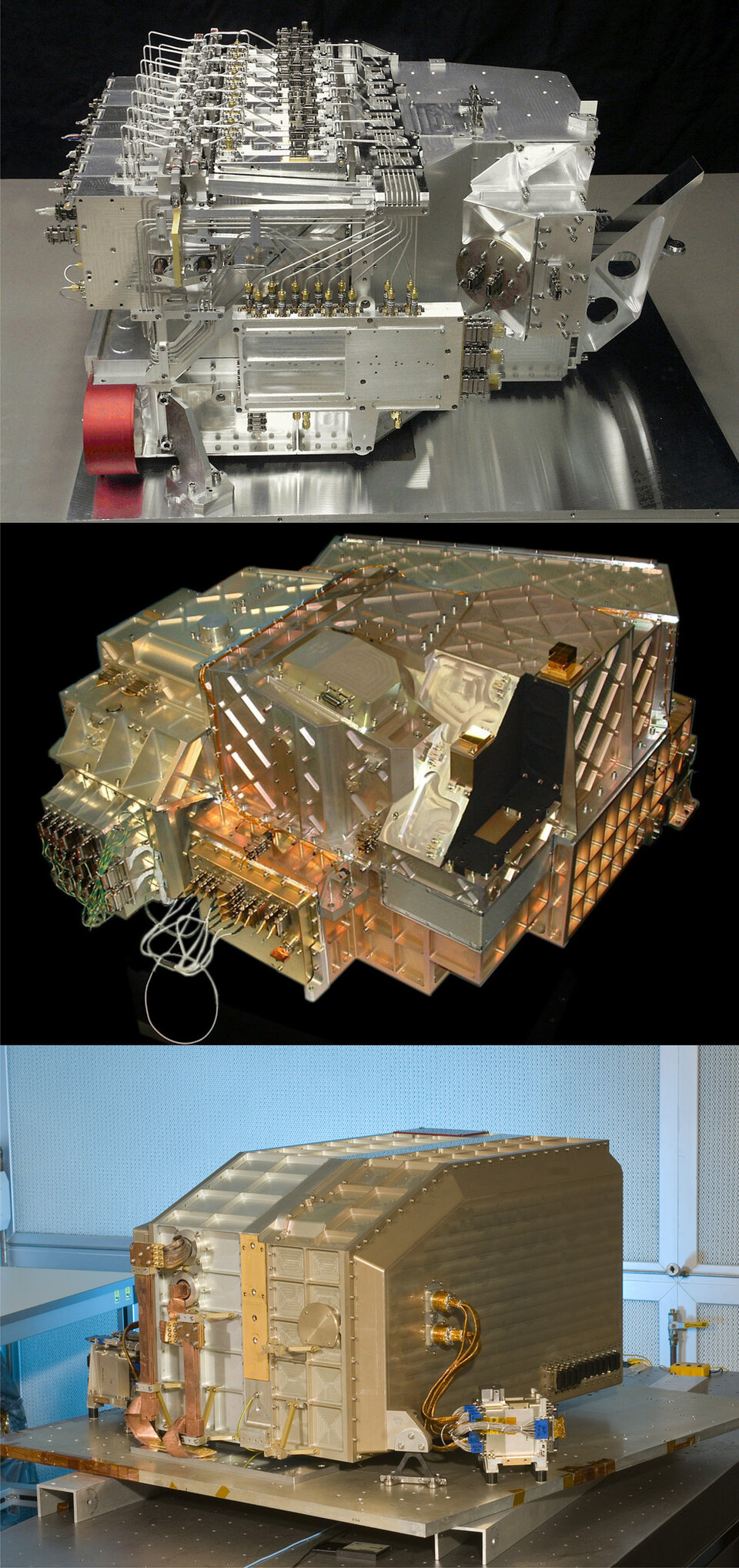
    HIFI, PACS and SPIRE

    All three of Herschel's instruments, the Spectral and Photometric Imaging Receiver (SPIRE), the Photodetector Array Camera and Spectrometer (PACS) and the Heterodyne Instrument for the Far Infrared (HIFI), underwent short functional tests to verify the health of the instruments after transport to the launch site in Kourou.

    All instruments performed flawlessly and passed their pre-launch test reviews.

    The next time we hear from them will be a few days after launch when they will be switched on one-by-one as part of the payload check out process.


    Everything in its place

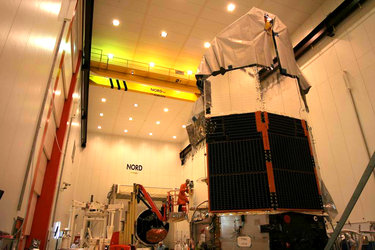
    The instrument checks followed the completion of checks of the mechanical stability of the satellite. Engineers carried out alignment tests by measuring relative and absolute positions of a number of elements using reference cubes. The elements measured were mostly those which protrude from the body of the satellite for example, the cryostat nozzles, thrusters, sun acquisition sensor, attitude anomaly detector and the telescope mounting structure. The stability of all of these elements was verified during the tests.

    Checks with the launcher adapter

    Herschel readied for a fit check
    Herschel readied for a fit check

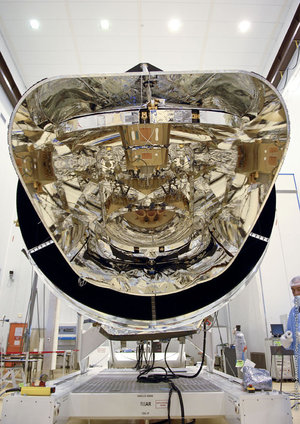
    After these alignment tests, engineers carried out a fit check of the Ariane 5 launcher adapter and verified that all mechanical and electrical connections between the adapter and the satellite worked perfectly. The launcher adapter is a lightweight metal cylinder, 0.32 m high and 2.624 m in diameter, that is used to fix the satellite to the launch vehicle.
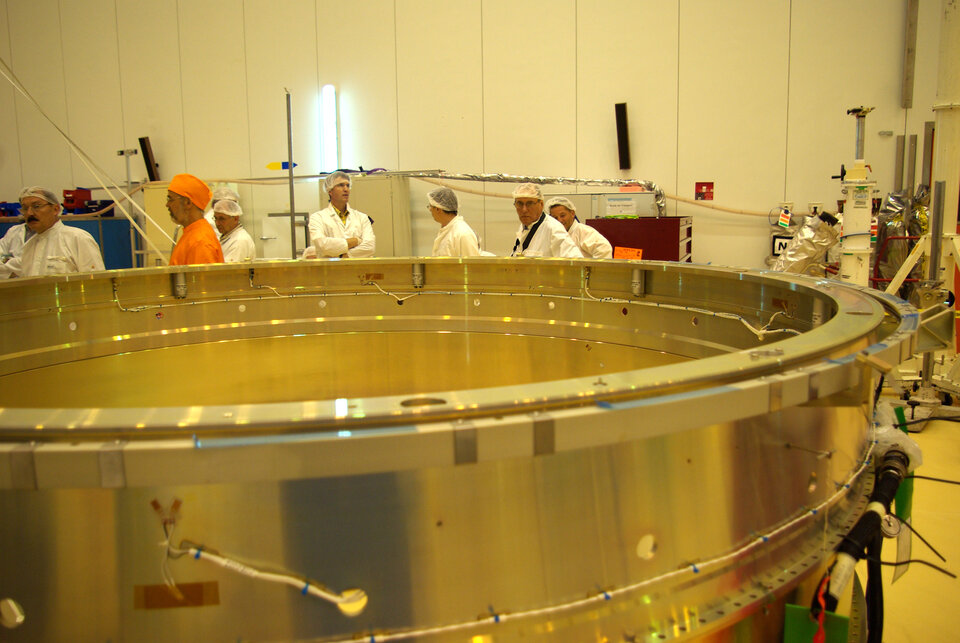
    Close up of the Ariane 5 launcher adapter
    Close up of the Ariane 5 launcher adapter

    The adapter connects Herschel to the top of the Sylda, a protective cover under which Planck will be installed. The electrical connections between Herschel and the adapter will allow to monitor and command the satellite from the time of integration with the launcher until liftoff, and will also facilitate monitoring of the cryogenic status.

    Outer thermal protection completed

    After completion of the mechanical checks, most of the final pieces of multi-layer insulation were placed on the satellite to complete the external thermal protection.

    Rate this

    Views

    Share

    • Currently 0 out of 5 Stars.
    • 1
    • 2
    • 3
    • 4
    • 5
    Rating: 0/5 (0 votes cast)

    Thank you for rating!

    You have already rated this page, you can only rate it once!

    Your rating has been changed, thanks for rating!

    29
    Tweet
    • Herschel: ESA's giant infrared observatory
    • Planck: looking back at the dawn of time
    • Related articles
      • Herschel instruments are 'good to go'
        • Planck gears up for the ride
          • Herschel and Planck to lift off on 6 May
            • Herschel and Planck launch update
              • Herschel spruced up after arrival in Kourou
                • Herschel and Planck launch postponed
                  • Planck launch campaign update
                    • Planck follows Herschel to launch site
                      • Herschel shipped to Europe’s Spaceport
                      • Read more
                        • L2, the second Lagrangian Point
                          • Observations: Seeing in infrared wavelengths
                            • Why infrared astronomy is a hot topic
                            • In depth
                            • This article in depth
                            • Herschel launch campaign journal
                            • Herschel in depth

    Connect with us

    • RSS
    • Youtube
    • Twitter
    • Flickr
    • G+
    • Facebook
    • Livestream
    • Subscribe
    • App Store
    • LATEST ARTICLES
    • · Rare merger reveals secrets of gal…
    • · Watching for hazards: ESA opens as…
    • · ESA astronaut Timothy Peake set fo…
    • · Space drives e-mobility
    • · Proba-V opens its eyes
    • FAQ

    • Jobs at ESA

    • Site Map

    • Contacts

    • Terms and conditions